模型保存与加载
序列化与反序列化
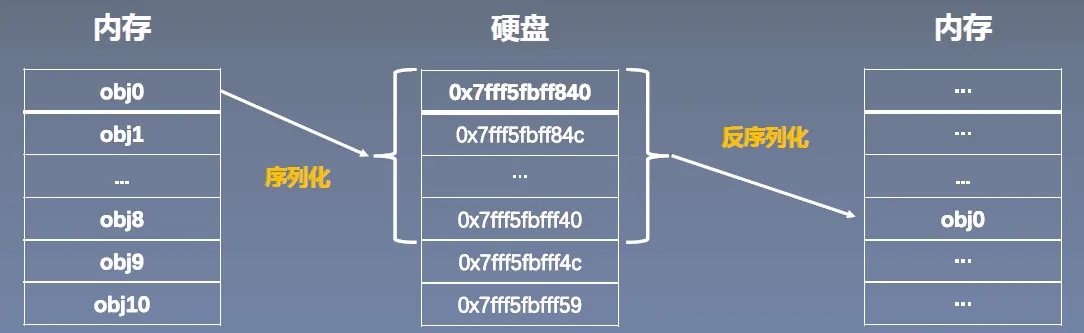
torch.save
主要参数:
obj :对象
f :输出路径
torch.load
主要参数
f :文件路径
map_location :指定存放位置 cpu or gpu
法1: 保存整个 Module
torch.save(net,path)
法2: 保存模型参数
state_dict = net.state_dict()
torch.save(state_dict , path)
e.g.
保存
net = LeNet2(classes=2019)
# "训练"
print("训练前: ", net.features[0].weight[0, ...])
net.initialize()
print("训练后: ", net.features[0].weight[0, ...])
path_model = "./model.pkl"
path_state_dict = "./model_state_dict.pkl"
# 保存整个模型
torch.save(net, path_model)
# 保存模型参数
net_state_dict = net.state_dict()
torch.save(net_state_dict, path_state_dict)
加载
# ================================== load net ===========================
# flag = 1
flag = 0
if flag:
    path_model = "./model.pkl"
    net_load = torch.load(path_model)
    print(net_load)
# ================================== load state_dict ===========================
flag = 1
# flag = 0
if flag:
    path_state_dict = "./model_state_dict.pkl"
    state_dict_load = torch.load(path_state_dict)
    print(state_dict_load.keys())
# ================================== update state_dict ===========================
flag = 1
# flag = 0
if flag:
    net_new = LeNet2(classes=2019)
    print("加载前: ", net_new.features[0].weight[0, ...])
    net_new.load_state_dict(state_dict_load)
    print("加载后: ", net_new.features[0].weight[0, ...])
模型微调( Finetune)
Transfer Learning :机器学习分支,研究 源域 (source 的知识如何应用到 目标域 (target domain)
模型微调步骤:
1.获取预训练模型参数
2.加载模型( load_state_dict
3.修改输出层
模型微调训练方法:
固定预训练的参数 requires_grad =False lr =
Features Extractor 较小学习率( params_group
e.g.
# 1/3 构建模型
resnet18_ft = models.resnet18()
# 2/3 加载参数
# flag = 0
flag = 1
if flag:
    path_pretrained_model = os.path.join(BASEDIR, "..", "..", "data", "finetune_resnet18-5c106cde.pth")
    if not os.path.exists(path_pretrained_model):
        raise Exception("\n{} 不存在,请下载 07-02-数据-模型finetune.zip\n放到 {}下,并解压即可".format(
            path_pretrained_model, os.path.dirname(path_pretrained_model)))
    state_dict_load = torch.load(path_pretrained_model)
    resnet18_ft.load_state_dict(state_dict_load)
# 法1 : 冻结卷积层
flag_m1 = 0
# flag_m1 = 1
if flag_m1:
    for param in resnet18_ft.parameters():
        param.requires_grad = False
    print("conv1.weights[0, 0, ...]:\n {}".format(resnet18_ft.conv1.weight[0, 0, ...]))
# 3/3 替换fc层
num_ftrs = resnet18_ft.fc.in_features
resnet18_ft.fc = nn.Linear(num_ftrs, classes)
resnet18_ft.to(device)
# ============================ step 3/5 损失函数 ============================
criterion = nn.CrossEntropyLoss()                                                   # 选择损失函数
# ============================ step 4/5 优化器 ============================
# 法2 : conv 小学习率
# flag = 0
flag = 1
if flag:
    fc_params_id = list(map(id, resnet18_ft.fc.parameters()))     # 返回的是parameters的 内存地址
    base_params = filter(lambda p: id(p) not in fc_params_id, resnet18_ft.parameters())
    optimizer = optim.SGD([
        {'params': base_params, 'lr': LR*0},   # 0
        {'params': resnet18_ft.fc.parameters(), 'lr': LR}], momentum=0.9)
else:
    optimizer = optim.SGD(resnet18_ft.parameters(), lr=LR, momentum=0.9)               # 选择优化器
scheduler = torch.optim.lr_scheduler.StepLR(optimizer, step_size=lr_decay_step, gamma=0.1)     # 设置学习率下降策略
# ============================ step 5/5 训练 ============================
train_curve = list()
valid_curve = list()
for epoch in range(start_epoch + 1, MAX_EPOCH):
    loss_mean = 0.
    correct = 0.
    total = 0.
    resnet18_ft.train()
    for i, data in enumerate(train_loader):
        # forward
        inputs, labels = data
        inputs, labels = inputs.to(device), labels.to(device)
        outputs = resnet18_ft(inputs)
        # backward
        optimizer.zero_grad()
        loss = criterion(outputs, labels)
        loss.backward()
        # update weights
        optimizer.step()
        # 统计分类情况
        _, predicted = torch.max(outputs.data, 1)
        total += labels.size(0)
        correct += (predicted == labels).squeeze().cpu().sum().numpy()
        # 打印训练信息
        loss_mean += loss.item()
        train_curve.append(loss.item())
        if (i+1) % log_interval == 0:
            loss_mean = loss_mean / log_interval
            print("Training:Epoch[{:0>3}/{:0>3}] Iteration[{:0>3}/{:0>3}] Loss: {:.4f} Acc:{:.2%}".format(
                epoch, MAX_EPOCH, i+1, len(train_loader), loss_mean, correct / total))
            loss_mean = 0.
            # if flag_m1:
            print("epoch:{} conv1.weights[0, 0, ...] :\n {}".format(epoch, resnet18_ft.conv1.weight[0, 0, ...]))
    scheduler.step()  # 更新学习率
    # validate the model
    if (epoch+1) % val_interval == 0:
        correct_val = 0.
        total_val = 0.
        loss_val = 0.
        resnet18_ft.eval()
        with torch.no_grad():
            for j, data in enumerate(valid_loader):
                inputs, labels = data
                inputs, labels = inputs.to(device), labels.to(device)
                outputs = resnet18_ft(inputs)
                loss = criterion(outputs, labels)
                _, predicted = torch.max(outputs.data, 1)
                total_val += labels.size(0)
                correct_val += (predicted == labels).squeeze().cpu().sum().numpy()
                loss_val += loss.item()
            loss_val_mean = loss_val/len(valid_loader)
            valid_curve.append(loss_val_mean)
            print("Valid:\t Epoch[{:0>3}/{:0>3}] Iteration[{:0>3}/{:0>3}] Loss: {:.4f} Acc:{:.2%}".format(
                epoch, MAX_EPOCH, j+1, len(valid_loader), loss_val_mean, correct_val / total_val))
train_x = range(len(train_curve))
train_y = train_curve
train_iters = len(train_loader)
valid_x = np.arange(1, len(valid_curve)+1) * train_iters*val_interval # 由于valid中记录的是epochloss,需要对记录点进行转换到iterations
valid_y = valid_curve
plt.plot(train_x, train_y, label='Train')
plt.plot(valid_x, valid_y, label='Valid')
plt.legend(loc='upper right')
plt.ylabel('loss value')
plt.xlabel('Iteration')
plt.show()
GPU 的使用
CPU Central Processing Unit, 中央处理器):主要包括控制器和运算器
GPU(Graphics Processing Unit, 图形处理器 ):处理统一的,无依赖的大规模数据运算
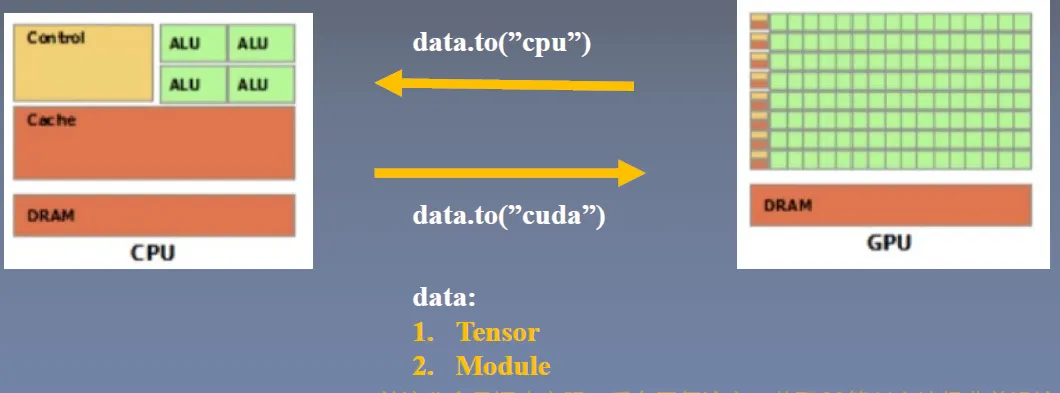
to函数:转换数据 类型 设备
tensor.to args , kwargs
module.to args , kwargs
区别:张量不执行 inplace ,模型 执行 inplace
torch.cuda常用方法
torch.cuda.device_count ()():计算当前可见可用 gpu 数
torch.cuda.get_device_name ()():获取 gpu 名称
torch.cuda.manual_seed ()():为当前 gpu 设置随机种子
torch.cuda.manual_seed_all ()():为所有可见可用 gpu 设置随机种子
torch.cuda.set_device ()():设置主 gpu 为哪一个物理 gpu (不推荐
推荐:os.environ.setdefault (“CUDA_VISIBLE_DEVICES”, “2,3”)
多gpu 运算的 分发并行 机制
分发 并行运算 结果回收
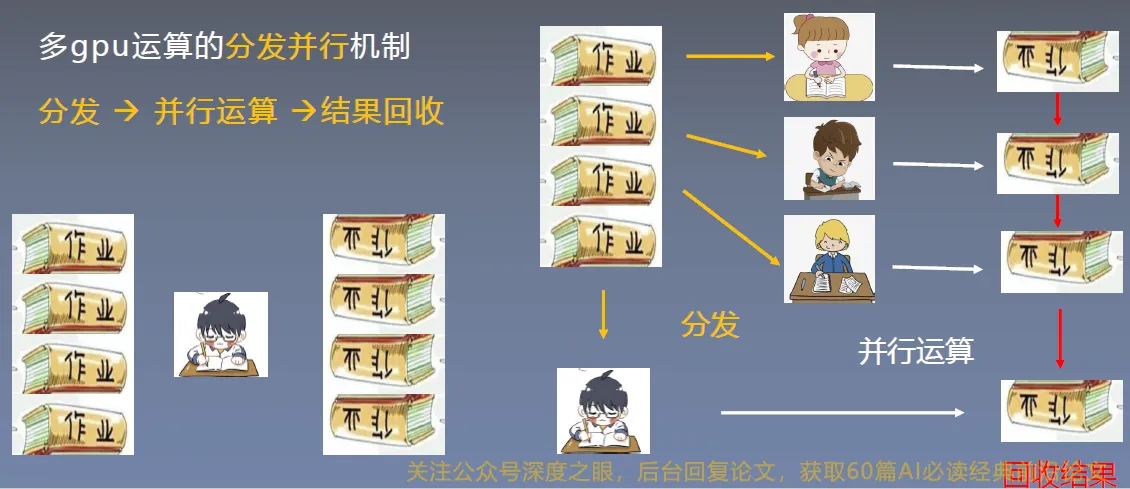
torch.nn.DataParallel
功能:包装模型,实现分发并行机制
主要参数:
module 需要包装分发的模型
device_ids 可分发的 gpu ,默认分发到所有 可见可用 gpu
output_device 结果输出设备
查询当前 gpu 内存剩余
def get_gpu_memory():
    import os
    os.system('nvidia-smi -q -d Memory | grep -A4 GPU | grep Free > tmp.txt')
    memory_gpu = [int(x.split()[2]) for x in open('tmp.txt', 'r').readlines()]
    os.system('rm tmp.txt')
    return memory_gpu
gpu模型加载
报错1:
RuntimeError: Attempting to deserialize object on a CUDA device but torch.cuda.is_available() is False. If you are running on a CPU -only machine, please use torch.load with map_location=torch.device('cpu') to map your storages to the CPU.
解决: torch.load(path_state_dict, map_location=“cpu”)
报错2:
RuntimeError: Error(s) in loading state_dict for FooNet:
Missing key(s) in state_dict: "linears.0.weight", "linears.1.weight", "linears.2.weight".
Unexpected key(s) in state_dict: "module.linears.0.weight",
"module.linears.1.weight", "module.linears.2.weight".
解决:
from collections import OrderedDict
new_state_dict = OrderedDict()
for k, v in state_dict_load.items():
    namekey = k[7:] if k.startswith('module.') else k
    new_state_dict[namekey] = v
s) in state_dict: “module.linears.0.weight”,
“module.linears.1.weight”, “module.linears.2.weight”.
解决:
```python
from collections import OrderedDict
new_state_dict = OrderedDict()
for k, v in state_dict_load.items():
    namekey = k[7:] if k.startswith('module.') else k
    new_state_dict[namekey] = v