下载地址:http://lanzou.co/ib7119f02
项目编译入口:
package.json
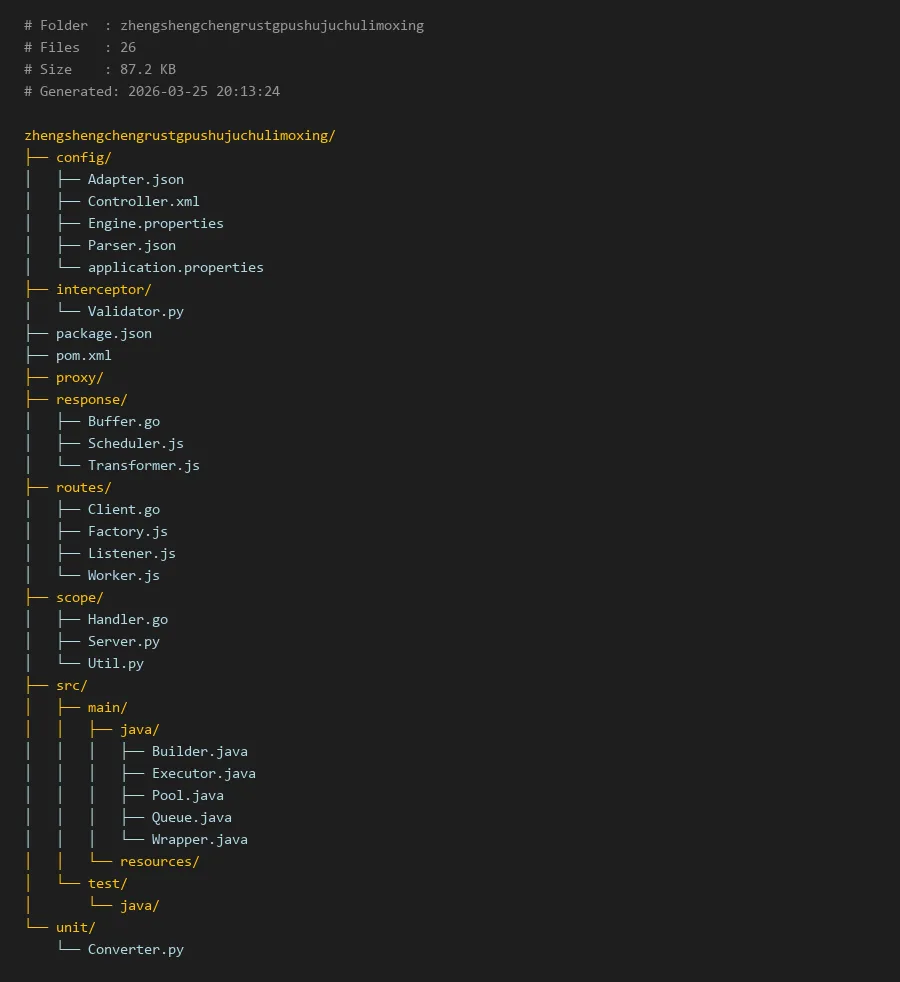
# Folder  : zhengshengchengrustgpushujuchulimoxing
# Files   : 26
# Size    : 87.2 KB
# Generated: 2026-03-25 20:13:24

zhengshengchengrustgpushujuchulimoxing/
├── config/
│   ├── Adapter.json
│   ├── Controller.xml
│   ├── Engine.properties
│   ├── Parser.json
│   └── application.properties
├── interceptor/
│   └── Validator.py
├── package.json
├── pom.xml
├── proxy/
├── response/
│   ├── Buffer.go
│   ├── Scheduler.js
│   └── Transformer.js
├── routes/
│   ├── Client.go
│   ├── Factory.js
│   ├── Listener.js
│   └── Worker.js
├── scope/
│   ├── Handler.go
│   ├── Server.py
│   └── Util.py
├── src/
│   ├── main/
│   │   ├── java/
│   │   │   ├── Builder.java
│   │   │   ├── Executor.java
│   │   │   ├── Pool.java
│   │   │   ├── Queue.java
│   │   │   └── Wrapper.java
│   │   └── resources/
│   └── test/
│       └── java/
└── unit/
    └── Converter.py
zhengshengchengrustgpushujuchulimoxing:GPU数据处理模型的技术实现
简介
zhengshengchengrustgpushujuchulimoxing是一个专注于GPU加速数据处理的技术框架,采用多语言混合架构设计,充分利用各种编程语言在特定领域的优势。该项目通过模块化设计实现了数据处理、任务调度、模型适配等核心功能,特别适合大规模数据并行处理场景。
框架的核心设计理念是将数据处理流程分解为可配置的组件,通过配置文件动态组合处理管道,同时利用GPU的并行计算能力加速数据处理过程。项目结构清晰,各目录承担特定职责,便于维护和扩展。
核心模块说明
项目主要包含以下几个核心模块:
- config/ - 配置文件目录,包含各种组件的配置参数
- interceptor/ - 拦截器模块,负责数据验证和预处理
- proxy/ - 代理层,处理网络通信和数据转发
- response/ - 响应处理模块,包含缓冲、调度和转换功能
- routes/ - 路由模块,定义数据处理流程和任务分发
- scope/ - 作用域管理模块,处理请求生命周期和资源管理
每个模块使用最适合其任务特性的编程语言实现,例如Go语言用于高性能网络处理,Python用于数据验证,JavaScript用于任务调度等。
代码示例
配置文件示例
首先,让我们查看主要的配置文件结构。application.properties定义了全局配置:
# GPU数据处理模型全局配置
gpu.enabled=true
gpu.device.count=4
gpu.memory.per.device=8192

data.batch.size=1024
data.pipeline.workers=8
data.compression.enabled=true

model.cache.size=2048
model.update.interval=3600

logging.level=INFO
logging.path=/var/log/gpu-processor/
Engine.properties配置计算引擎参数:
# 计算引擎配置
engine.type=cuda
engine.version=11.0
engine.max_threads_per_block=1024
engine.shared_memory_size=49152

kernel.optimization.level=3
kernel.cache.enabled=true
kernel.precompile=true

memory.pinned.enabled=true
memory.stream.count=4
数据验证拦截器
interceptor/Validator.py实现数据格式验证:
import json
import numpy as np
from typing import Dict, Any, Optional

class DataValidator:
    def __init__(self, config_path: str):
        with open(config_path, 'r') as f:
            self.config = json.load(f)

        self.schema = self.config.get("data_schema", {
   })
        self.thresholds = self.config.get("validation_thresholds", {
   })

    def validate_batch(self, data_batch: Dict[str, Any]) -> Dict[str, Any]:
        """验证数据批次"""
        validation_result = {

            "is_valid": True,
            "errors": [],
            "warnings": [],
            "processed_count": 0
        }

        # 检查数据维度
        if "tensor_data" in data_batch:
            tensor_data = data_batch["tensor_data"]
            expected_shape = self.schema.get("tensor_shape")

            if expected_shape and tensor_data.shape != tuple(expected_shape):
                validation_result["is_valid"] = False
                validation_result["errors"].append(
                    f"Tensor shape mismatch: expected {expected_shape}, got {tensor_data.shape}"
                )

        # 检查数值范围
        if "metadata" in data_batch:
            metadata = data_batch["metadata"]
            for key, value in metadata.items():
                threshold = self.thresholds.get(key)
                if threshold:
                    min_val, max_val = threshold
                    if value < min_val or value > max_val:
                        validation_result["warnings"].append(
                            f"Value {key}={value} outside threshold [{min_val}, {max_val}]"
                        )

        if validation_result["is_valid"]:
            validation_result["processed_count"] = len(data_batch.get("items", []))

        return validation_result

    def normalize_data(self, data: np.ndarray) -> np.ndarray:
        """数据标准化"""
        mean = self.schema.get("normalization_mean", 0.0)
        std = self.schema.get("normalization_std", 1.0)

        if std > 0:
            return (data - mean) / std
        return data
GPU数据处理路由
routes/Worker.js实现GPU工作线程管理:
```javascript
const { EventEmitter } = require('events');
class GPUWorker extends EventEmitter {
constructor(workerId, gpuConfig) {
super();
this.workerId = workerId;
this.gpuConfig = gpuConfig;
this.isBusy = false;
this.taskQueue = [];
this.results = new Map();
    this.initGPUContext();
}

initGPUContext() {
    // 初始化GPU上下文
    this.gpuContext = {
        deviceId: this.workerId % this.gpuConfig.deviceCount,
        memoryLimit: this.gpuConfig.memoryPerDevice,
        stream: null,
        kernelCache: new Map()
    };

    console.log(`Worker ${this.workerId}: GPU context initialized on device ${this.gpuContext.deviceId}`);
}

async processTask(task) {
    this.isBusy = true;

    try {
        const { taskId, operation, data, parameters } = task;