下载地址:http://lanzou.co/i3daaebf3
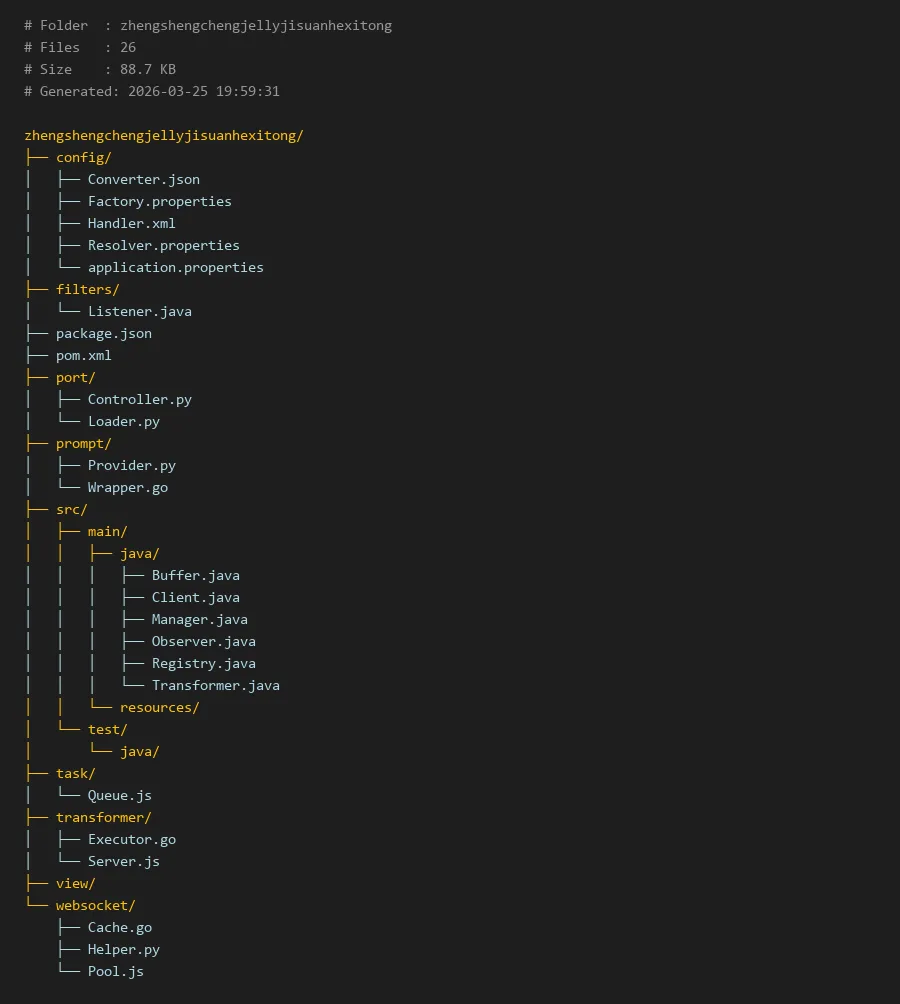
项目编译入口:
package.json
# Folder  : zhengshengchengjellyjisuanhexitong
# Files   : 26
# Size    : 88.7 KB
# Generated: 2026-03-25 19:59:31

zhengshengchengjellyjisuanhexitong/
├── config/
│   ├── Converter.json
│   ├── Factory.properties
│   ├── Handler.xml
│   ├── Resolver.properties
│   └── application.properties
├── filters/
│   └── Listener.java
├── package.json
├── pom.xml
├── port/
│   ├── Controller.py
│   └── Loader.py
├── prompt/
│   ├── Provider.py
│   └── Wrapper.go
├── src/
│   ├── main/
│   │   ├── java/
│   │   │   ├── Buffer.java
│   │   │   ├── Client.java
│   │   │   ├── Manager.java
│   │   │   ├── Observer.java
│   │   │   ├── Registry.java
│   │   │   └── Transformer.java
│   │   └── resources/
│   └── test/
│       └── java/
├── task/
│   └── Queue.js
├── transformer/
│   ├── Executor.go
│   └── Server.js
├── view/
└── websocket/
    ├── Cache.go
    ├── Helper.py
    └── Pool.js
zhengshengchengjellyjisuanhexitong:一个多语言计算系统
简介
zhengshengchengjellyjisuanhexitong(简称ZJC系统)是一个创新的多语言混合计算框架,旨在解决复杂计算任务中的跨语言协作问题。该系统巧妙地将Java、Python和Go语言集成在一起,通过统一的配置管理和消息传递机制,实现了高效的计算资源调度和任务处理。
系统采用模块化设计,每个组件都有明确的职责边界。核心思想是通过配置文件定义计算流程,利用不同语言的优势处理特定类型的任务:Java负责内存管理和并发控制,Python擅长数据处理和算法实现,Go则处理高性能的网络通信。
核心模块说明
配置管理模块
位于config/目录,包含多种格式的配置文件:
application.properties:系统全局配置Converter.json:数据转换规则定义Factory.properties:对象工厂配置Handler.xml:处理器链配置Resolver.properties:依赖解析配置
端口适配模块
port/目录包含系统入口点:
Controller.py:Python编写的控制层,负责接收和分发计算请求Loader.py:系统启动加载器
提示处理模块
prompt/目录处理计算提示和包装:
Provider.py:计算提示生成器Wrapper.go:Go语言编写的计算结果包装器
核心业务模块
src/main/java/包含Java核心类:
Buffer.java:数据缓冲区管理Client.java:客户端通信接口Manager.java:系统管理器
过滤器模块
filters/目录包含事件监听器:
Listener.java:系统事件监听器
代码示例
1. 系统配置示例
首先查看config/application.properties中的基础配置:
# 系统基础配置
system.name=zhengshengchengjellyjisuanhexitong
system.version=1.0.0
calculation.thread.pool.size=10
max.buffer.size=1048576
default.timeout=30000

# 语言执行器配置
java.executor.class=com.zjc.JavaExecutor
python.executor.path=/usr/bin/python3
go.executor.path=/usr/local/go/bin

# 日志配置
log.level=INFO
log.path=./logs/zjc.log
数据转换规则定义在config/Converter.json中:
{

  "converters": [
    {

      "name": "json_to_xml",
      "source_format": "json",
      "target_format": "xml",
      "processor": "xml.Converter",
      "priority": 1
    },
    {

      "name": "csv_to_json",
      "source_format": "csv",
      "target_format": "json",
      "processor": "data.Transformer",
      "priority": 2
    }
  ],
  "default_encoding": "UTF-8",
  "enable_validation": true
}
2. Java核心类实现
src/main/java/Buffer.java展示了数据缓冲区的实现:
package com.zhengshengchengjellyjisuanhexitong;

import java.util.concurrent.ArrayBlockingQueue;
import java.util.concurrent.BlockingQueue;

public class Buffer<T> {

    private final BlockingQueue<T> queue;
    private final int capacity;
    private volatile boolean isActive;

    public Buffer(int capacity) {

        this.capacity = capacity;
        this.queue = new ArrayBlockingQueue<>(capacity);
        this.isActive = true;
    }

    public void put(T item) throws InterruptedException {

        if (!isActive) {

            throw new IllegalStateException("Buffer is not active");
        }
        queue.put(item);
    }

    public T take() throws InterruptedException {

        return queue.take();
    }

    public int size() {

        return queue.size();
    }

    public int remainingCapacity() {

        return queue.remainingCapacity();
    }

    public void shutdown() {

        isActive = false;
        queue.clear();
    }

    public boolean isActive() {

        return isActive;
    }
}
src/main/java/Manager.java展示了系统管理器的核心逻辑:
```java
package com.zhengshengchengjellyjisuanhexitong;
import java.util.concurrent.ConcurrentHashMap;
import java.util.concurrent.ExecutorService;
import java.util.concurrent.Executors;
import java.util.concurrent.Future;
public class Manager {
private final ExecutorService executorService;
private final ConcurrentHashMap> tasks;
private final Buffer taskBuffer;
public Manager(int threadPoolSize, int bufferCapacity) {
    this.executorService = Executors.newFixedThreadPool(threadPoolSize);
    this.tasks = new ConcurrentHashMap<>();
    this.taskBuffer = new Buffer<>(bufferCapacity);
    startTaskDispatcher();
}

private void startTaskDispatcher() {
    Thread dispatcher = new Thread(() -> {
        while (!Thread.currentThread().isInterrupted()) {
            try {
                CalculationTask task = taskBuffer.take();
                Future<?> future = executorService.submit(() -> {
                    try {
                        return executeTask(task);
                    } catch (Exception e) {
                        handleTaskError(task, e);
                        return null;
                    }
                });
                tasks.put(task.getId(), future);
            } catch (InterruptedException e) {
                Thread.currentThread().interrupt();
                break;
            }
        }
    });
    dispatcher.setDaemon(true);