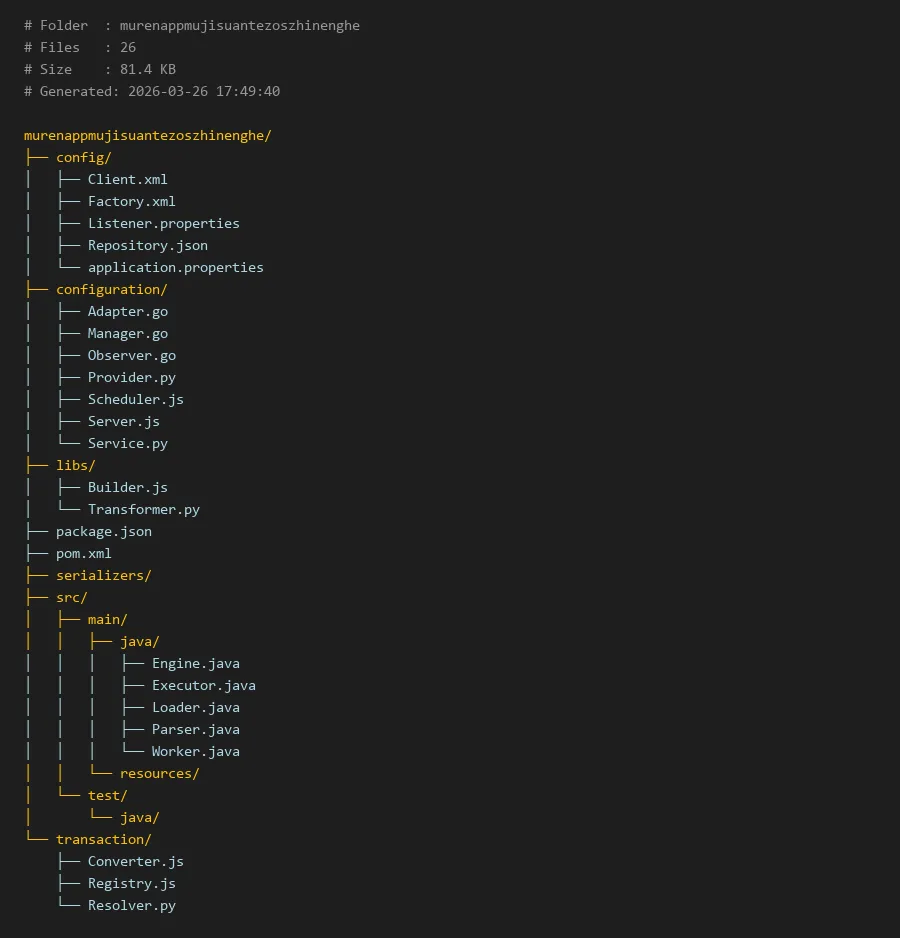
│ ├── Builder.js
│ └── Transformer.py
├── package.json
├── pom.xml
├── serializers/
├── src/
│ ├── main/
│ │ ├── java/
│ │ │ ├── Engine.java
│ │ │ ├── Executor.java
│ │ │ ├── Loader.java
│ │ │ ├── Parser.java
│ │ │ └── Worker.java
│ │ └── resources/
│ └── test/
│ └── java/
└── transaction/
├── Converter.js
├── Registry.js
└── Resolver.py
# murenappmujisuantezoszhinenghe:一个智能税务计算引擎的技术实现

## 简介

murenappmujisuantezoszhinenghe是一个专门设计用于模拟个人所得税APP的后端计算引擎。该项目采用微服务架构,融合了多种编程语言和技术栈,旨在提供一个高效、准确且可扩展的税务计算解决方案。通过模块化的设计,该引擎能够处理复杂的税务规则,适应不同地区的政策变化,并为前端应用提供稳定的API服务。本文将深入探讨该项目的核心模块,并通过具体的代码示例展示其实现细节。

## 核心模块说明

项目结构清晰地划分了配置管理、业务逻辑处理和数据转换等核心功能区域。`config/`目录存放了各种配置文件,包括XML、JSON和Properties格式,用于定义系统行为、客户端连接和工厂模式参数。`configuration/`目录则包含了核心的业务逻辑组件,如适配器、管理器、观察者、服务提供者等,这些组件使用Go、Python和JavaScript等多种语言编写,体现了多语言协同开发的理念。`libs/`目录下的构建器和转换器工具,负责数据的预处理和格式转换。`src/`目录是Java核心引擎的所在地,`Engine.java`作为整个系统的计算中枢,协调各个模块的工作。

## 代码示例

以下代码示例将围绕项目的关键文件展开,展示如何配置、初始化并运行这个模拟个人所得税APP的核心引擎。

首先,让我们查看`config/application.properties`中的基础配置,它定义了系统运行的关键参数。

```properties
# 应用基础配置
server.port=8080
tax.calculation.engine.version=2.1
database.url=jdbc:mysql://localhost:3306/tax_db
cache.provider=redis

# 个税专项附加扣除项开关
deduction.children.enabled=true
deduction.education.enabled=true
deduction.housing.loan.enabled=true
deduction.housing.rent.enabled=true
deduction.elderly.enabled=true
接下来,我们关注configuration/Service.py,这个Python服务负责处理具体的税务计算逻辑。它从配置中读取规则,并调用核心引擎进行计算。
# configuration/Service.py
import json
from libs.Transformer import transform_income_data

class TaxCalculationService:
    def __init__(self, config_path='config/Repository.json'):
        with open(config_path, 'r') as f:
            self.tax_rules = json.load(f)['rules']
        print("税务计算服务初始化完成,加载规则版本:", self.tax_rules['version'])

    def calculate(self, annual_income, deductions):
        """
        计算应纳税额
        :param annual_income: 年收入
        :param deductions: 专项附加扣除字典
        :return: 应纳税额, 税后收入
        """
        # 1. 数据标准化处理
        standardized_data = transform_income_data(annual_income)

        # 2. 计算应纳税所得额(简化逻辑)
        taxable_income = standardized_data - 60000  # 基本减除费用
        for key, value in deductions.items():
            if value and self.tax_rules['deductions'].get(key, {
   }).get('enabled'):
                taxable_income -= value

        # 3. 应用累进税率
        tax = self._apply_progressive_tax(taxable_income)
        after_tax_income = annual_income - tax
        return round(tax, 2), round(after_tax_income, 2)

    def _apply_progressive_tax(self, income):
        if income <= 0:
            return 0.0
        for bracket in self.tax_rules['tax_brackets']:
            if bracket['min'] < income <= bracket['max']:
                return income * bracket['rate'] - bracket['quick_deduction']
        # 超过最高档
        return income * 0.45 - 181920

# 使用示例
if __name__ == '__main__':
    service = TaxCalculationService()
    test_deductions = {
   'housing_loan': 12000, 'children': 2000}
    tax_due, net_income = service.calculate(250000, test_deductions)
    print(f"应纳税额: {tax_due}, 税后收入: {net_income}")
现在,让我们看看Java核心引擎src/main/java/Engine.java是如何被设计和调用的。它作为总协调者,整合了各个模块。
```java
// src/main/java/Engine.java
package com.murenappmujisuantezoszhinenghe;
import java.util.Map;
public class Engine {
private ConfigManager configManager;
private TaxServiceAdapter taxServiceAdapter;
private CacheProvider cacheProvider;
public Engine() {
    this.configManager = new ConfigManager("config/application.properties");
    this.taxServiceAdapter = new TaxServiceAdapter();
    this.cacheProvider = CacheProvider.getInstance();
    System.out.println("智能税务计算引擎启动成功。");
}

/**
 * 核心计算方法
 * @param userId 用户ID
 * @param incomeDetails 收入详情
 * @return 计算结果
 */
public CalculationResult calculateTax(String userId, Map<String, Object> incomeDetails) {
    // 1. 检查缓存
    String cacheKey = "tax_calc_" + userId + "_" + incomeDetails.hashCode();
    CalculationResult cachedResult = cacheProvider.get(cacheKey);
    if (cachedResult != null) {
        System.out.println("缓存命中,为用户" +