下载地址:http://lanzou.co/i76c2b08f
项目编译入口:
package.json
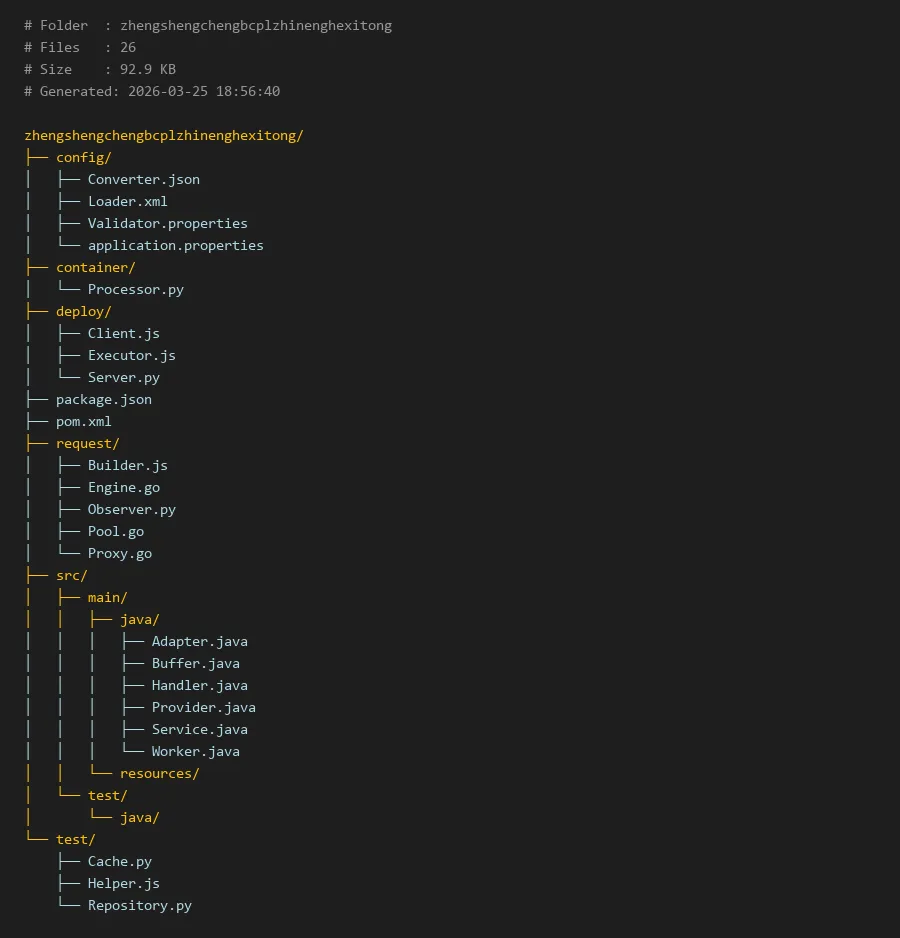
# Folder  : zhengshengchengbcplzhinenghexitong
# Files   : 26
# Size    : 92.9 KB
# Generated: 2026-03-25 18:56:40

zhengshengchengbcplzhinenghexitong/
├── config/
│   ├── Converter.json
│   ├── Loader.xml
│   ├── Validator.properties
│   └── application.properties
├── container/
│   └── Processor.py
├── deploy/
│   ├── Client.js
│   ├── Executor.js
│   └── Server.py
├── package.json
├── pom.xml
├── request/
│   ├── Builder.js
│   ├── Engine.go
│   ├── Observer.py
│   ├── Pool.go
│   └── Proxy.go
├── src/
│   ├── main/
│   │   ├── java/
│   │   │   ├── Adapter.java
│   │   │   ├── Buffer.java
│   │   │   ├── Handler.java
│   │   │   ├── Provider.java
│   │   │   ├── Service.java
│   │   │   └── Worker.java
│   │   └── resources/
│   └── test/
│       └── java/
└── test/
    ├── Cache.py
    ├── Helper.js
    └── Repository.py
zhengshengchengbcplzhinenghexitong:一个多语言智能核心系统
简介
zhengshengchengbcplzhinenghexitong(以下简称ZSC系统)是一个创新的多语言智能核心系统,它集成了多种编程语言的优势,构建了一个高效、可扩展的智能处理平台。该系统采用微服务架构设计,通过统一的配置管理和容器化处理,实现了跨语言组件的无缝协作。ZSC系统特别注重性能优化和资源管理,在请求处理、数据转换和任务执行等方面表现出色。
该系统最显著的特点是它的多语言混合架构:Java用于核心业务逻辑和适配器层,Python负责数据处理和容器管理,Go语言处理高并发请求,JavaScript则负责客户端和部署执行。这种设计使得每个组件都能使用最适合其任务特性的编程语言,从而最大化系统整体性能。
核心模块说明
1. 配置管理模块 (config/)
配置管理模块是ZSC系统的基石,它统一管理所有组件的配置信息。系统支持多种配置格式,包括JSON、XML和Properties文件,以适应不同组件的需求。
Converter.json:定义数据转换规则和格式映射Loader.xml:配置类加载器和依赖注入规则Validator.properties:设置数据验证规则和参数校验application.properties:应用全局配置,如数据库连接、日志级别等
2. 容器处理模块 (container/)
容器模块是系统的核心处理单元,负责组件的生命周期管理和依赖注入。
Processor.py:Python实现的通用处理器,提供数据预处理、转换和后处理功能
3. 部署模块 (deploy/)
部署模块负责系统的启动、运行和客户端交互。
Client.js:JavaScript实现的Web客户端,提供用户界面Executor.js:任务执行器,处理异步任务和批处理作业Server.py:Python实现的主服务器,协调各组件工作
4. 请求处理模块 (request/)
请求处理模块是系统的高性能核心,采用Go语言实现,处理所有传入请求。
Engine.go:请求引擎,负责路由和请求分发Pool.go:连接池和资源池管理Proxy.go:代理服务器,处理负载均衡和故障转移Builder.js:请求构建器,构造标准化的请求对象Observer.py:观察者模式实现,监控请求状态
5. 源代码模块 (src/)
源代码模块包含系统的核心业务逻辑,主要使用Java实现。
Adapter.java:适配器模式实现,连接不同接口的组件Buffer.java:缓冲区管理,优化数据读写性能
代码示例
1. 配置加载示例
以下示例展示如何加载和解析不同格式的配置文件:
# config_loader.py - 配置文件加载器
import json
import xml.etree.ElementTree as ET
import configparser

class ConfigManager:
    def __init__(self, config_dir="config/"):
        self.config_dir = config_dir

    def load_json_config(self, filename):
        """加载JSON格式配置文件"""
        filepath = f"{self.config_dir}{filename}"
        with open(filepath, 'r', encoding='utf-8') as f:
            config = json.load(f)
        return config

    def load_xml_config(self, filename):
        """加载XML格式配置文件"""
        filepath = f"{self.config_dir}{filename}"
        tree = ET.parse(filepath)
        root = tree.getroot()
        return self._parse_xml_element(root)

    def load_properties(self, filename):
        """加载Properties格式配置文件"""
        filepath = f"{self.config_dir}{filename}"
        config = configparser.ConfigParser()
        config.read(filepath)
        return dict(config['DEFAULT'])

    def _parse_xml_element(self, element):
        """递归解析XML元素"""
        result = {
   }
        for child in element:
            if len(child) > 0:
                result[child.tag] = self._parse_xml_element(child)
            else:
                result[child.tag] = child.text
        return result

# 使用示例
config_manager = ConfigManager()
converter_config = config_manager.load_json_config("Converter.json")
loader_config = config_manager.load_xml_config("Loader.xml")
validator_config = config_manager.load_properties("Validator.properties")
2. 请求处理示例
以下Go代码展示请求引擎的核心实现:
```go
// request/Engine.go - 请求引擎实现
package request
import (
"net/http"
"sync"
"time"
)
type RequestEngine struct {
routes map[string]http.HandlerFunc
middleware []MiddlewareFunc
pool *RequestPool
mu sync.RWMutex
timeout time.Duration
}
type MiddlewareFunc func(http.HandlerFunc) http.HandlerFunc
func NewEngine(timeout time.Duration) *RequestEngine {
return &RequestEngine{
routes: make(map[string]http.HandlerFunc),
pool: NewRequestPool(100),
timeout: timeout,
}
}
func (e *RequestEngine) RegisterRoute(path string, handler http.HandlerFunc) {
e.mu.Lock()
defer e.mu.Unlock()
// 应用中间件
wrappedHandler := handler
for i := len(e.middleware) - 1; i >= 0; i-- {
    wrappedHandler = e.middleware[i](wrappedHandler)
}

e.routes[path] = wrappedHandler
}