下载地址:http://lanzou.com.cn/ia0fa1494
项目编译入口:
package.json
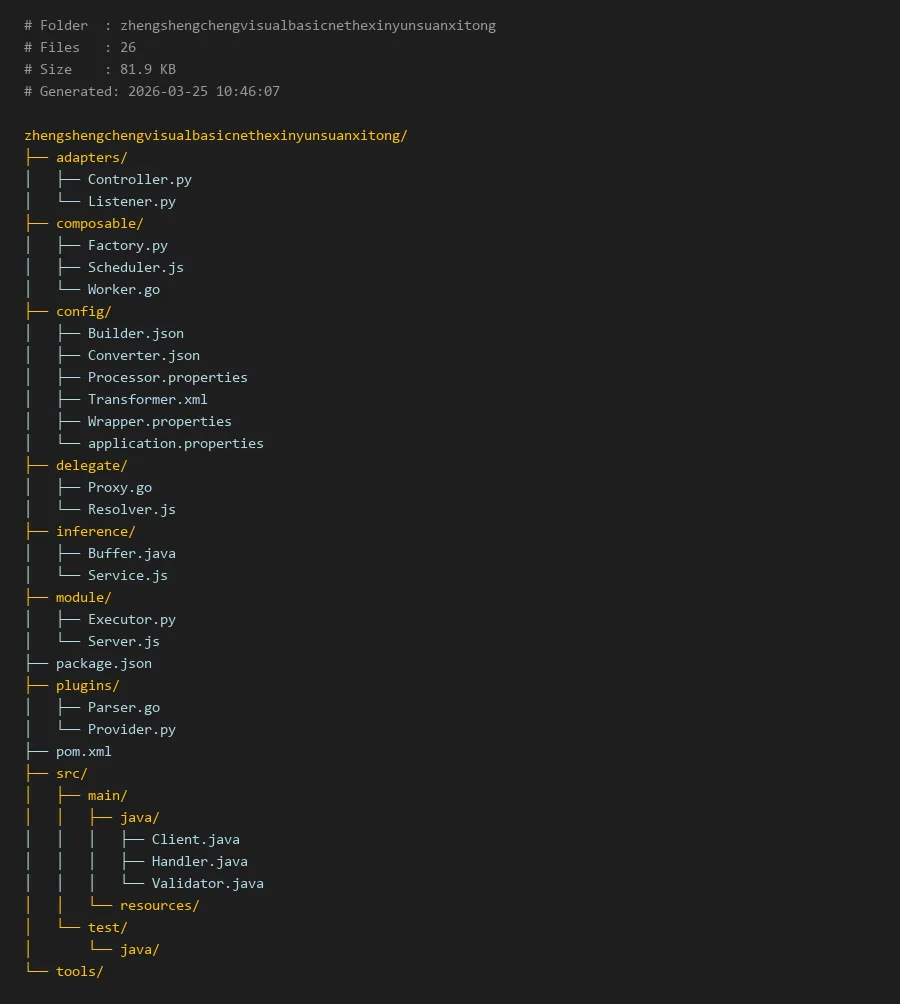
# Folder  : zhengshengchengvisualbasicnethexinyunsuanxitong
# Files   : 26
# Size    : 81.9 KB
# Generated: 2026-03-25 10:46:07

zhengshengchengvisualbasicnethexinyunsuanxitong/
├── adapters/
│   ├── Controller.py
│   └── Listener.py
├── composable/
│   ├── Factory.py
│   ├── Scheduler.js
│   └── Worker.go
├── config/
│   ├── Builder.json
│   ├── Converter.json
│   ├── Processor.properties
│   ├── Transformer.xml
│   ├── Wrapper.properties
│   └── application.properties
├── delegate/
│   ├── Proxy.go
│   └── Resolver.js
├── inference/
│   ├── Buffer.java
│   └── Service.js
├── module/
│   ├── Executor.py
│   └── Server.js
├── package.json
├── plugins/
│   ├── Parser.go
│   └── Provider.py
├── pom.xml
├── src/
│   ├── main/
│   │   ├── java/
│   │   │   ├── Client.java
│   │   │   ├── Handler.java
│   │   │   └── Validator.java
│   │   └── resources/
│   └── test/
│       └── java/
└── tools/
zhengshengchengvisualbasicnethexinyunsuanxitong:一个多语言混合运算系统的技术实现
简介
zhengshengchengvisualbasicnethexinyunsuanxitong(以下简称"核心运算系统")是一个采用多语言架构设计的分布式计算系统。该系统通过整合Python、JavaScript、Go、Java等多种编程语言的优势,构建了一个灵活、高效的运算平台。项目采用模块化设计,每个目录承担特定的职责,通过清晰的接口定义实现跨语言协作。
系统核心设计理念是将复杂的运算任务分解为独立的处理单元,通过配置驱动的方式组合这些单元,形成完整的数据处理流水线。这种架构特别适合需要多种计算范式(如数值计算、异步处理、并发控制)的应用场景。
核心模块说明
1. 配置层(config/)
配置层是整个系统的控制中心,使用多种格式的配置文件定义系统行为:
application.properties:系统全局配置Processor.properties:处理器参数配置Transformer.xml:数据转换规则定义Builder.json:任务构建配置Converter.json:数据格式转换配置Wrapper.properties:接口包装配置
2. 适配器层(adapters/)
负责系统与外部环境的交互:
Controller.py:Python实现的REST API控制器Listener.py:事件监听器,处理系统事件
3. 组合层(composable/)
提供可组合的计算单元:
Factory.py:对象工厂,创建运算组件Scheduler.js:JavaScript实现的作业调度器Worker.go:Go语言实现的高并发工作器
4. 委托层(delegate/)
实现代理和解析功能:
Proxy.go:Go语言实现的代理服务Resolver.js:JavaScript实现的依赖解析器
5. 推理层(inference/)
负责核心计算逻辑:
Buffer.java:Java实现的缓冲区管理Service.js:JavaScript实现的推理服务
6. 模块层(module/)
预留的扩展模块目录,支持自定义功能扩展。
代码示例
1. 配置管理示例
# adapters/Controller.py 中的配置加载部分
import json
import xml.etree.ElementTree as ET
from pathlib import Path

class ConfigManager:
    def __init__(self, config_path="../config"):
        self.config_path = Path(config_path)
        self.configs = {
   }

    def load_all_configs(self):
        """加载所有配置文件"""
        # 加载JSON配置
        json_files = self.config_path.glob("*.json")
        for json_file in json_files:
            with open(json_file, 'r', encoding='utf-8') as f:
                self.configs[json_file.stem] = json.load(f)

        # 加载Properties配置
        prop_files = self.config_path.glob("*.properties")
        for prop_file in prop_files:
            self.configs[prop_file.stem] = self._load_properties(prop_file)

        # 加载XML配置
        xml_files = self.config_path.glob("*.xml")
        for xml_file in xml_files:
            tree = ET.parse(xml_file)
            self.configs[xml_file.stem] = tree.getroot()

        return self.configs

    def _load_properties(self, file_path):
        """加载Properties文件"""
        config = {
   }
        with open(file_path, 'r', encoding='utf-8') as f:
            for line in f:
                line = line.strip()
                if line and not line.startswith('#'):
                    key, value = line.split('=', 1)
                    config[key.strip()] = value.strip()
        return config

# 使用示例
config_manager = ConfigManager()
all_configs = config_manager.load_all_configs()
print(f"已加载 {len(all_configs)} 个配置文件")
2. 工厂模式实现
```python
composable/Factory.py
from abc import ABC, abstractmethod
import importlib
class ComponentFactory(ABC):
"""抽象工厂基类"""
@abstractmethod
def create_processor(self, config):
    pass

@abstractmethod
def create_transformer(self, config):
    pass
class DynamicFactory(ComponentFactory):
"""动态工厂实现"""
def __init__(self):
    self.registry = {}

def register_component(self, component_type, module_path, class_name):
    """注册组件"""
    self.registry[component_type] = {
        'module': module_path,
        'class': class_name
    }

def create_processor(self, config):
    """创建处理器"""
    processor_type = config.get('type', 'default')

    if processor_type in self.registry:
        component_info = self.registry[processor_type]
        module = importlib.import_module(component_info['module'])
        processor_class = getattr(module, component_info['class'])
        return processor_class(config)

    # 默认处理器
    return DefaultProcessor(config)

def create_transformer(self, config):
    """创建转换器"""
    # 类似处理器创建逻辑
    return DefaultTransformer(config)
class DefaultProcessor:
def init(self, config):
self.config = config
self.name = config.get('name', 'unnamed_processor')
def process(self, data):
    """处理数据"""
    print(f"Processing data with {self.name}")
    # 实际处理逻辑
    return data * 2