训练一个玛丽奥玩游戏的 RL 代理
原文:
pytorch.org/tutorials/intermediate/mario_rl_tutorial.html译者:飞龙
注意
点击这里下载完整的示例代码
作者: 冯元松, Suraj Subramanian, 王浩, 郭宇章。
这个教程将带你了解深度强化学习的基础知识。最后,你将实现一个能够自己玩游戏的 AI 马里奥(使用双深度 Q 网络)。
虽然这个教程不需要 RL 的先验知识,但你可以通过这些 RL 概念来熟悉,还可以使用这个方便的 速查表作为参考。完整的代码在这里可用。
%%bash
pip  install  gym-super-mario-bros==7.4.0
pip  install  tensordict==0.2.0
pip  install  torchrl==0.2.0
import torch
from torch import nn
from torchvision import transforms as T
from PIL import Image
import numpy as np
from pathlib import Path
from collections import deque
import random, datetime, os
# Gym is an OpenAI toolkit for RL
import gym
from gym.spaces import Box
from gym.wrappers import FrameStack
# NES Emulator for OpenAI Gym
from nes_py.wrappers import JoypadSpace
# Super Mario environment for OpenAI Gym
import gym_super_mario_bros
from tensordict import TensorDict
from torchrl.data import TensorDictReplayBuffer, LazyMemmapStorage
RL 定义
环境 代理与之交互并学习的世界。
动作 a aa:代理对环境的响应。所有可能动作的集合称为动作空间。
状态 s ss:环境的当前特征。环境可能处于的所有可能状态的集合称为状态空间。
奖励 r rr:奖励是环境向代理提供的关键反馈。这是驱使代理学习并改变其未来行动的动力。在多个时间步骤上的奖励的聚合被称为回报。
最优动作-值函数 Q ∗ ( s , a ) Q^*(s,a)Q∗(s,a):给出了如果你从状态 s ss 开始,采取任意动作 a aa,然后在每个未来时间步骤中采取最大化回报的动作的预期回报。Q QQ 可以说代表了状态中动作的“质量”。我们试图近似这个函数。
环境
初始化环境
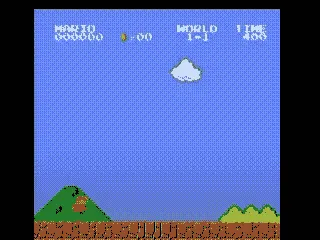
在马里奥中,环境由管道、蘑菇和其他组件组成。
当马里奥执行一个动作时,环境会以改变的(下一个)状态、奖励和其他信息做出响应。
# Initialize Super Mario environment (in v0.26 change render mode to 'human' to see results on the screen)
if gym.__version__ < '0.26':
    env = gym_super_mario_bros.make("SuperMarioBros-1-1-v0", new_step_api=True)
else:
    env = gym_super_mario_bros.make("SuperMarioBros-1-1-v0", render_mode='rgb', apply_api_compatibility=True)
# Limit the action-space to
#   0\. walk right
#   1\. jump right
env = JoypadSpace(env, [["right"], ["right", "A"]])
env.reset()
next_state, reward, done, trunc, info = env.step(action=0)
print(f"{next_state.shape},\n  {reward},\n  {done},\n  {info}")
/opt/conda/envs/py_3.10/lib/python3.10/site-packages/gym/envs/registration.py:555: UserWarning:
WARN: The environment SuperMarioBros-1-1-v0 is out of date. You should consider upgrading to version `v3`.
/opt/conda/envs/py_3.10/lib/python3.10/site-packages/gym/envs/registration.py:627: UserWarning:
WARN: The environment creator metadata doesn't include `render_modes`, contains: ['render.modes', 'video.frames_per_second']
/opt/conda/envs/py_3.10/lib/python3.10/site-packages/gym/utils/passive_env_checker.py:233: DeprecationWarning:
`np.bool8` is a deprecated alias for `np.bool_`.  (Deprecated NumPy 1.24)
(240, 256, 3),
 0.0,
 False,
 {'coins': 0, 'flag_get': False, 'life': 2, 'score': 0, 'stage': 1, 'status': 'small', 'time': 400, 'world': 1, 'x_pos': 40, 'y_pos': 79}
预处理环境
环境数据通过 next_state 返回给代理。正如你在上面看到的,每个状态由一个 [3, 240, 256] 大小的数组表示。通常这比我们的代理需要的信息更多;例如,马里奥的行动不取决于管道或天空的颜色!
我们使用包装器在将环境数据发送给代理之前对其进行预处理。
GrayScaleObservation 是一个常见的包装器,用于将 RGB 图像转换为灰度图像;这样做可以减小状态表示的大小而不丢失有用的信息。现在每个状态的大小为:[1, 240, 256]
ResizeObservation 将每个观察结果缩小为一个正方形图像。新的大小:[1, 84, 84]
SkipFrame 是一个自定义包装器,继承自 gym.Wrapper 并实现 step() 函数。因为连续帧变化不大,我们可以跳过 n 个中间帧而不会丢失太多信息。第 n 帧聚合了每个跳过帧累积的奖励。
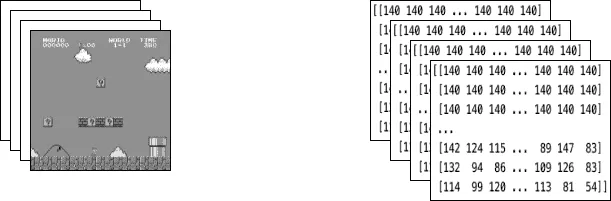
FrameStack 是一个包装器,允许我们将环境的连续帧压缩成一个观察点,以供我们的学习模型使用。这样,我们可以根据前几帧中他的移动方向来确定马里奥是着陆还是跳跃。
class SkipFrame(gym.Wrapper):
    def __init__(self, env, skip):
  """Return only every `skip`-th frame"""
        super().__init__(env)
        self._skip = skip
    def step(self, action):
  """Repeat action, and sum reward"""
        total_reward = 0.0
        for i in range(self._skip):
            # Accumulate reward and repeat the same action
            obs, reward, done, trunk, info = self.env.step(action)
            total_reward += reward
            if done:
                break
        return obs, total_reward, done, trunk, info
class GrayScaleObservation(gym.ObservationWrapper):
    def __init__(self, env):
        super().__init__(env)
        obs_shape = self.observation_space.shape[:2]
        self.observation_space = Box(low=0, high=255, shape=obs_shape, dtype=np.uint8)
    def permute_orientation(self, observation):
        # permute [H, W, C] array to [C, H, W] tensor
        observation = np.transpose(observation, (2, 0, 1))
        observation = torch.tensor(observation.copy(), dtype=torch.float)
        return observation
    def observation(self, observation):
        observation = self.permute_orientation(observation)
        transform = T.Grayscale()
        observation = transform(observation)
        return observation
class ResizeObservation(gym.ObservationWrapper):
    def __init__(self, env, shape):
        super().__init__(env)
        if isinstance(shape, int):
            self.shape = (shape, shape)
        else:
            self.shape = tuple(shape)
        obs_shape = self.shape + self.observation_space.shape[2:]
        self.observation_space = Box(low=0, high=255, shape=obs_shape, dtype=np.uint8)
    def observation(self, observation):
        transforms = T.Compose(
            [T.Resize(self.shape, antialias=True), T.Normalize(0, 255)]
        )
        observation = transforms(observation).squeeze(0)
        return observation
# Apply Wrappers to environment
env = SkipFrame(env, skip=4)
env = GrayScaleObservation(env)
env = ResizeObservation(env, shape=84)
if gym.__version__ < '0.26':
    env = FrameStack(env, num_stack=4, new_step_api=True)
else:
    env = FrameStack(env, num_stack=4)
将上述包装器应用于环境后,最终包装的状态由 4 个灰度连续帧堆叠在一起组成,如上图左侧所示。每次马里奥执行一个动作,环境会以这种结构的状态做出响应。该结构由一个大小为 [4, 84, 84] 的三维数组表示。
代理
我们创建一个类Mario来代表游戏中的我们的代理。马里奥应该能够:
- 行动根据当前状态(环境的)的最优动作策略。
- 记住经验。经验 = (当前状态,当前动作,奖励,下一个状态)。马里奥缓存并稍后回忆他的经验以更新他的动作策略。
- 随着时间的推移学习更好的动作策略
class Mario:
    def __init__():
        pass
    def act(self, state):
  """Given a state, choose an epsilon-greedy action"""
        pass
    def cache(self, experience):
  """Add the experience to memory"""
        pass
    def recall(self):
  """Sample experiences from memory"""
        pass
    def learn(self):
  """Update online action value (Q) function with a batch of experiences"""
        pass
在接下来的部分中,我们将填充马里奥的参数并定义他的函数。
行动
对于任何给定的状态,代理可以选择执行最优动作(利用)或随机动作(探索)。
马里奥以self.exploration_rate的机会随机探索;当他选择利用时,他依赖于MarioNet(在Learn部分中实现)提供最优动作。
class Mario:
    def __init__(self, state_dim, action_dim, save_dir):
        self.state_dim = state_dim
        self.action_dim = action_dim
        self.save_dir = save_dir
        self.device = "cuda" if torch.cuda.is_available() else "cpu"
        # Mario's DNN to predict the most optimal action - we implement this in the Learn section
        self.net = MarioNet(self.state_dim, self.action_dim).float()
        self.net = self.net.to(device=self.device)
        self.exploration_rate = 1
        self.exploration_rate_decay = 0.99999975
        self.exploration_rate_min = 0.1
        self.curr_step = 0
        self.save_every = 5e5  # no. of experiences between saving Mario Net
    def act(self, state):
  """
 Given a state, choose an epsilon-greedy action and update value of step.
 Inputs:
 state(``LazyFrame``): A single observation of the current state, dimension is (state_dim)
 Outputs:
 ``action_idx`` (``int``): An integer representing which action Mario will perform
 """
        # EXPLORE
        if np.random.rand() < self.exploration_rate:
            action_idx = np.random.randint(self.action_dim)
        # EXPLOIT
        else:
            state = state[0].__array__() if isinstance(state, tuple) else state.__array__()
            state = torch.tensor(state, device=self.device).unsqueeze(0)
            action_values = self.net(state, model="online")
            action_idx = torch.argmax(action_values, axis=1).item()
        # decrease exploration_rate
        self.exploration_rate *= self.exploration_rate_decay
        self.exploration_rate = max(self.exploration_rate_min, self.exploration_rate)
        # increment step
        self.curr_step += 1
        return action_idx
缓存和回忆
这两个函数充当马里奥的“记忆”过程。
cache(): 每次马里奥执行一个动作时,他将experience存储到他的记忆中。他的经验包括当前状态,执行的动作,动作的奖励,下一个状态,以及游戏是否完成。
recall(): 马里奥随机从他的记忆中抽取一批经验,并用它来学习游戏。
class Mario(Mario):  # subclassing for continuity
    def __init__(self, state_dim, action_dim, save_dir):
        super().__init__(state_dim, action_dim, save_dir)
        self.memory = TensorDictReplayBuffer(storage=LazyMemmapStorage(100000, device=torch.device("cpu")))
        self.batch_size = 32
    def cache(self, state, next_state, action, reward, done):
  """
 Store the experience to self.memory (replay buffer)
 Inputs:
 state (``LazyFrame``),
 next_state (``LazyFrame``),
 action (``int``),
 reward (``float``),
 done(``bool``))
 """
        def first_if_tuple(x):
            return x[0] if isinstance(x, tuple) else x
        state = first_if_tuple(state).__array__()
        next_state = first_if_tuple(next_state).__array__()
        state = torch.tensor(state)
        next_state = torch.tensor(next_state)
        action = torch.tensor([action])
        reward = torch.tensor([reward])
        done = torch.tensor([done])
        # self.memory.append((state, next_state, action, reward, done,))
        self.memory.add(TensorDict({"state": state, "next_state": next_state, "action": action, "reward": reward, "done": done}, batch_size=[]))
    def recall(self):
  """
 Retrieve a batch of experiences from memory
 """
        batch = self.memory.sample(self.batch_size).to(self.device)
        state, next_state, action, reward, done = (batch.get(key) for key in ("state", "next_state", "action", "reward", "done"))
        return state, next_state, action.squeeze(), reward.squeeze(), done.squeeze()
学习
马里奥在幕后使用DDQN 算法。DDQN 使用两个 ConvNets - Q o n l i n e Q_{online}Qonline和Q t a r g e t Q_{target}Qtarget - 分别近似最优动作值函数。
在我们的实现中,我们在Q o n l i n e Q_{online}Qonline和Q t a r g e t Q_{target}Qtarget之间共享特征生成器features,但为每个分类器保持单独的 FC。 θ t a r g e t \theta_{target}θtarget(Q t a r g e t Q_{target}Qtarget的参数)被冻结以防止通过反向传播进行更新。相反,它会定期与θ o n l i n e \theta_{online}θonline同步(稍后会详细介绍)。
神经网络
class MarioNet(nn.Module):
  """mini CNN structure
 input -> (conv2d + relu) x 3 -> flatten -> (dense + relu) x 2 -> output
 """
    def __init__(self, input_dim, output_dim):
        super().__init__()
        c, h, w = input_dim
        if h != 84:
            raise ValueError(f"Expecting input height: 84, got: {h}")
        if w != 84:
            raise ValueError(f"Expecting input width: 84, got: {w}")
        self.online = self.__build_cnn(c, output_dim)
        self.target = self.__build_cnn(c, output_dim)
        self.target.load_state_dict(self.online.state_dict())
        # Q_target parameters are frozen.
        for p in self.target.parameters():
            p.requires_grad = False
    def forward(self, input, model):
        if model == "online":
            return self.online(input)
        elif model == "target":
            return self.target(input)
    def __build_cnn(self, c, output_dim):
        return nn.Sequential(
            nn.Conv2d(in_channels=c, out_channels=32, kernel_size=8, stride=4),
            nn.ReLU(),
            nn.Conv2d(in_channels=32, out_channels=64, kernel_size=4, stride=2),
            nn.ReLU(),
            nn.Conv2d(in_channels=64, out_channels=64, kernel_size=3, stride=1),
            nn.ReLU(),
            nn.Flatten(),
            nn.Linear(3136, 512),
            nn.ReLU(),
            nn.Linear(512, output_dim),
        )
TD 估计和 TD 目标
学习涉及两个值:
TD 估计 - 给定状态s ss的预测最优Q ∗ Q^*Q∗
T D e = Q o n l i n e ∗ ( s , a ) {TD}_e = Q_{online}^*(s,a)TDe=Qonline∗(s,a)
TD 目标 - 当前奖励和下一个状态s ′ s's′中估计的Q ∗ Q^*Q∗的聚合
a ′ = a r g m a x a Q o n l i n e ( s ′ , a ) a' = argmax_{a} Q_{online}(s', a)a′=argmaxaQonline(s′,a)
T D t = r + γ Q t a r g e t ∗ ( s ′ , a ′ ) {TD}_t = r + \gamma Q_{target}^*(s',a')TDt=r+γQtarget∗(s′,a′)
因为我们不知道下一个动作a ′ a'a′会是什么,所以我们使用在下一个状态s ′ s's′中最大化Q o n l i n e Q_{online}Qonline的动作a ′ a'a′。
请注意,我们在td_target()上使用@torch.no_grad()装饰器来禁用梯度计算(因为我们不需要在θ t a r g e t \theta_{target}θtarget上进行反向传播)。
class Mario(Mario):
    def __init__(self, state_dim, action_dim, save_dir):
        super().__init__(state_dim, action_dim, save_dir)
        self.gamma = 0.9
    def td_estimate(self, state, action):
        current_Q = self.net(state, model="online")[
            np.arange(0, self.batch_size), action
        ]  # Q_online(s,a)
        return current_Q
    @torch.no_grad()
    def td_target(self, reward, next_state, done):
        next_state_Q = self.net(next_state, model="online")
        best_action = torch.argmax(next_state_Q, axis=1)
        next_Q = self.net(next_state, model="target")[
            np.arange(0, self.batch_size), best_action
        ]
        return (reward + (1 - done.float()) * self.gamma * next_Q).float()
更新模型
当马里奥从他的重放缓冲区中采样输入时,我们计算T D t TD_tTDt和T D e TD_eTDe,并将这个损失反向传播到Q o n l i n e Q_{online}Qonline以更新其参数θ o n l i n e \theta_{online}θonline(α \alphaα是传递给optimizer的学习率lr)
θ o n l i n e ← θ o n l i n e + α ∇ ( T D e − T D t ) \theta_{online} \leftarrow \theta_{online} + \alpha \nabla(TD_e - TD_t)θonline←θonline+α∇(TDe−TDt)
θ t a r g e t \theta_{target}θtarget不通过反向传播进行更新。相反,我们定期将θ o n l i n e \theta_{online}θonline复制到θ t a r g e t \theta_{target}θtarget
θ t a r g e t ← θ o n l i n e \theta_{target} \leftarrow \theta_{online}θtarget←θonline
class Mario(Mario):
    def __init__(self, state_dim, action_dim, save_dir):
        super().__init__(state_dim, action_dim, save_dir)
        self.optimizer = torch.optim.Adam(self.net.parameters(), lr=0.00025)
        self.loss_fn = torch.nn.SmoothL1Loss()
    def update_Q_online(self, td_estimate, td_target):
        loss = self.loss_fn(td_estimate, td_target)
        self.optimizer.zero_grad()
        loss.backward()
        self.optimizer.step()
        return loss.item()
    def sync_Q_target(self):
        self.net.target.load_state_dict(self.net.online.state_dict())
保存检查点
class Mario(Mario):
    def save(self):
        save_path = (
            self.save_dir / f"mario_net_{int(self.curr_step  //  self.save_every)}.chkpt"
        )
        torch.save(
            dict(model=self.net.state_dict(), exploration_rate=self.exploration_rate),
            save_path,
        )
        print(f"MarioNet saved to {save_path} at step {self.curr_step}")
将所有内容整合在一起
class Mario(Mario):
    def __init__(self, state_dim, action_dim, save_dir):
        super().__init__(state_dim, action_dim, save_dir)
        self.burnin = 1e4  # min. experiences before training
        self.learn_every = 3  # no. of experiences between updates to Q_online
        self.sync_every = 1e4  # no. of experiences between Q_target & Q_online sync
    def learn(self):
        if self.curr_step % self.sync_every == 0:
            self.sync_Q_target()
        if self.curr_step % self.save_every == 0:
            self.save()
        if self.curr_step < self.burnin:
            return None, None
        if self.curr_step % self.learn_every != 0:
            return None, None
        # Sample from memory
        state, next_state, action, reward, done = self.recall()
        # Get TD Estimate
        td_est = self.td_estimate(state, action)
        # Get TD Target
        td_tgt = self.td_target(reward, next_state, done)
        # Backpropagate loss through Q_online
        loss = self.update_Q_online(td_est, td_tgt)
        return (td_est.mean().item(), loss)
日志记录
import numpy as np
import time, datetime
import matplotlib.pyplot as plt
class MetricLogger:
    def __init__(self, save_dir):
        self.save_log = save_dir / "log"
        with open(self.save_log, "w") as f:
            f.write(
                f"{'Episode':>8}{'Step':>8}{'Epsilon':>10}{'MeanReward':>15}"
                f"{'MeanLength':>15}{'MeanLoss':>15}{'MeanQValue':>15}"
                f"{'TimeDelta':>15}{'Time':>20}\n"
            )
        self.ep_rewards_plot = save_dir / "reward_plot.jpg"
        self.ep_lengths_plot = save_dir / "length_plot.jpg"
        self.ep_avg_losses_plot = save_dir / "loss_plot.jpg"
        self.ep_avg_qs_plot = save_dir / "q_plot.jpg"
        # History metrics
        self.ep_rewards = []
        self.ep_lengths = []
        self.ep_avg_losses = []
        self.ep_avg_qs = []
        # Moving averages, added for every call to record()
        self.moving_avg_ep_rewards = []
        self.moving_avg_ep_lengths = []
        self.moving_avg_ep_avg_losses = []
        self.moving_avg_ep_avg_qs = []
        # Current episode metric
        self.init_episode()
        # Timing
        self.record_time = time.time()
    def log_step(self, reward, loss, q):
        self.curr_ep_reward += reward
        self.curr_ep_length += 1
        if loss:
            self.curr_ep_loss += loss
            self.curr_ep_q += q
            self.curr_ep_loss_length += 1
    def log_episode(self):
        "Mark end of episode"
        self.ep_rewards.append(self.curr_ep_reward)
        self.ep_lengths.append(self.curr_ep_length)
        if self.curr_ep_loss_length == 0:
            ep_avg_loss = 0
            ep_avg_q = 0
        else:
            ep_avg_loss = np.round(self.curr_ep_loss / self.curr_ep_loss_length, 5)
            ep_avg_q = np.round(self.curr_ep_q / self.curr_ep_loss_length, 5)
        self.ep_avg_losses.append(ep_avg_loss)
        self.ep_avg_qs.append(ep_avg_q)
        self.init_episode()
    def init_episode(self):
        self.curr_ep_reward = 0.0
        self.curr_ep_length = 0
        self.curr_ep_loss = 0.0
        self.curr_ep_q = 0.0
        self.curr_ep_loss_length = 0
    def record(self, episode, epsilon, step):
        mean_ep_reward = np.round(np.mean(self.ep_rewards[-100:]), 3)
        mean_ep_length = np.round(np.mean(self.ep_lengths[-100:]), 3)
        mean_ep_loss = np.round(np.mean(self.ep_avg_losses[-100:]), 3)
        mean_ep_q = np.round(np.mean(self.ep_avg_qs[-100:]), 3)
        self.moving_avg_ep_rewards.append(mean_ep_reward)
        self.moving_avg_ep_lengths.append(mean_ep_length)
        self.moving_avg_ep_avg_losses.append(mean_ep_loss)
        self.moving_avg_ep_avg_qs.append(mean_ep_q)
        last_record_time = self.record_time
        self.record_time = time.time()
        time_since_last_record = np.round(self.record_time - last_record_time, 3)
        print(
            f"Episode {episode} - "
            f"Step {step} - "
            f"Epsilon {epsilon} - "
            f"Mean Reward {mean_ep_reward} - "
            f"Mean Length {mean_ep_length} - "
            f"Mean Loss {mean_ep_loss} - "
            f"Mean Q Value {mean_ep_q} - "
            f"Time Delta {time_since_last_record} - "
            f"Time {datetime.datetime.now().strftime('%Y-%m-%dT%H:%M:%S')}"
        )
        with open(self.save_log, "a") as f:
            f.write(
                f"{episode:8d}{step:8d}{epsilon:10.3f}"
                f"{mean_ep_reward:15.3f}{mean_ep_length:15.3f}{mean_ep_loss:15.3f}{mean_ep_q:15.3f}"
                f"{time_since_last_record:15.3f}"
                f"{datetime.datetime.now().strftime('%Y-%m-%dT%H:%M:%S'):>20}\n"
            )
        for metric in ["ep_lengths", "ep_avg_losses", "ep_avg_qs", "ep_rewards"]:
            plt.clf()
            plt.plot(getattr(self, f"moving_avg_{metric}"), label=f"moving_avg_{metric}")
            plt.legend()
            plt.savefig(getattr(self, f"{metric}_plot"))
PyTorch 2.2 中文官方教程(八)(2)https://developer.aliyun.com/article/1482529