Let's play the minesweeper game (Wikipedia, online game)!
You are given a 2D char matrix representing the game board. 'M' represents an unrevealed mine, 'E' represents an unrevealed empty square, 'B' represents a revealed blank square that has no adjacent (above, below, left, right, and all 4 diagonals) mines, digit ('1' to '8') represents how many mines are adjacent to this revealed square, and finally 'X' represents a revealed mine.
Now given the next click position (row and column indices) among all the unrevealed squares ('M' or 'E'), return the board after revealing this position according to the following rules:
- If a mine ('M') is revealed, then the game is over - change it to 'X'.
- If an empty square ('E') with no adjacent mines is revealed, then change it to revealed blank ('B') and all of its adjacent unrevealed squares should be revealed recursively.
- If an empty square ('E') with at least one adjacent mine is revealed, then change it to a digit ('1' to '8') representing the number of adjacent mines.
- Return the board when no more squares will be revealed.
Example 1:
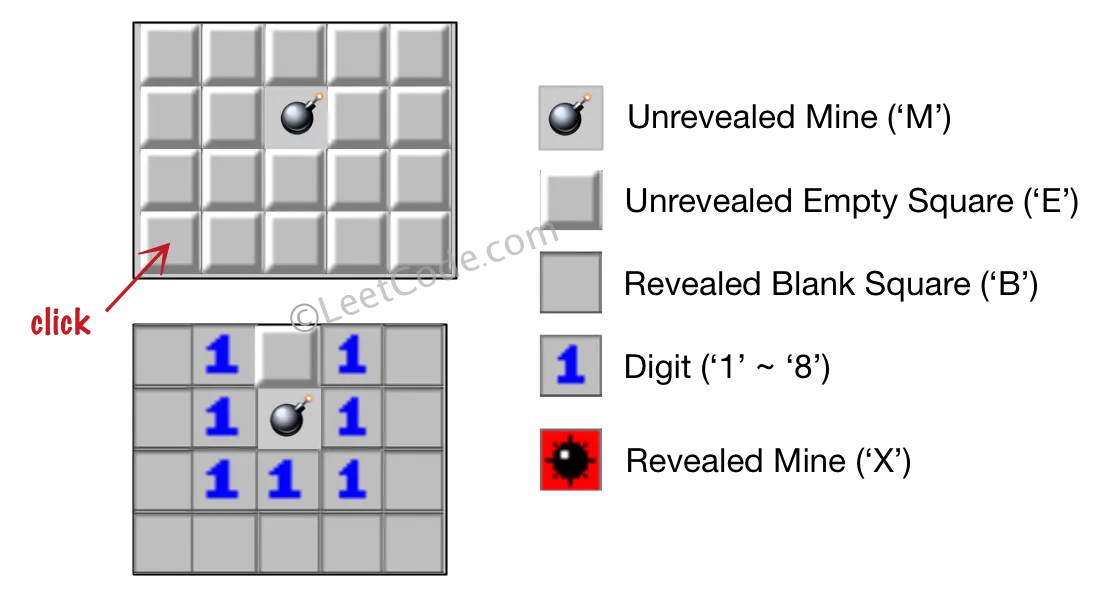
Input:

[['E', 'E', 'E', 'E', 'E'],
 ['E', 'E', 'M', 'E', 'E'],
 ['E', 'E', 'E', 'E', 'E'],
 ['E', 'E', 'E', 'E', 'E']]

Click : [3,0]

Output:

[['B', '1', 'E', '1', 'B'],
 ['B', '1', 'M', '1', 'B'],
 ['B', '1', '1', '1', 'B'],
 ['B', 'B', 'B', 'B', 'B']]

Explanation:
Example 2:
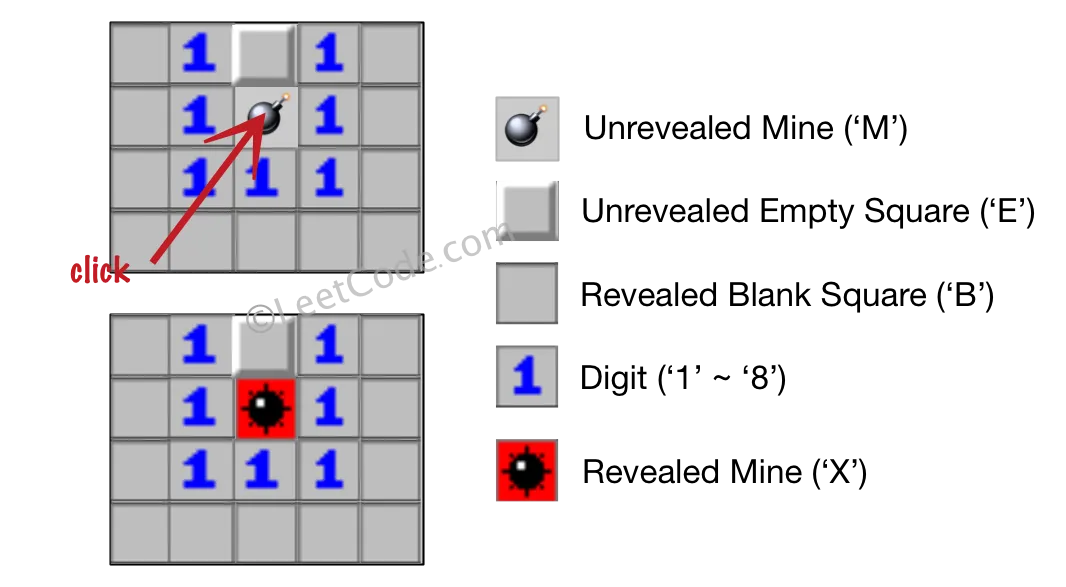
Input:

[['B', '1', 'E', '1', 'B'],
 ['B', '1', 'M', '1', 'B'],
 ['B', '1', '1', '1', 'B'],
 ['B', 'B', 'B', 'B', 'B']]

Click : [1,2]

Output:

[['B', '1', 'E', '1', 'B'],
 ['B', '1', 'X', '1', 'B'],
 ['B', '1', '1', '1', 'B'],
 ['B', 'B', 'B', 'B', 'B']]

Explanation:
Note:
- The range of the input matrix's height and width is [1,50].
- The click position will only be an unrevealed square ('M' or 'E'), which also means the input board contains at least one clickable square.
- The input board won't be a stage when game is over (some mines have been revealed).
- For simplicity, not mentioned rules should be ignored in this problem. For example, you don't need to reveal all the unrevealed mines when the game is over, consider any cases that you will win the game or flag any squares.
这道题就是经典的扫雷游戏啦,经典到不能再经典,从Win98开始,附件中始终存在的游戏,和纸牌、红心大战、空当接龙一起称为四大天王,曾经消耗了博主太多的时间。小时侯一直不太会玩扫雷,就是瞎点,完全不根据数字分析,每次点几下就炸了,就觉得这个游戏好无聊。后来长大了一些,慢慢的理解了游戏的玩法,才发现这个游戏果然很经典,就像破解数学难题一样,充满了挑战与乐趣。花样百出的LeetCode这次把扫雷出成题,让博主借机回忆了一把小时侯,不错不错,那么来做题吧。题目中图文并茂,相信就算是没玩过扫雷的也能弄懂了,而且规则也说的比较详尽了,那么我们相对应的做法也就明了了。对于当前需要点击的点,我们先判断是不是雷,是的话直接标记X返回即可。如果不是的话,我们就数该点周围的雷个数,如果周围有雷,则当前点变为雷的个数并返回。如果没有的话,我们再对周围所有的点调用递归函数再点击即可。参见代码如下:
解法一:
class Solution {
public:
    vector<vector<char>> updateBoard(vector<vector<char>>& board, vector<int>& click) {
        if (board.empty() || board[0].empty()) return {};
        int m = board.size(), n = board[0].size(), row = click[0], col = click[1], cnt = 0;
        if (board[row][col] == 'M') {
            board[row][col] = 'X';
        } else {
            for (int i = -1; i < 2; ++i) {
                for (int j = -1; j < 2; ++j) {
                    int x = row + i, y = col + j;
                    if (x < 0 || x >= m || y < 0 || y >= n) continue;
                    if (board[x][y] == 'M') ++cnt;
                }
            }
            if (cnt > 0) {
                board[row][col] = cnt + '0';
            } else {
                board[row][col] = 'B';
                for (int i = -1; i < 2; ++i) {
                    for (int j = -1; j < 2; ++j) {
                        int x = row + i, y = col + j;
                        if (x < 0 || x >= m || y < 0 || y >= n) continue;
                        if (board[x][y] == 'E') {
                            vector<int> nextPos{x, y};
                            updateBoard(board, nextPos);
                        }
                    }
                }
            }
        }
        return board;
    }
};
下面这种解法跟上面的解法思路基本一样,写法更简洁了一些。可以看出上面的解法中的那两个for循环出现了两次,这样显得代码比较冗余,一般来说对于重复代码是要抽离成函数的,但那样还要多加个函数,也麻烦。我们可以根据第一次找周围雷个数的时候,若此时cnt个数为0并且标识是E的位置记录下来,那么如果最后雷个数确实为0了的话,我们直接遍历我们保存下来为E的位置调用递归函数即可,就不用再写两个for循环了,参见代码如下:
解法二:
class Solution {
public:
    vector<vector<char>> updateBoard(vector<vector<char>>& board, vector<int>& click) {
        if (board.empty() || board[0].empty()) return {};
        int m = board.size(), n = board[0].size(), row = click[0], col = click[1], cnt = 0;
        if (board[row][col] == 'M') {
            board[row][col] = 'X';
        } else {
            vector<vector<int>> neighbors;
            for (int i = -1; i < 2; ++i) {
                for (int j = -1; j < 2; ++j) {
                    int x = row + i, y = col + j;
                    if (x < 0 || x >= m || y < 0 || y >= n) continue;
                    if (board[x][y] == 'M') ++cnt;
                    else if (cnt == 0 && board[x][y] == 'E') neighbors.push_back({x, y});
                }
            }
            if (cnt > 0) {
                board[row][col] = cnt + '0';
            } else {
                for (auto a : neighbors) {
                    board[a[0]][a[1]] = 'B';
                    updateBoard(board, a);
                }
            }
        }
        return board;
    }
};
下面这种方法是上面方法的迭代写法,用queue来存储之后要遍历的位置,这样就不用递归调用函数了,参见代码如下:
解法三:
class Solution {
public:
    vector<vector<char>> updateBoard(vector<vector<char>>& board, vector<int>& click) {
        if (board.empty() || board[0].empty()) return {};
        int m = board.size(), n = board[0].size();
        queue<pair<int, int>> q({{click[0], click[1]}});
        while (!q.empty()) {
            int row = q.front().first, col = q.front().second, cnt = 0; q.pop();
            vector<pair<int, int>> neighbors;
            if (board[row][col] == 'M') board[row][col] = 'X';
            else {
                for (int i = -1; i < 2; ++i) {
                    for (int j = -1; j < 2; ++j) {
                        int x = row + i, y = col + j;
                        if (x < 0 || x >= m || y < 0 || y >= n) continue;
                        if (board[x][y] == 'M') ++cnt;
                        else if (cnt == 0 && board[x][y] == 'E') neighbors.push_back({x, y});
                    }
                }
            }
            if (cnt > 0) board[row][col] = cnt + '0';
            else {
                for (auto a : neighbors) {
                    board[a.first][a.second] = 'B';
                    q.push(a);
                }
            }
        }
        return board;
    }
};
本文转自博客园Grandyang的博客,原文链接:Minesweeper 扫雷游戏,如需转载请自行联系原博主。