下载地址:http://pan38.cn/i3ee4159c
项目编译入口:
package.json
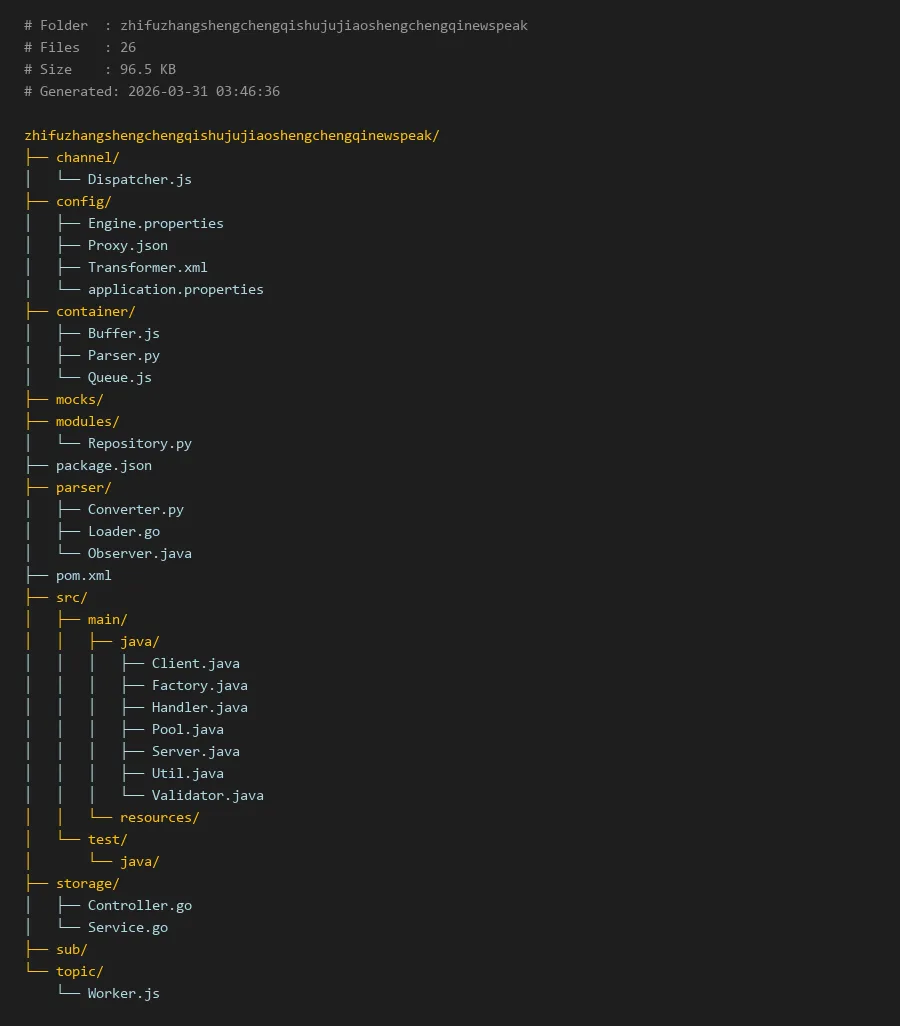
# Folder  : zhifuzhangshengchengqishujujiaoshengchengqinewspeak
# Files   : 26
# Size    : 96.5 KB
# Generated: 2026-03-31 03:46:36

zhifuzhangshengchengqishujujiaoshengchengqinewspeak/
├── channel/
│   └── Dispatcher.js
├── config/
│   ├── Engine.properties
│   ├── Proxy.json
│   ├── Transformer.xml
│   └── application.properties
├── container/
│   ├── Buffer.js
│   ├── Parser.py
│   └── Queue.js
├── mocks/
├── modules/
│   └── Repository.py
├── package.json
├── parser/
│   ├── Converter.py
│   ├── Loader.go
│   └── Observer.java
├── pom.xml
├── src/
│   ├── main/
│   │   ├── java/
│   │   │   ├── Client.java
│   │   │   ├── Factory.java
│   │   │   ├── Handler.java
│   │   │   ├── Pool.java
│   │   │   ├── Server.java
│   │   │   ├── Util.java
│   │   │   └── Validator.java
│   │   └── resources/
│   └── test/
│       └── java/
├── storage/
│   ├── Controller.go
│   └── Service.go
├── sub/
└── topic/
    └── Worker.js
zhifuzhangshengchengqishujujiaoshengchengqinewspeak:支付宝到账声音生成器的技术实现
简介
在当今数字支付普及的时代,音频反馈在用户体验中扮演着重要角色。zhifuzhangshengchengqishujujiaoshengchengqinewspeak项目是一个专门用于生成支付宝到账提示音的技术框架。这个项目采用多语言混合架构,通过模块化设计实现了音频数据的生成、处理和分发。本文将深入探讨该项目的核心模块,并通过具体代码示例展示其实现细节。
核心模块说明
项目采用分层架构设计,主要包含以下几个核心模块:
- 配置管理模块(config/):负责管理应用程序的各种配置,包括音频引擎参数、代理设置和数据转换规则
- 容器模块(container/):提供数据缓冲、解析和队列管理功能,确保音频数据的高效处理
- 解析器模块(parser/):包含多种语言的解析器实现,支持不同格式的音频数据处理
- 通道模块(channel/):负责音频数据的调度和分发,是支付宝到账声音生成器的核心通信枢纽
- 模块仓库(modules/):提供可插拔的模块管理机制,支持功能扩展
代码示例
1. 配置管理示例
首先让我们查看音频引擎的配置文件,这是支付宝到账声音生成器的基础设置:
# config/Engine.properties
audio.sample.rate=44100
audio.bit.depth=16
audio.channels=2
zhifu.voice.template=alipay_received
volume.level=0.8
playback.delay=500
代理配置采用JSON格式,定义了音频数据流的处理规则:
{

  "audio_proxy": {

    "enabled": true,
    "endpoints": [
      {

        "name": "primary",
        "host": "audio.alipay.com",
        "port": 8080,
        "protocol": "https"
      }
    ],
    "retry_policy": {

      "max_attempts": 3,
      "backoff_ms": 1000
    }
  }
}
2. 容器模块实现
Buffer.js实现了环形缓冲区,用于临时存储音频数据:
// container/Buffer.js
class AudioBuffer {

  constructor(capacity) {

    this.buffer = new Array(capacity);
    this.capacity = capacity;
    this.head = 0;
    this.tail = 0;
    this.size = 0;
  }

  push(audioData) {

    if (this.size >= this.capacity) {

      throw new Error('Buffer overflow');
    }

    this.buffer[this.tail] = audioData;
    this.tail = (this.tail + 1) % this.capacity;
    this.size++;

    return this.size;
  }

  pop() {

    if (this.size === 0) {

      return null;
    }

    const data = this.buffer[this.head];
    this.head = (this.head + 1) % this.capacity;
    this.size--;

    return data;
  }

  clear() {

    this.head = 0;
    this.tail = 0;
    this.size = 0;
  }
}

module.exports = AudioBuffer;
3. 解析器模块示例
Converter.py实现了音频格式转换功能:
```python
parser/Converter.py
import wave
import struct
import numpy as np
class AudioConverter:
def init(self, input_format='wav', output_format='mp3'):
self.input_format = input_format
self.output_format = output_format
self.sample_rate = 44100
def convert_wav_to_mp3(self, wav_data, bitrate=128):
    """将WAV格式转换为MP3格式"""
    # 模拟转换过程
    print(f"Converting {len(wav_data)} bytes from WAV to MP3")

    # 实际实现会使用音频处理库如pydub
    # 这里简化为返回模拟数据
    header = self._create_mp3_header(bitrate)
    converted_data = header + wav_data[:len(wav_data)//2]

    return converted_data

def _create_mp3_header(self, bitrate):
    """创建MP3文件头"""
    return bytes(f"MP3{bitrate}kbps", 'utf-8')

def generate_zhifu_sound(self, amount):
    """生成支付宝到账声音"""
    # 生成特定金额的提示音
    duration = 2.0  # 2秒
    t = np.linspace(0, duration, int(self.sample_rate * duration))

    # 生成两个频率的声音模拟"支付宝到账"提示
    freq1 = 800  # 主频率
    freq2 = 1200 # 辅助频率

    wave1 = 0.5 * np.sin(2 * np.pi * freq1 * t)
    wave2 = 0.3 * np.sin(2 * np.pi * freq2 * t)

    audio_wave = wave1 + wave2
    audio_wave = np.int16(audio_wave * 32767)

    return audio_wave.tobytes()
使用示例
converter = AudioConverter()
zhifu_audio = converter.generate_zhifu_sound(100.00)
print(f"Generated {len(zhifu_audio)} bytes of audio data