下载地址:http://lanzou.co/id1d03b82
项目编译入口:
package.json
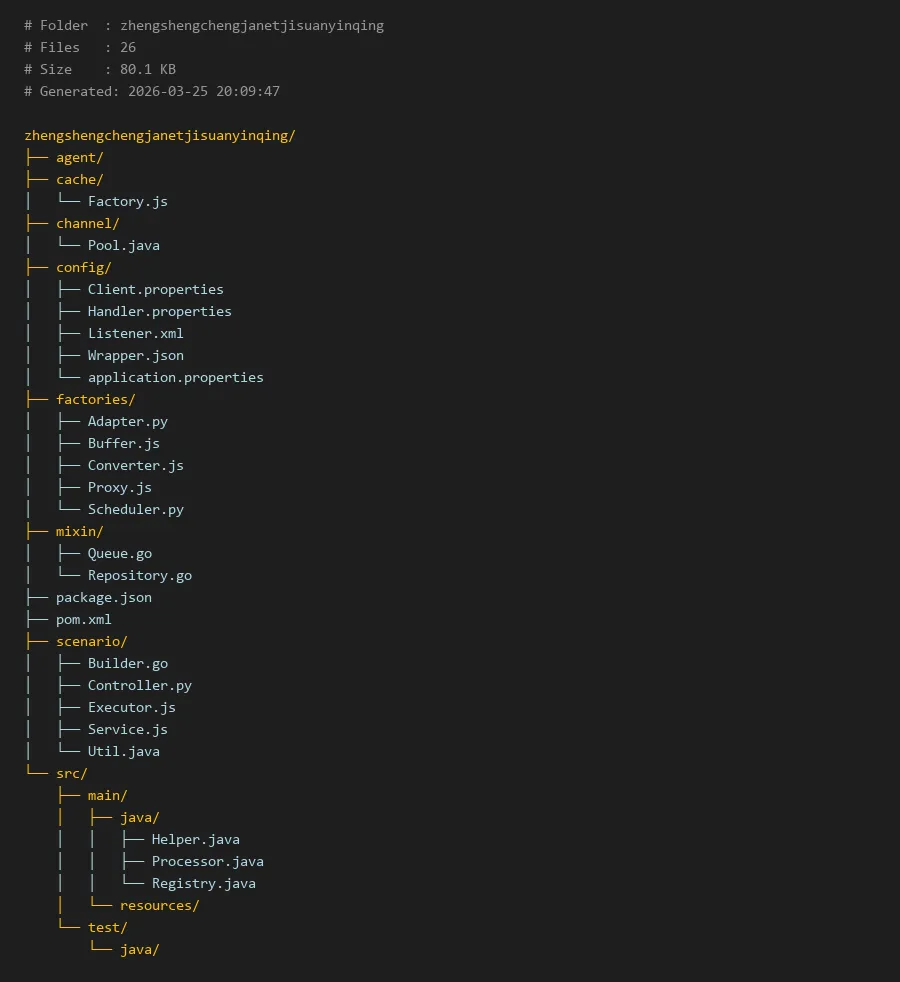
# Folder  : zhengshengchengjanetjisuanyinqing
# Files   : 26
# Size    : 80.1 KB
# Generated: 2026-03-25 20:09:47

zhengshengchengjanetjisuanyinqing/
├── agent/
├── cache/
│   └── Factory.js
├── channel/
│   └── Pool.java
├── config/
│   ├── Client.properties
│   ├── Handler.properties
│   ├── Listener.xml
│   ├── Wrapper.json
│   └── application.properties
├── factories/
│   ├── Adapter.py
│   ├── Buffer.js
│   ├── Converter.js
│   ├── Proxy.js
│   └── Scheduler.py
├── mixin/
│   ├── Queue.go
│   └── Repository.go
├── package.json
├── pom.xml
├── scenario/
│   ├── Builder.go
│   ├── Controller.py
│   ├── Executor.js
│   ├── Service.js
│   └── Util.java
└── src/
    ├── main/
    │   ├── java/
    │   │   ├── Helper.java
    │   │   ├── Processor.java
    │   │   └── Registry.java
    │   └── resources/
    └── test/
        └── java/
zhengshengchengjanetjisuanyinqing:一个多语言混合计算引擎的技术解析
简介
zhengshengchengjanetjisuanyinqing(以下简称Z引擎)是一个创新的多语言混合计算引擎,它通过整合Java、Python、JavaScript和Go等多种编程语言的优势,构建了一个高性能、可扩展的分布式计算系统。该项目采用微服务架构设计,每个模块使用最适合的语言实现,通过统一的接口进行通信和协作。
Z引擎的核心设计理念是"语言专业化"——不同的计算任务使用最合适的编程语言处理。Java负责网络通信和线程管理,Python处理数据分析和机器学习,JavaScript处理前端交互和实时计算,Go则负责高并发场景和系统调度。这种混合架构在保证性能的同时,提供了极大的灵活性。
核心模块说明
1. 配置管理模块 (config/)
配置模块采用多种格式存储配置信息,支持动态加载和热更新。application.properties作为主配置文件,其他配置文件按功能分类管理。
2. 工厂模式模块 (factories/)
工厂模块实现了各种设计模式,包括适配器、代理、调度器等,提供了统一的组件创建和管理接口。
3. 通道管理模块 (channel/)
基于Java的通道池管理,负责维护网络连接和消息传递,确保高并发下的稳定通信。
4. 缓存系统模块 (cache/)
采用JavaScript实现的缓存工厂,支持多种缓存策略和存储后端。
5. 混合计算模块 (mixin/)
使用Go语言实现的高性能队列和存储库,处理大规模数据流和状态管理。
6. 场景构建模块 (scenario/)
场景控制器和构建器,负责业务流程的编排和执行。
代码示例
1. Java通道池实现
// channel/Pool.java
package channel;

import java.util.concurrent.BlockingQueue;
import java.util.concurrent.LinkedBlockingQueue;
import java.util.concurrent.TimeUnit;

public class Pool {

    private final BlockingQueue<Channel> pool;
    private final int maxSize;
    private final long timeout;

    public Pool(int maxSize, long timeout) {

        this.maxSize = maxSize;
        this.timeout = timeout;
        this.pool = new LinkedBlockingQueue<>(maxSize);
        initializePool();
    }

    private void initializePool() {

        for (int i = 0; i < maxSize; i++) {

            pool.offer(new Channel("channel-" + i));
        }
    }

    public Channel acquire() throws InterruptedException {

        Channel channel = pool.poll(timeout, TimeUnit.MILLISECONDS);
        if (channel == null) {

            throw new RuntimeException("Channel acquisition timeout");
        }
        return channel;
    }

    public void release(Channel channel) {

        if (!pool.offer(channel)) {

            channel.close();
        }
    }

    public int getAvailableCount() {

        return pool.size();
    }

    public void shutdown() {

        pool.forEach(Channel::close);
        pool.clear();
    }
}
2. Python调度器实现
```python
factories/Scheduler.py
import asyncio
import threading
import time
from datetime import datetime
from typing import Callable, Dict, Any, Optional
class Scheduler:
def init(self, max_workers: int = 10):
self.max_workers = max_workers
self.tasks: Dict[str, asyncio.Task] = {}
self.lock = threading.RLock()
self.running = False
async def schedule_periodic(self,
                           task_id: str,
                           func: Callable,
                           interval: float,
                           *args, **kwargs) -> None:
    """调度周期性任务"""
    async def periodic_wrapper():
        while self.running:
            start_time = time.time()
            try:
                await func(*args, **kwargs)
            except Exception as e:
                print(f"Task {task_id} failed: {e}")

            elapsed = time.time() - start_time
            sleep_time = max(0, interval - elapsed)
            await asyncio.sleep(sleep_time)

    with self.lock:
        if task_id in self.tasks:
            raise ValueError(f"Task {task_id} already exists")

        task = asyncio.create_task(periodic_wrapper())
        self.tasks[task_id] = task

def schedule_once(self,
                 task_id: str,
                 func: Callable,
                 delay: float,
                 *args, **kwargs) -> None:
    """调度一次性延迟任务"""
    async def delayed_wrapper():
        await asyncio.sleep(delay)
        try:
            await func(*args, **kwargs)
        except Exception as e:
            print(f"One-time task {task_id} failed: {e}")
        finally:
            with self.lock:
                self.tasks.pop(task_id, None)

    with self.lock:
        if task_id in self.tasks:
            raise ValueError(f"Task {task_id} already exists")

        task = asyncio.create_task(delayed_wrapper())
        self.tasks[task_id] = task

async def start(self):
    """启动调度器"""
    self.running = True
    print(f"Scheduler started at {datetime.now()}")

async def stop(self):
    """停止调度器"""
    self.running = False
    # 取消所有任务
    with self.lock:
        for task_id, task in self.tasks.items():
            task.cancel()
        self.tasks.clear()

    # 等待任务取消完成
    await