
![A{G0V70]ZO4MJ}O~`0{L{WH.png](https://ucc.alicdn.com/pic/developer-ecology/q7zvrojhun744_33368709e8ed4317a62792af2a1a7d41.png?x-oss-process=image/resize,w_1400/format,webp "A{G0V70]ZO4MJ}O~`0{L{WH.png")
持续创作,加速成长!这是我参与「掘金日新计划 · 6 月更文挑战」的第22天,点击查看活动详情
What I Learned
接触Node.js也有十来天了,算是学点新东西。The best way to learn something new is to use it. 学习新知识最好的方式莫过于去使用它(do something),在自然语言、编程语言的习得过程中尤为如此。
- Express 4.x:
- 静态文件引用;
- 路由;
- get,set自定义属性;
- 基本事件触发、响应;服务器、客户端之间的实时通信;
- 这个功能不要太强大。。还需继续挖掘;
- 模板引擎EJS(Embedded JavaScript),较简单,跟Jekyll的Liquid语法有一拼;
- 文件上传模块formidable:
- 文件上传;
- 计算md5;
- path模块:path.join(); path.extname();
- 原生JavaScript的知识点巩固:
- DOM操作;
- Map操作;
- Date转换;
- 对象封装;
- 正则表达式;
Features
- 最后长这样子:
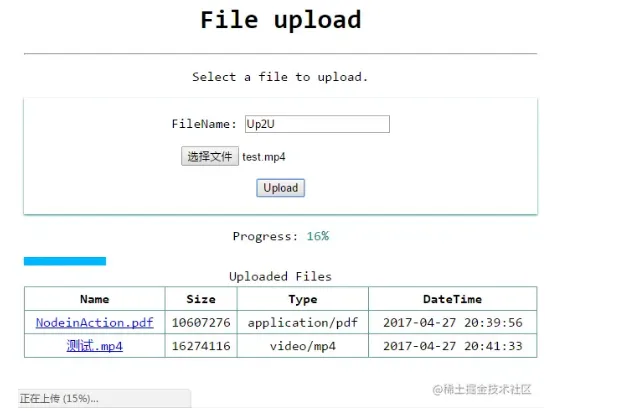
- 作为应用Express 4.x与socket.io的小例子,实现文件的上传、下载;
关键是如何通过socket.io实现前后端的实时通信:在routes中使用socket触发文件上传进度事件。
- 前端上传进度条:显示上传进度,用div宽度模拟,比较简陋;
- 点击文件名可下载:相对上传,下载简单多了,通过response的download方法实现;
- 文件去重:在上传过程中通过formidable提供的
form.hash='md5'计算文件唯一标识,保证上传后的文件不重复; - 客户端校验:用户输入后,简单的文件名合法性校验;
Let's code
- Server Side : app.js
var express = require('express');
var path = require('path');
var app = express();
var port = 8888;
// view engine setup
app.set('views', path.join(__dirname, 'views'));
app.set('view engine', 'ejs');
// include static files
app.use(express.static(path.join(__dirname, 'public')));
// upload destination setup
app.set('files', path.join(__dirname, '/public/files'));
var index = require('./routes/index');
// router
app.get('/upload', index.list);
app.post('/upload', index.submit(app.get('files')));
app.get('/file/:id/download', index.download(app.get('files')));
var server = app.listen(port);
console.log("Listening on port: " + port);
var io = require('socket.io')(server);
app.set('socketio', io); // store a reference to the io object, can be passed to routes
- Router - Form and File List: index.js
var formidable = require('formidable');
var fs = require('fs');
var path = require('path');
var fileUploaded = new Map(); // store uploaded files
exports.list = function (req, res) {
  res.render('index', {
    title: "File upload",
    fileUploaded: fileUploaded
  });
};
• Router - Submit and Upload: index.js
javascript
exports.submit = function (dir) {
  return function (req, res, next) {
    var form = new formidable.IncomingForm();
    // high level formidable API
    form.uploadDir = dir; // set destination
    form.hash = 'md5'; // use hash algorithm, we can get hash value by 'file.hash'
    form.parse(req, function (err, fields, files) {
      // console.log(fields);
      // console.log(files);
      files.file.lastModifiedDate = files.file.lastModifiedDate.toLocaleString();
      var f = {
        newName: fields.name.length == 0
          ? files.file.name
          : fields.name + path.extname(files.file.name),
        file: files.file
      };
      if (fileUploaded.has(files.file.hash)) {
        form.emit('aborted'); // doesn't work!?
        console.log('aborted');
      } else {
        fileUploaded.set(files.file.hash, f); // add to map
      }
      fs.rename(files.file.path, path.join(form.uploadDir, files.file.name), function (err) {
        if (err) {
          console.log(err);
        }
        res.redirect('/upload');
        console.log('Finished.');
      });
    });
    var io = req.app.get('socketio'); // get reference to socket.io
    // listening progress event and send data to client
    form.on('progress', function (bytesReceived, bytesExpected) {
      var percent = Math.floor(bytesReceived / bytesExpected * 100);
      console.log(percent);
      var progress = {
        name: 'progress',
        percent: percent
      };
      // emit event : progress
      io.emit('progress', progress); //notify all client, no session here
    });
  }
};
• Router - Download :index.js
exports.download = function (dir) {
  return function (req, res, next) {
    var id = req.params.id;
    var file = fileUploaded.get(id);
    var targetPath = path.join(dir, file.file.name);
    // second parameter can be used to specify file name
    res.download(targetPath, file.newName);
  };
};
• Layout(only part of the file): index.ejs
<table>
<caption>Uploaded Files</caption>
<thead>
<tr>
  <th>Name</th>
  <th>Size</th>
  <th>Type</th>
  <th>DateTime</th>
  <!--<th>Details</th>-->
</tr>
</thead>
<tbody>
<% fileUploaded.forEach(function(item, key, mapObj) { %>
<tr>
  <td><a href='/file/<%=key%>/download'><%=item.newName%></a></td>
  <td><%=item.file.size%></td>
  <td><%=item.file.type%></td>
  <td><%=item.file.lastModifiedDate%></td>
  <!--lastModifiedDate, mtime???-->
  <!--<td><%=JSON.stringify(item.file)%></td>-->
</tr>
<%})%>
</tbody>
</table>
• Client Validation(only part of the file): client.js
// client validation
function validateInput() {
  var uploadButton = document.forms[0].upload;
  uploadButton.onclick = function () {
    var file = document.forms[0].file.value;
    if (file.length == 0) {
      document.getElementById('uploadProgress').innerText = 'No file selectd!';
      return false;
    }
    var name = document.forms[0].name.value;
    if (name.length != 0) {
      var invalidChars = name.match(/[^a-zA-Z0-9_()\u4e00-\u9fa5]+/g); // match invalid file name
      if (invalidChars.length != 0) {
        document.getElementById('uploadProgress').innerText = 'Invalid file name!';
        return false;
      }
    }
  }
}
// communication between client and server using socket.io
function getUploadProgressFromServer() {
  var socket = io.connect("http://localhost:8888");
  var uploadProgress = document.getElementById("uploadProgress");
  var bar = document.getElementById('bar');
  socket.on("progress", function (data) {
    if ("progress" === data.name) {
      uploadProgress.innerText = data.percent + '%';
      bar.style.width = data.percent / 100 * document.body.offsetWidth + 'px';
    } else {
      console.log("There is nothing.", data);
    }
  });
}
Notes:
- 为简单起见,后端触发上传进度事件时,通过broadcast方式通知所有客户端,所以当多个客户端(可用两个不同的浏览器模拟)在传文件时,会在所有的窗口内显示进度,更好的实现方式应该是使用socket.io的Session;
- 前端上传进度条、已上传文件列表的实现、样式等均比较粗糙,未使用bootstrap美化,不过作为Demo型程序,已经足够;
- 目前该程序上传的文件放在服务器指定目录下,但记录仅保存在内存中,未涉及DB;如果有兴趣,可做些扩展,将上传记录持久化至DB中,比如常用的MongoDB,MySQL,SQLite甚至SQLServer,node社区提供了各种好用的module;
- 理论上应该可以传输各种格式的文件;另外,该示例中并未限制上传文件的大小,如有需要可查阅formidable的相关文档;其实node中用于文件上传的module非常多,比较成熟、常用的有multer,formidable,multiparty等,感兴趣的话都可以用一用;
Problems:
- 对重复文件上传操作:虽然能保证服务器端仅保留一份,但由于这里计算md5的方式只能等文件流获取完毕才能计算(推测),所以依然会进行上传操作,这在文件较大时……简直了!是否可先计算文件md5(采用crypto模块),对比已上传文件的md5,如果不存在,再进行上传?
- formidable的file对象,传至客户端页面(index.ejs中,已注掉),直接输出为:
{"size":102056,
"path":"D:\\...\\uploadProgress\\public\\files\\upload_0dcfbb98abc3b2c7356f87f218df715b",
"name":"debug.log",
"type":"application/octet-stream",
"mtime":"2017-04-26 20:58:08",
"hash":"40f2f78bff67c9e6164aa790f9627d83"}
- 很明显,其中包含mtime(最终修改时间);然而,当通过
file.mtime获取该属性时,竟然是undefined,但是可通过file.lastModifiedDate来获取此属性,也是醉了,这到底是什么原因??
- 上述问题,如您知道原因,还请不吝赐教,非常感谢!
Source Code: Github
If you have any questions or any bugs are found, please feel free to contact me.
Your comments and suggestions are welcome!
