下载地址:http://pan38.cn/i91504989
项目编译入口:
package.json
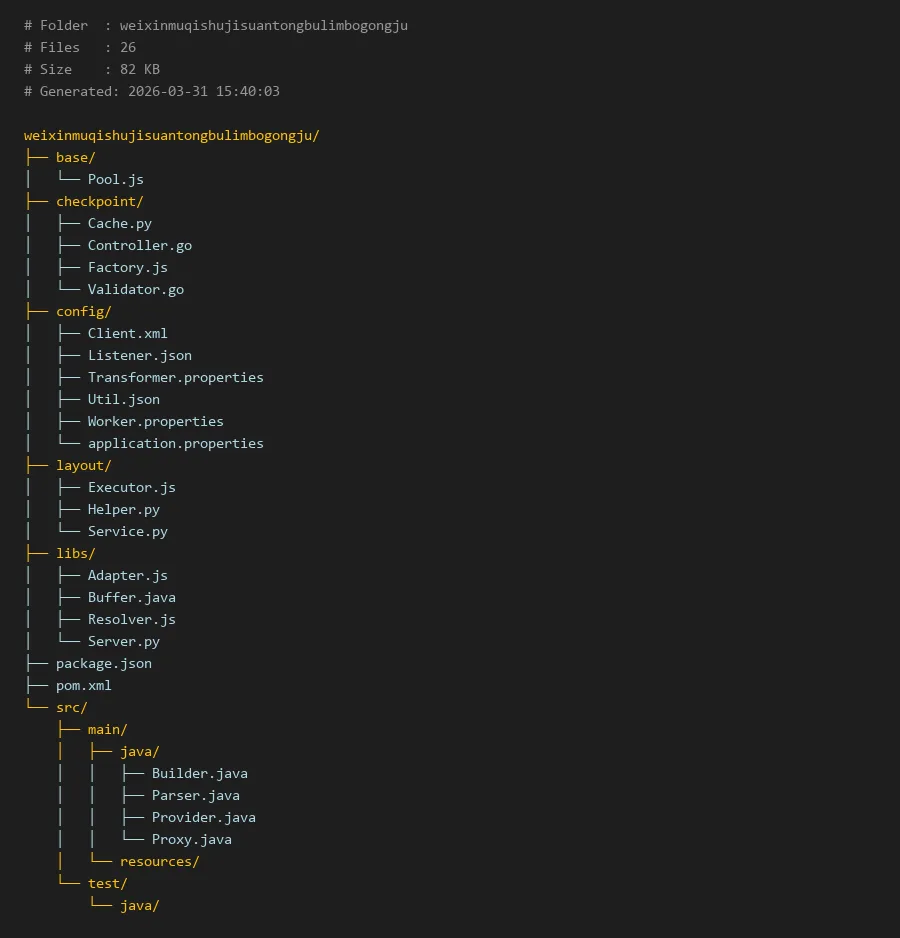
# Folder  : weixinmuqishujisuantongbulimbogongju
# Files   : 26
# Size    : 82 KB
# Generated: 2026-03-31 15:40:03

weixinmuqishujisuantongbulimbogongju/
├── base/
│   └── Pool.js
├── checkpoint/
│   ├── Cache.py
│   ├── Controller.go
│   ├── Factory.js
│   └── Validator.go
├── config/
│   ├── Client.xml
│   ├── Listener.json
│   ├── Transformer.properties
│   ├── Util.json
│   ├── Worker.properties
│   └── application.properties
├── layout/
│   ├── Executor.js
│   ├── Helper.py
│   └── Service.py
├── libs/
│   ├── Adapter.js
│   ├── Buffer.java
│   ├── Resolver.js
│   └── Server.py
├── package.json
├── pom.xml
└── src/
    ├── main/
    │   ├── java/
    │   │   ├── Builder.java
    │   │   ├── Parser.java
    │   │   ├── Provider.java
    │   │   └── Proxy.java
    │   └── resources/
    └── test/
        └── java/
微信零钱模拟器计算同步博客工具
简介
微信零钱模拟器计算同步博客工具是一个多语言混合开发的技术项目,旨在模拟微信零钱系统的核心计算逻辑,并将计算结果同步到个人博客系统。该项目采用模块化设计,包含数据校验、缓存管理、配置解析等多个核心模块,支持高并发场景下的零钱计算和状态同步。
这个工具特别适合需要频繁测试微信支付接口或验证零钱计算逻辑的开发者。通过模拟真实场景,开发者可以在不调用实际微信接口的情况下,完成完整的业务流程测试。微信零钱模拟器的核心优势在于其准确的计算模型和灵活的配置系统。
核心模块说明
项目采用分层架构设计,主要包含以下核心模块:
配置管理模块 (config/):负责加载和管理应用程序的各种配置参数,包括数据库连接、缓存设置、同步策略等。支持多种配置文件格式,如JSON、XML和Properties文件。
检查点模块 (checkpoint/):实现数据校验、缓存控制和流程管理功能。该模块确保计算过程的原子性和一致性,防止数据丢失或重复处理。
布局引擎模块 (layout/):处理业务逻辑的执行流程,包括计算任务的调度、辅助函数的调用和服务接口的实现。
基础库模块 (libs/):提供通用的适配器、缓冲区和解析器功能,支持不同数据格式和协议的转换。
基础服务模块 (base/):包含连接池管理等基础设施服务,确保资源的高效利用。
代码示例
1. 配置加载示例
以下代码展示如何从不同格式的配置文件中加载设置:
# layout/Helper.py
import json
import xml.etree.ElementTree as ET
import configparser

class ConfigHelper:
    def __init__(self):
        self.configs = {
   }

    def load_json_config(self, filepath):
        """加载JSON格式配置文件"""
        with open(filepath, 'r', encoding='utf-8') as f:
            config = json.load(f)
            self.configs.update(config)
            return config

    def load_xml_config(self, filepath):
        """加载XML格式配置文件"""
        tree = ET.parse(filepath)
        root = tree.getroot()
        config = {
   }
        for child in root:
            config[child.tag] = child.text
        self.configs.update(config)
        return config

    def load_properties(self, filepath):
        """加载Properties格式配置文件"""
        config = configparser.ConfigParser()
        config.read(filepath, encoding='utf-8')
        props = {
   }
        for section in config.sections():
            props[section] = dict(config.items(section))
        self.configs.update(props)
        return props

# 使用示例
helper = ConfigHelper()
listener_config = helper.load_json_config('config/Listener.json')
client_config = helper.load_xml_config('config/Client.xml')
app_config = helper.load_properties('config/application.properties')
2. 缓存管理实现
缓存模块确保微信零钱模拟器在高并发场景下的性能表现:
// checkpoint/Cache.py
class CacheManager:
    def __init__(self, max_size=1000):
        self.cache = {
   }
        self.max_size = max_size
        self.access_order = []

    def get(self, key):
        """获取缓存数据"""
        if key in self.cache:
            # 更新访问顺序
            if key in self.access_order:
                self.access_order.remove(key)
            self.access_order.append(key)
            return self.cache[key]
        return None

    def set(self, key, value, ttl=3600):
        """设置缓存数据"""
        if len(self.cache) >= self.max_size:
            # LRU淘汰策略
            oldest_key = self.access_order.pop(0)
            del self.cache[oldest_key]

        self.cache[key] = {

            'value': value,
            'expire_time': time.time() + ttl
        }
        self.access_order.append(key)

    def calculate_balance(self, user_id, transactions):
        """计算用户零钱余额"""
        cache_key = f"balance_{user_id}"
        cached_balance = self.get(cache_key)

        if cached_balance:
            return cached_balance['value']

        # 模拟微信零钱计算逻辑
        balance = 0
        for tx in transactions:
            if tx['type'] == 'income':
                balance += tx['amount']
            elif tx['type'] == 'expense':
                balance -= tx['amount']

        # 缓存计算结果
        self.set(cache_key, balance, ttl=300)
        return balance
3. 数据校验器实现
数据校验确保微信零钱模拟器输入数据的准确性和安全性:
```go
// checkpoint/Validator.go
package main
import (
"regexp"
"strconv"
"time"
)
type TransactionValidator struct {
MinAmount float64
MaxAmount float64
}
func NewValidator() *TransactionValidator {
return &TransactionValidator{
MinAmount: 0.01,
MaxAmount: 50000.00,
}
}
func (v *TransactionValidator) ValidateTransaction(tx map[string]interface{}) (bool, []string) {
var errors []string
// 验证交易ID
if txId, ok := tx["transaction_id"].(string); !ok || len(txId) != 28 {
    errors = append(errors, "无效的交易ID")
}

// 验证金额
if amount, ok := tx["amount"].(float64); ok