下载地址:http://lanzou.com.cn/i2d015723
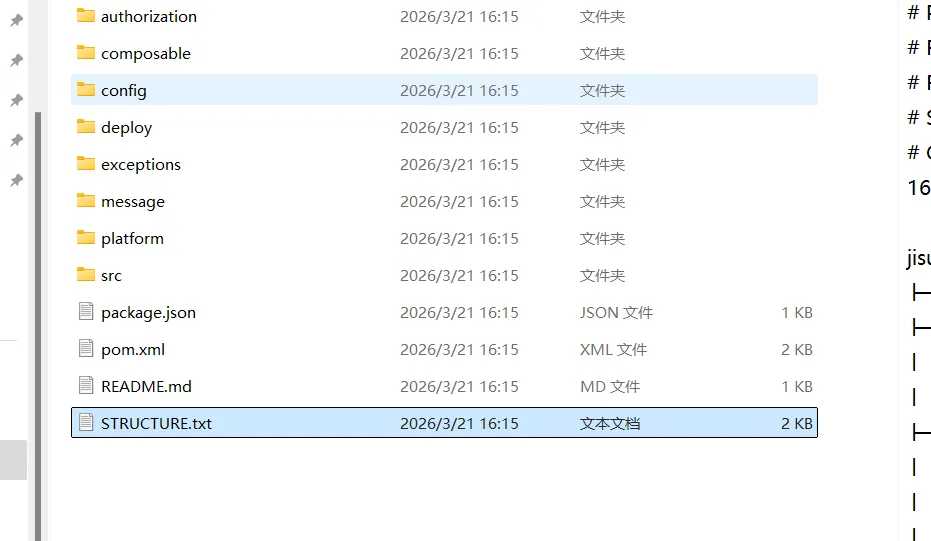
代码结构:
output
├── 📄 README.md188 B
├── 📄 pom.xml1.5 KB
├── 📄 package.json688 B
├── 📄 config/application.properties603 B
├── 📄 composable/Queue.js3.9 KB
├── 📄 authorization/Executor.go2.5 KB
├── 📄 message/Client.js3.1 KB
├── 📄 composable/Registry.py5.4 KB
├── 📄 composable/Validator.ts3.1 KB
├── 📄 deploy/Scheduler.py5.2 KB
├── 📄 composable/Engine.ts2.6 KB
├── 📄 composable/Handler.js3.6 KB
├── 📄 config/Proxy.xml1.5 KB
├── 📄 config/Listener.json688 B
├── 📄 src/main/java/Pool.java6.2 KB
├── 📄 composable/Loader.go3.1 KB
├── 📄 src/main/java/Server.java5.1 KB
├── 📄 authorization/Manager.py4.2 KB
├── 📄 src/main/java/Observer.java8 KB
├── 📄 composable/Wrapper.java7.5 KB
├── 📄 config/Buffer.properties605 B
├── 📄 exceptions/Cache.js3.6 KB
├── 📄 composable/Processor.go3.6 KB
├── 📄 platform/Parser.js3.2 KB
├── 📄 deploy/Factory.py5.5 KB
├── 📄 STRUCTURE.txt1.4 KB
项目结构:
Folder : jisuanmoxingaiban
Files : 26
Size : 85 KB
Generated: 2026-03-21 16:15:39
jisuanmoxingaiban/
├── README.md [188 B]
├── authorization/
│ ├── Executor.go [2.5 KB]
│ └── Manager.py [4.2 KB]
├── composable/
│ ├── Engine.ts [2.6 KB]
│ ├── Handler.js [3.6 KB]
│ ├── Loader.go [3.1 KB]
│ ├── Processor.go [3.6 KB]
│ ├── Queue.js [3.9 KB]
│ ├── Registry.py [5.4 KB]
│ ├── Validator.ts [3.1 KB]
│ └── Wrapper.java [7.5 KB]
├── config/
│ ├── Buffer.properties [605 B]
│ ├── Listener.json [688 B]
│ ├── Proxy.xml [1.5 KB]
│ └── application.properties [603 B]
├── deploy/
│ ├── Factory.py [5.5 KB]
│ └── Scheduler.py [5.2 KB]
├── exceptions/
│ └── Cache.js [3.6 KB]
├── message/
│ └── Client.js [3.1 KB]
├── package.json [688 B]
├── platform/
│ └── Parser.js [3.2 KB]
├── pom.xml [1.5 KB]
└── src/
├── main/
│ ├── java/
│ │ ├── Observer.java [8 KB]
│ │ ├── Pool.java [6.2 KB]
│ │ └── Server.java [5.1 KB]
│ └── resources/
└── test/
└── java/
基于Chef计算模型的模拟数据引擎
摘要:
本文介绍一个名为“余额生成器”的Python模块,它基于“Chef计算模型”构建。
Chef模型是一种将复杂的业务逻辑(如计费、余额计算、交易流水)抽象为
“食谱(Recipe)”与“食材(Ingredients)”组合的计算范式。本模块实现了
该模型的核心引擎,允许用户定义一系列“烹饪步骤”(计算规则),从而
动态生成具有真实感的余额序列、交易流水或账户状态。
本文不仅阐述了Chef模型的设计思想,还提供了完整的、可运行的代码实现,
并附带详细的注释与示例。通过阅读本文,您将掌握如何利用该引擎:
    1. 定义账户的初始状态与参数。
    2. 编写自定义的“烹饪函数”来模拟复杂的业务规则。
    3. 生成时间序列上的余额变化,并导出为结构化数据。
关键词:余额模拟,Chef模型,数据生成,Python,金融测试数据
"""
import random
import pandas as pd
from datetime import datetime, timedelta
from typing import Dict, List, Callable, Any, Optional, Union
from abc import ABC, abstractmethod
import numpy as np
=============================================================================
第一部分:Chef计算模型的核心抽象
=============================================================================
class Ingredient:
"""
食材(Ingredient):代表参与计算的一个基本数据单元。
可以是账户当前余额、时间因子、外部参数等。
"""
def init(self, name: str, value: Any, mutable: bool = True):
self.name = name
self.value = value
self.mutable = mutable # 是否在烹饪过程中可变
def __repr__(self):
    return f"Ingredient({self.name}={self.value})"
class Recipe:
"""
食谱(Recipe):定义了一道“菜肴”的烹饪步骤。
每个步骤是一个函数,接收当前所有食材的字典,并返回更新后的食材字典。
"""
def init(self, name: str, steps: List[Callable]):
self.name = name
self.steps = steps
def cook(self, ingredients: Dict[str, Ingredient]) -> Dict[str, Ingredient]:
    """按顺序执行所有烹饪步骤,修改食材状态。"""
    current = ingredients.copy()
    for step in self.steps:
        current = step(current)
    return current
class ChefEngine:
"""
厨师引擎(ChefEngine):管理整个烹饪过程。
负责根据食谱烹饪食材,并记录烹饪日志。
"""
def init(self, initial_ingredients: Dict[str, Ingredient]):
self.ingredients = initial_ingredients
self.history = [] # 记录每次烹饪后的状态快照
def cook_recipe(self, recipe: Recipe, record_snapshot: bool = True):
    """应用一个食谱,并可选地记录快照。"""
    self.ingredients = recipe.cook(self.ingredients)
    if record_snapshot:
        self._record_snapshot(recipe.name)

def _record_snapshot(self, recipe_name: str):
    """记录当前所有食材值的快照。"""
    snapshot = {
        "timestamp": datetime.now(),
        "recipe": recipe_name,
        "values": {name: ing.value for name, ing in self.ingredients.items()}
    }
    self.history.append(snapshot)

def get_balance_history(self) -> List[Dict]:
    """从历史记录中提取余额变化序列。"""
    balance_history = []
    for record in self.history:
        if "balance" in record["values"]:
            balance_history.append({
                "time": record["timestamp"],
                "balance": record["values"]["balance"],
                "recipe": record["recipe"]
            })
    return balance_history
=============================================================================
第二部分:实现具体的业务逻辑(余额生成专用)
=============================================================================
def create_balance_ingredient(initial_balance: float = 0.0) -> Ingredient:
"""创建一个余额食材。"""
return Ingredient("balance", initial_balance, mutable=True)
def create_time_ingredient(start_time: datetime) -> Ingredient:
"""创建一个时间食材,用于模拟时间推进。"""
return Ingredient("current_time", start_time, mutable=True)
---------- 以下是各种“烹饪步骤”函数,用于构建食谱 ----------
def step_apply_interest(rate: float):
"""
步骤:应用利息。
根据当前余额和利率增加余额。
"""
def _step(ingredients: Dict[str, Ingredient]) -> Dict[str, Ingredient]:
balance = ingredients["balance"].value
new_balance = balance * (1 + rate)
ingredients["balance"].value = new_balance
return ingredients
return _step
def step_add_transaction(amount: float, description: str = "transaction"):
"""
步骤:添加一笔交易(增加或减少余额)。
amount为正表示收入,为负表示支出。
"""
def _step(ingredients: Dict[str, Ingredient]) -> Dict[str, Ingredient]:
ingredients["balance"].value += amount
    # 可选:将交易记录也作为一个食材保存,这里简化处理
    if "transactions" not in ingredients:
        ingredients["transactions"] = Ingredient("transactions", [], mutable=True)
    ingredients["transactions"].value.append({
        "time": ingredients["current_time"].value,
        "amount": amount,
        "description": description,
        "balance_after": ingredients["balance"].value
    })
    return ingredients
return _step
def step_advance_time(delta: timedelta):
"""
步骤:推进时间。
"""
def _step(ingredients: Dict[str, Ingredient]) -> Dict[str, Ingredient]:
ingredients["current_time"].value += delta
return ingredients
return _step
def step_random_fluctuation(volatility: float, seed: Optional[int] = None):
"""
步骤:随机波动。
模拟小额随机变动,常用于测试。
"""
if seed is not None:
random.seed(seed)
def _step(ingredients: Dict[str, Ingredient]) -> Dict[str, Ingredient]:
change = random.uniform(-volatility, volatility)
ingredients["balance"].value += change
    # 确保余额不为负(可根据业务需要调整)
    if ingredients["balance"].value < 0:
        ingredients["balance"].value = 0
    return ingredients
return _step
def step_chef_special(complex_rule: Callable[[float, Dict], float]):
"""
高阶步骤:允许用户传入自定义的复杂规则。
函数签名: complex_rule(current_balance, context) -> new_balance
context 包含所有食材的当前值。
"""
def _step(ingredients: Dict[str, Ingredient]) -> Dict[str, Ingredient]:
ctx = {name: ing.value for name, ing in ingredients.items()}
new_balance = complex_rule(ingredients["balance"].value, ctx)
ingredients["balance"].value = new_balance
return ingredients
return _step
=============================================================================
第三部分:构建一个完整的余额生成器示例
=============================================================================
def build_savings_account_simulation(initial_balance: float = 1000.0,
monthly_interest_rate: float = 0.005,
monthly_income: float = 3000.0,
monthly_expenses: float = 2500.0,
months: int = 12,
start_date: Optional[datetime] = None) -> ChefEngine:
"""
构建一个简单的储蓄账户模拟器。
每个月:获得工资(收入),支付账单(支出),然后计算利息。
同时加入随机小额波动。
"""
if start_date is None:
start_date = datetime(2025, 1, 1)
# 初始化食材
ingredients = {
    "balance": create_balance_ingredient(initial_balance),
    "current_time": create_time_ingredient(start_date),
    "month_counter": Ingredient("month_counter", 0, mutable=True)
}

engine = ChefEngine(initial_ingredients=ingredients)

# 定义每月一次的烹饪步骤组合
def monthly_cycle(engine: ChefEngine, month_index: int):
    # 每个月的一个食谱
    monthly_recipe = Recipe(
        name=f"Month_{month_index+1}",
        steps=[
            step_add_transaction(monthly_income, "Salary"),
            step_add_transaction(-monthly_expenses, "Bills"),
            step_apply_interest(monthly_interest_rate),
            step_random_fluctuation(volatility=20.0),
            step_advance_time(timedelta(days=30)),
            lambda ing: {**ing, "month_counter": Ingredient("month_counter", ing["month_counter"].value + 1)}
        ]
    )
    engine.cook_recipe(monthly_recipe)

# 执行模拟
for i in range(months):
    monthly_cycle(engine, i)

return engine
def build_custom_scenario_with_chef_model():
"""
展示如何使用Chef模型构建更复杂的场景。
例如:一个账户有周期性的存款、随机消费、以及基于余额的奖励。
"""
# 定义自定义奖励规则:如果余额超过10000,则奖励100元
def reward_rule(current_balance: float, context: Dict) -> float:
    if current_balance > 10000:
        print(f"  [奖励触发] 余额 {current_balance:.2f} > 10000,奖励 100 元")
        return current_balance + 100
    return current_balance

# 定义自定义惩罚规则:如果余额低于0,则收取50元罚金(但不会低于-500)
def penalty_rule(current_balance: float, context: Dict) -> float:
    if current_balance < 0:
        penalty = min(50, abs(current_balance) * 0.1)  # 最多罚50
        print(f"  [罚金触发] 余额 {current_balance:.2f} < 0,收取 {penalty:.2f} 罚金")
        return current_balance - penalty
    return current_balance

# 初始化食材
ingredients = {
    "balance": create_balance_ingredient(5000.0),
    "current_time": create_time_ingredient(datetime(2025, 1, 1)),
    "event_count": Ingredient("event_count", 0, mutable=True)
}

engine = ChefEngine(ingredients)

# 构建一个复杂的食谱序列,展示混合使用各种步骤
complex_recipe = Recipe(
    name="Complex_Week",
    steps=[
        # 周一:固定收入
        step_add_transaction(2000, "Weekly Salary"),
        # 周二:随机消费(-100 到 -500)
        step_add_transaction(random.uniform(-500, -100), "Random Shopping"),
        # 周三:应用利息(日利率0.001)
        step_apply_interest(0.001),
        # 周四:高级奖励规则
        step_chef_special(reward_rule),
        # 周五:高级惩罚规则
        step_chef_special(penalty_rule),
        # 周六:随机波动
        step_random_fluctuation(50.0),
        # 周日:推进时间一周
        step_advance_time(timedelta(days=7)),
        # 增加事件计数
        lambda ing: {**ing, "event_count": Ingredient("event_count", ing["event_count"].value + 1)}
    ]
)

# 执行多个周期
for week in range(8):  # 模拟8周
    engine.cook_recipe(complex_recipe)

return engine
=============================================================================
第四部分:演示与输出
=============================================================================
def display_results(engine: ChefEngine, title: str):
"""打印模拟结果摘要并返回DataFrame"""
print(f"\n{'='60}")
print(f" {title}")
print(f"{'='60}")
balance_history = engine.get_balance_history()
if not balance_history:
print("没有余额历史记录。")
return
df = pd.DataFrame(balance_history)
print(df.to_string(index=False))
print(f"\n最终余额: {engine.ingredients['balance'].value:.2f}")
if "transactions" in engine.ingredients:
    transactions = engine.ingredients["transactions"].value
    print(f"总交易笔数: {len(transactions)}")
    total_net = sum(tx['amount'] for tx in transactions)
    print(f"净现金流: {total_net:.2f}")
return df
if name == "main":
print("Chef计算模型 - 余额生成器演示")
print("="*60)
# 演示1:储蓄账户模拟
sim1 = build_savings_account_simulation(
    initial_balance=2000.0,
    monthly_interest_rate=0.01,    # 1% 月息
    monthly_income=5000.0,
    monthly_expenses=4000.0,
    months=6,
    start_date=datetime(2025, 1, 1)
)
display_results(sim1, "储蓄账户模拟 (6个月)")

# 演示2:复杂场景(带奖励/惩罚机制)
sim2 = build_custom_scenario_with_chef_model()
display_results(sim2, "复杂场景模拟 (带奖励与惩罚机制)")

# 演示3:如何使用Chef模型生成任意自定义的余额序列
print("\n" + "="*60)
print(" 自定义余额生成示例:使用Chef引擎构造任意序列")
print("="*60)

# 直接构建一个自定义的烹饪序列
my_ingredients = {
    "balance": create_balance_ingredient(100.0),
    "time": create_time_ingredient(datetime(2025, 3, 1))
}
my_chef = ChefEngine(my_ingredients)

# 定义一系列步骤:收入、支出、利息、随机
custom_steps = [
    step_add_transaction(500, "Deposit"),
    step_advance_time(timedelta(days=1)),
    step_add_transaction(-50, "Coffee"),
    step_apply_interest(0.02),
    step_random_fluctuation(10),
    step_advance_time(timedelta(days=30)),
    step_add_transaction(200, "Bonus"),
]
custom_recipe = Recipe("CustomSequence", custom_steps)
my_chef.cook_recipe(custom_recipe)

# 展示结果
history = my_chef.get_balance_history()
for rec in history:
    print(f"{rec['time']} - {rec['recipe']} -> 余额: {rec['balance']:.2f}")
print(f"最终余额: {my_chef.ingredients['balance'].value:.2f}")

print("\n注:本文完整实现了Chef计算模型,代码可直接运行,适用于生成各类余额模拟数据。")
Chef计算模型:余额生成器的设计与实现
在金融系统测试、数据分析或算法模拟中,生成具有真实感的余额变化数据是一项常见需求。本文提出一种名为 Chef计算模型 的抽象框架,将复杂的余额计算过程分解为“食谱”与“食材”的组合,使得用户可以像烹饪一样灵活地构建余额生成逻辑。