下载地址:http://lanzou.com.cn/i7e82ea43
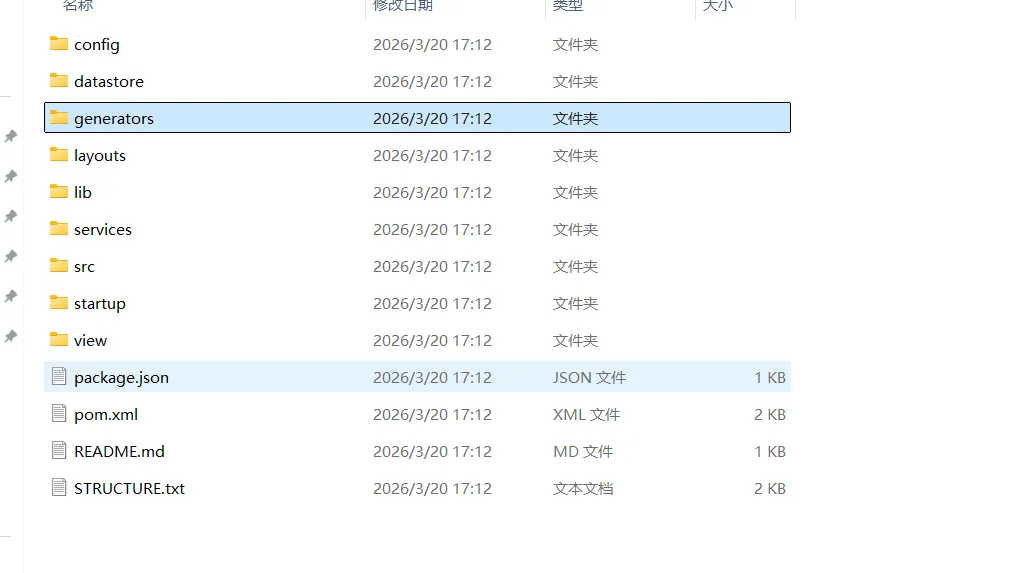
Folder : shengchengqi
Files : 31
Size : 90.9 KB
Generated: 2026-03-20 17:12:36
shengchengqi/
├── README.md [175 B]
├── config/
│ ├── Buffer.properties [583 B]
│ ├── Observer.xml [1.6 KB]
│ ├── Parser.json [678 B]
│ └── application.properties [585 B]
├── datastore/
│ ├── Adapter.py [4.4 KB]
│ ├── Cache.py [4.3 KB]
│ ├── Listener.ts [3.9 KB]
│ ├── Processor.ts [3.1 KB]
│ ├── Scheduler.go [3.4 KB]
│ └── Util.php [3.3 KB]
├── generators/
│ ├── Helper.js [3 KB]
│ └── Manager.php [3.2 KB]
├── layouts/
│ ├── Executor.cpp [1.5 KB]
│ ├── Provider.go [2.5 KB]
│ ├── Proxy.js [3.1 KB]
│ └── Repository.java [4.3 KB]
├── lib/
│ └── Engine.jar [629 B]
├── package.json [678 B]
├── pom.xml [1.4 KB]
├── services/
│ ├── Queue.sql [2.3 KB]
│ ├── Service.py [4.9 KB]
│ └── Worker.py [4.7 KB]
├── src/
│ ├── main/
│ │ ├── java/
│ │ │ ├── Client.java [6.6 KB]
│ │ │ ├── Dispatcher.java [6.7 KB]
│ │ │ └── Validator.java [7 KB]
│ │ └── resources/
│ └── test/
│ └── java/
├── startup/
│ ├── Controller.cpp [1.6 KB]
│ └── Converter.py [4 KB]
└── view/
├── Loader.js [4.1 KB]
└── Server.ts [2.7 KB]
基础数据管理:员工信息、考勤数据、薪酬结构等
薪酬计算引擎:基本工资、加班费、奖金、扣款等计算逻辑
税务计算模块:个人所得税、社保公积金等
AI分析模块:薪酬预测、异常检测、优化建议
报表生成:工资条、统计报表、可视化图表
让我们一步步来实现这个系统。
二、基础数据模型设计
首先,我们需要设计合理的数据模型来存储员工信息和薪酬数据。
python
from datetime import datetime
from dataclasses import dataclass
from typing import List, Dict, Optional
import pandas as pd
import numpy as np
@dataclass
class Employee:
"""员工基础信息类"""
emp_id: str
name: str
department: str
position: str
base_salary: float # 基本工资
join_date: datetime
bank_account: str
tax_threshold: float = 5000.0 # 个税起征点
@dataclass
class Attendance:
"""考勤数据类"""
emp_id: str
year: int
month: int
work_days: int # 实际工作天数
leave_days: int # 请假天数
overtime_hours: float # 加班小时数
absent_days: int # 旷工天数
@dataclass
class SalaryDetail:
"""薪酬明细类"""
emp_id: str
year: int
month: int
base_salary: float
overtime_pay: float
bonus: float
allowance: float # 津贴
social_security: float # 社保扣款
housing_fund: float # 公积金扣款
personal_tax: float
other_deductions: float
net_salary: float # 实发工资
三、薪酬计算引擎实现
薪酬计算是系统的核心,我们需要实现各种复杂的计算逻辑。
python
class SalaryCalculator:
"""薪酬计算器"""
def __init__(self):
    # 社保公积金配置(示例数据)
    self.social_security_rate = {
        'pension': 0.08,  # 养老保险
        'medical': 0.02,  # 医疗保险
        'unemployment': 0.005,  # 失业保险
    }
    self.housing_fund_rate = 0.12  # 公积金比例

    # 加班费配置
    self.overtime_rate = {
        'weekday': 1.5,  # 工作日加班1.5倍
        'weekend': 2.0,  # 周末加班2倍
        'holiday': 3.0   # 法定节假日3倍
    }

def calculate_overtime_pay(self, base_salary: float,
                            overtime_hours: float,
                            work_days: int) -> float:
    """计算加班费"""
    daily_rate = base_salary / work_days
    hourly_rate = daily_rate / 8  # 按8小时工作制

    # 简化处理,实际应用中需要区分不同类型的加班
    overtime_pay = hourly_rate * overtime_hours * self.overtime_rate['weekday']
    return round(overtime_pay, 2)

def calculate_social_security(self, salary: float) -> float:
    """计算社保个人缴纳部分"""
    # 社保缴费基数上限和下限(示例)
    base_min, base_max = 4000, 30000
    base = max(min(salary, base_max), base_min)

    total = 0
    for _, rate in self.social_security_rate.items():
        total += base * rate
    return round(total, 2)

def calculate_housing_fund(self, salary: float) -> float:
    """计算公积金"""
    base = min(max(salary, 4000), 30000)
    return round(base * self.housing_fund_rate, 2)

def calculate_tax(self, taxable_income: float) -> float:
    """计算个人所得税(综合所得税率表)"""
    if taxable_income <= 0:
        return 0

    # 七级超额累进税率表
    tax_brackets = [
        (36000, 0.03, 0),
        (144000, 0.10, 2520),
        (300000, 0.20, 16920),
        (420000, 0.25, 31920),
        (660000, 0.30, 52920),
        (960000, 0.35, 85920),
        (float('inf'), 0.45, 181920)
    ]

    for limit, rate, quick_deduction in tax_brackets:
        if taxable_income <= limit:
            return round(taxable_income * rate - quick_deduction, 2)
    return 0

def calculate_salary(self, employee: Employee,
                     attendance: Attendance,
                     bonus: float = 0,
                     allowance: float = 0,
                     other_deductions: float = 0) -> SalaryDetail:
    """计算完整薪酬"""

    # 1. 计算应发工资
    overtime_pay = self.calculate_overtime_pay(
        employee.base_salary,
        attendance.overtime_hours,
        attendance.work_days
    )

    gross_salary = (employee.base_salary + overtime_pay +
                   bonus + allowance)

    # 2. 计算社保和公积金
    social_security = self.calculate_social_security(gross_salary)
    housing_fund = self.calculate_housing_fund(gross_salary)

    # 3. 计算应纳税所得额
    taxable_income = (gross_salary - social_security -
                     housing_fund - employee.tax_threshold)

    # 4. 计算个人所得税
    personal_tax = self.calculate_tax(taxable_income)

    # 5. 计算实发工资
    net_salary = (gross_salary - social_security -
                 housing_fund - personal_tax - other_deductions)

    return SalaryDetail(
        emp_id=employee.emp_id,
        year=attendance.year,
        month=attendance.month,
        base_salary=employee.base_salary,
        overtime_pay=overtime_pay,
        bonus=bonus,
        allowance=allowance,
        social_security=social_security,
        housing_fund=housing_fund,
        personal_tax=personal_tax,
        other_deductions=other_deductions,
        net_salary=net_salary
    )
四、AI智能分析模块
这是系统的亮点所在。我们将使用机器学习算法来实现智能化的薪酬分析。
4.1 薪酬预测模型
python
from sklearn.ensemble import RandomForestRegressor
from sklearn.model_selection import train_test_split
from sklearn.preprocessing import LabelEncoder
import warnings
warnings.filterwarnings('ignore')
class SalaryPredictor:
"""薪酬预测器"""
def __init__(self):
    self.model = RandomForestRegressor(
        n_estimators=100,
        max_depth=10,
        random_state=42
    )
    self.label_encoders = {}

def prepare_features(self, df: pd.DataFrame) -> pd.DataFrame:
    """准备特征数据"""
    # 对类别特征进行编码
    categorical_features = ['department', 'position']
    for feature in categorical_features:
        if feature not in self.label_encoders:
            self.label_encoders[feature] = LabelEncoder()
            df[feature + '_encoded'] = self.label_encoders[feature].fit_transform(df[feature])
        else:
            df[feature + '_encoded'] = self.label_encoders[feature].transform(df[feature])
        df.drop(feature, axis=1, inplace=True)

    # 计算工作年限
    if 'join_date' in df.columns:
        df['join_date'] = pd.to_datetime(df['join_date'])
        current_date = pd.Timestamp.now()
        df['work_years'] = (current_date - df['join_date']).dt.days / 365.25
        df.drop('join_date', axis=1, inplace=True)

    return df

def train(self, historical_data: pd.DataFrame):
    """训练模型"""
    # 准备数据
    features = historical_data.drop(['emp_id', 'net_salary', 'month', 'year'], axis=1)
    features = self.prepare_features(features)
    target = historical_data['net_salary']

    # 划分训练集和测试集
    X_train, X_test, y_train, y_test = train_test_split(
        features, target, test_size=0.2, random_state=42
    )

    # 训练模型
    self.model.fit(X_train, y_train)

    # 评估模型
    train_score = self.model.score(X_train, y_train)
    test_score = self.model.score(X_test, y_test)

    print(f"模型训练完成 - R²分数:")
    print(f"训练集: {train_score:.4f}")
    print(f"测试集: {test_score:.4f}")

    return train_score, test_score

def predict(self, employee_features: pd.DataFrame) -> np.ndarray:
    """预测薪酬"""
    features = self.prepare_features(employee_features.copy())
    predictions = self.model.predict(features)
    return predictions

def get_feature_importance(self, feature_names: list) -> pd.DataFrame:
    """获取特征重要性"""
    importance_df = pd.DataFrame({
        'feature': feature_names,
        'importance': self.model.feature_importances_
    }).sort_values('importance', ascending=False)
    return importance_df
4.2 异常检测
python
from sklearn.ensemble import IsolationForest
class SalaryAnomalyDetector:
"""薪酬异常检测器"""
def __init__(self, contamination=0.1):
    self.detector = IsolationForest(
        contamination=contamination,
        random_state=42
    )

def detect_anomalies(self, salary_data: pd.DataFrame) -> pd.DataFrame:
    """检测异常薪酬数据"""
    # 选择用于检测的特征
    features = ['base_salary', 'overtime_pay', 'bonus',
               'allowance', 'net_salary']

    # 标准化处理
    from sklearn.preprocessing import StandardScaler
    scaler = StandardScaler()
    scaled_data = scaler.fit_transform(salary_data[features])

    # 检测异常
    predictions = self.detector.fit_predict(scaled_data)

    # 标记异常
    salary_data['is_anomaly'] = predictions == -1
    salary_data['anomaly_score'] = self.detector.decision_function(scaled_data)

    return salary_data

def explain_anomaly(self, anomaly_row: pd.Series) -> str:
    """解释异常原因"""
    explanations = []

    # 检查各项指标是否超出正常范围
    metrics = ['base_salary', 'overtime_pay', 'bonus', 'allowance']

    for metric in metrics:
        if metric in anomaly_row.index:
            value = anomaly_row[metric]
            # 这里可以结合历史数据判断是否异常
            if value > anomaly_row[f'{metric}_mean'] + 2 * anomaly_row[f'{metric}_std']:
                explanations.append(f"{metric}显著偏高")
            elif value < anomaly_row[f'{metric}_mean'] - 2 * anomaly_row[f'{metric}_std']:
                explanations.append(f"{metric}显著偏低")

    if not explanations:
        explanations.append("综合指标异常")

    return ";".join(explanations)
五、完整的工资计算系统
现在,让我们将这些模块整合成一个完整的系统:
python
class SalaryManagementSystem:
"""智能薪酬管理系统"""
def __init__(self):
    self.employees = {}  # 员工信息库
    self.salary_history = []  # 薪酬历史记录
    self.calculator = SalaryCalculator()
    self.predictor = SalaryPredictor()
    self.anomaly_detector = SalaryAnomalyDetector()

def add_employee(self, employee: Employee):
    """添加员工"""
    self.employees[employee.emp_id] = employee
    print(f"员工 {employee.name} 添加成功")

def process_monthly_salary(self, attendance_list: List[Attendance],
                           bonuses: Dict[str, float] = None,
                           allowances: Dict[str, float] = None) -> List[SalaryDetail]:
    """处理月度工资"""
    results = []

    for attendance in attendance_list:
        emp_id = attendance.emp_id
        if emp_id not in self.employees:
            print(f"警告: 未找到员工 {emp_id}")
            continue

        employee = self.employees[emp_id]
        bonus = bonuses.get(emp_id, 0) if bonuses else 0
        allowance = allowances.get(emp_id, 0) if allowances else 0

        salary_detail = self.calculator.calculate_salary(
            employee, attendance, bonus, allowance
        )

        results.append(salary_detail)
        self.salary_history.append(salary_detail)

        # 打印工资条
        self.print_payslip(salary_detail, employee)

    return results

def print_payslip(self, salary_detail: SalaryDetail, employee: Employee):
    """打印工资条"""
    print("\n" + "="*50)
    print(f"工资条 - {employee.name} ({employee.emp_id})")
    print(f"{salary_detail.year}年{salary_detail.month}月")
    print("="*50)
    print(f"基本工资: ¥{salary_detail.base_salary:,.2f}")
    print(f"加班费: ¥{salary_detail.overtime_pay:,.2f}")
    print(f"奖金: ¥{salary_detail.bonus:,.2f}")
    print(f"津贴: ¥{salary_detail.allowance:,.2f}")
    print("-"*50)
    print(f"社保扣款: ¥{salary_detail.social_security:,.2f}")
    print(f"公积金扣款: ¥{salary_detail.housing_fund:,.2f}")
    print(f"个人所得税: ¥{salary_detail.personal_tax:,.2f}")
    if salary_detail.other_deductions > 0:
        print(f"其他扣款: ¥{salary_detail.other_deductions:,.2f}")
    print("-"*50)
    print(f"实发工资: ¥{salary_detail.net_salary:,.2f}")
    print("="*50 + "\n")

def analyze_salary_trends(self, department: str = None) -> pd.DataFrame:
    """分析薪酬趋势"""
    if not self.salary_history:
        print("暂无薪酬数据")
        return None

    # 转换为DataFrame
    df = pd.DataFrame([vars(s) for s in self.salary_history])

    # 合并员工信息
    emp_df = pd.DataFrame([vars(e) for e in self.employees.values()])
    df = df.merge(emp_df, on='emp_id')

    if department:
        df = df[df['department'] == department]

    # 生成统计报表
    stats = df.groupby(['year', 'month']).agg({
        'net_salary': ['mean', 'median', 'sum'],
        'base_salary': 'mean',
        'bonus': 'mean'
    }).round(2)

    return stats

def ai_recommendations(self) -> Dict:
    """AI优化建议"""
    if len(self.salary_history) < 10:
        return {"status": "数据不足,需要更多历史数据"}

    df = pd.DataFrame([vars(s) for s in self.salary_history])

    recommendations = {}

    # 1. 分析薪酬分布
    salary_stats = df['net_salary'].describe()
    recommendations['salary_distribution'] = {
        '平均工资': f"¥{salary_stats['mean']:,.2f}",
        '中位数': f"¥{salary_stats['50%']:,.2f}",
        '标准差': f"¥{salary_stats['std']:,.2f}"
    }

    # 2. 检查加班费占比
    df['overtime_ratio'] = df['overtime_pay'] / df['net_salary']
    avg_overtime_ratio = df['overtime_ratio'].mean()

    if avg_overtime_ratio > 0.3:
        recommendations['overtime_warning'] = "加班费占比较高,建议评估人员配置或招聘新员工"
    elif avg_overtime_ratio > 0.2:
        recommendations['overtime_suggestion'] = "加班情况较为普遍,建议关注员工工作负荷"

    # 3. 税务优化建议
    avg_tax_rate = (df['personal_tax'] / df['net_salary']).mean()
    if avg_tax_rate > 0.15:
        recommendations['tax_suggestion'] = "建议关注税务筹划,合理利用专项附加扣除"

    return recommendations
六、实战演示
让我们通过一个完整的示例来展示系统的使用:
python
创建系统实例
sms = SalaryManagementSystem()
添加员工
employee1 = Employee(
emp_id="EMP001",
name="张三",
department="技术部",
position="高级工程师",
base_salary=15000,
join_date=datetime(2020, 1, 1),
bank_account="6217**1234"
)
employee2 = Employee(
emp_id="EMP002",
name="李四",
department="市场部",
position="市场经理",
base_salary=12000,
join_date=datetime(2021, 3, 15),
bank_account="6217**5678"
)
sms.add_employee(employee1)
sms.add_employee(employee2)
准备考勤数据
attendance_list = [
Attendance(emp_id="EMP001", year=2024, month=1,
work_days=22, leave_days=0, overtime_hours=15, absent_days=0),
Attendance(emp_id="EMP002", year=2024, month=1,
work_days=20, leave_days=2, overtime_hours=5, absent_days=0)
]
设置奖金
bonuses = {"EMP001": 3000, "EMP002": 2000}
allowances = {"EMP001": 500, "EMP002": 300}
计算工资
results = sms.process_monthly_salary(attendance_list, bonuses, allowances)
分析薪酬趋势
print("\n薪酬统计分析:")
trends = sms.analyze_salary_trends()
if trends is not None:
print(trends)
AI优化建议
print("\nAI优化建议:")
recommendations = sms.ai_recommendations()
for key, value in recommendations.items():
print(f"{key}: {value}")
异常检测示例
print("\n异常检测:")
if len(results) > 0:
salary_df = pd.DataFrame([vars(r) for r in results])
anomaly_result = sms.anomaly_detector.detect_anomalies(salary_df)
anomalies = anomaly_result[anomaly_result['is_anomaly'] == True]
if len(anomalies) > 0:
print(f"发现 {len(anomalies)} 个异常记录")
else:
print("未发现异常记录")