低位优先的字符串排序相当于是对键索引计数方法的一个扩展,主要用于处理固定长度字符串,比如说手机号,固定电话,银行卡卡号,字符串的长度为N,从右向左开始进行每个键作为值开始遍历,实现比较简单:
|
1
2
3
4
5
6
7
8
9
10
11
12
13
14
15
16
17
18
19
20
21
22
23
24
25
26
27
28
29
30
31
32
33
34
35
|
-(
void
)lowSort:(NSMutableArray *)dataSource singleLength:(NSInteger)len
{
NSInteger sourceCount=[dataSource count];
NSInteger R=256;
NSMutableArray *tempArr=[[NSMutableArray alloc]initWithCapacity:1];
for
(NSInteger i=0; i<sourceCount; i++) {
[tempArr addObject:[NSNull
null
]];
}
for
(NSInteger d=len-1; d>=0; d--) {
NSMutableArray *count=[[NSMutableArray alloc]initWithCapacity:1];
for
(NSInteger i=0; i<R+1; i++) {
[count addObject:[NSNumber numberWithInteger:0]];
}
//统计频率
for
(NSInteger i=0; i<sourceCount; i++) {
NSString *str=[dataSource objectAtIndex:i];
NSInteger charValue=[str characterAtIndex:d]-48;
count[charValue+1]=[NSNumber numberWithInteger:[count[charValue+1] integerValue]+1];
}
for
(NSInteger j=0; j<R; j++) {
count[j+1]=[NSNumber numberWithInteger:[count[j] integerValue]+[count[j+1] integerValue]];
}
//将元素从上到下分类
for
(NSInteger m=0; m<sourceCount; m++) {
NSString *str=[dataSource objectAtIndex:m];
NSInteger charValue=[str characterAtIndex:d]-48;
tempArr[[count[charValue] integerValue]]=dataSource[m];
count[charValue]=[NSNumber numberWithInteger:[count[charValue] integerValue]+1];
}
//重新排序赋值
for
(NSInteger i=0; i<sourceCount; i++) {
dataSource[i]=tempArr[i];
}
}
}
|
代码测试:
|
1
2
3
4
5
6
7
8
|
LSD *lsd=[[LSD alloc]init];
NSMutableArray *dataSource=[[NSMutableArray alloc]initWithObjects:
@"12345"
,
@"23456"
,
@"78901"
,
@"89764"
,
@"12345"
,
@"45678"
,
@"89794"
,
@"89754"
,
@"64532"
,
@"69784"
,nil];
[lsd lowSort:dataSource singleLength:7];
[dataSource enumerateObjectsUsingBlock:^(id _Nonnull obj, NSUInteger idx, BOOL * _Nonnull stop) {
NSLog(
@"%@"
,obj);
}];
NSLog(
@"技术交流群:%@"
,
@"228407086"
);
NSLog(
@"博客园-FlyElephant:http://www.cnblogs.com/xiaofeixiang"
);
|
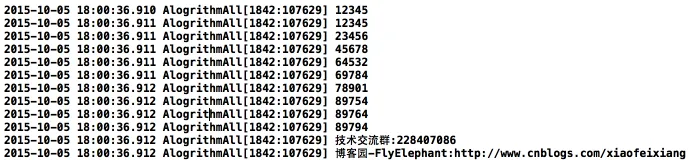
效果如下:
本文转自Fly_Elephant博客园博客,原文链接:http://www.cnblogs.com/xiaofeixiang/p/4855578.html,如需转载请自行联系原作者