Java NIO Overview

简介: Java Nio 1Java NIO Tutorial2Java NIO Overview3Java NIO Channel4Java NIO Buffer5Java NIO Scatter / Gather6Java NIO Channel t...


Java Nio 

1 Java NIO Tutorial
2 Java NIO Overview
3 Java NIO Channel
4 Java NIO Buffer
5 Java NIO Scatter / Gather
6 Java NIO Channel to Channel Transfers
7 Java NIO Selector
8 Java NIO FileChannel
9 Java NIO SocketChannel
10 Java NIO ServerSocketChannel
11 Java NIO DatagramChannel
12 Java NIO Pipe
13 Java NIO vs. IO

Java NIO Overview

 
By Jakob Jenkov
 Connect with me: 
Rate article:
Share article:

Java NIO consist of the following core components:

  • Channels
  • Buffers
  • Selectors

Java NIO has more classes and components than these, but the ChannelBuffer and Selector forms the core of the API, in my opinion. The rest of the components, like Pipe and FileLock are merely utility classes to be used in conjunction with the three core components. Therefore, I'll focus on these three components in this NIO overview. The other components are explained in their own texts elsewhere in this tutorial. See the menu at the top corner of this page.

Channels and Buffers

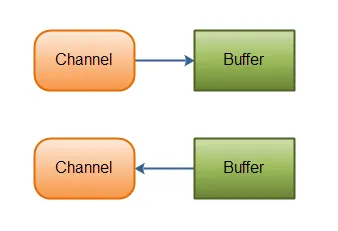
Typically, all IO in NIO starts with a Channel. A Channel is a bit like a stream. From the Channel data can be read into a Buffer. Data can also be written from a Buffer into a Channel. Here is an illustration of that:
Java NIO: Channels and Buffers
Java NIO: Channels read data into Buffers, and Buffers write data into Channels

There are several Channel and Buffer types. Here is a list of the primary Channel implementations in Java NIO:

  • FileChannel
  • DatagramChannel
  • SocketChannel
  • ServerSocketChannel

As you can see, these channels cover UDP + TCP network IO, and file IO.

There are a few interesting interfaces accompanying these classes too, but I'll keep them out of this Java NIO overview for simplicity's sake. They'll be explained where relevant, in other texts of this Java NIO tutorial.

Here is a list of the core Buffer implementations in Java NIO:

  • ByteBuffer
  • CharBuffer
  • DoubleBuffer
  • FloatBuffer
  • IntBuffer
  • LongBuffer
  • ShortBuffer

These Buffer's cover the basic data types that you can send via IO: byte, short, int, long, float, double and characters.

Java NIO also has a MappedByteBuffer which is used in conjunction with memory mapped files. I'll leave thisBuffer out of this overview though.

Selectors

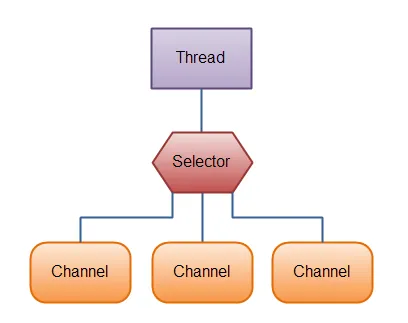
Selector allows a single thread to handle multiple Channel's. This is handy if your application has many connections (Channels) open, but only has low traffic on each connection. For instance, in a chat server.

Here is an illustration of a thread using a Selector to handle 3 Channel's:
Java NIO: Selectors
Java NIO: A Thread uses a Selector to handle 3 Channel's

To use a Selector you register the Channel's with it. Then you call it's select() method. This method will block until there is an event ready for one of the registered channels. Once the method returns, the thread can then process these events. Examples of events are incoming connection, data received etc.



目录
相关文章
|
Java 大数据
解析Java中的NIO与传统IO的区别与应用
|
监控 Java API
探索Java NIO:究竟在哪些领域能大显身手?揭秘原理、应用场景与官方示例代码
Java NIO(New IO)自Java SE 1.4引入,提供比传统IO更高效、灵活的操作,支持非阻塞IO和选择器特性,适用于高并发、高吞吐量场景。NIO的核心概念包括通道(Channel)、缓冲区(Buffer)和选择器(Selector),能实现多路复用和异步操作。其应用场景涵盖网络通信、文件操作、进程间通信及数据库操作等。NIO的优势在于提高并发性和性能,简化编程;但学习成本较高,且与传统IO存在不兼容性。尽管如此,NIO在构建高性能框架如Netty、Mina和Jetty中仍广泛应用。
661 3
|
存储 监控 Java
Java的NIO体系
通过本文的介绍,希望您能够深入理解Java NIO体系的核心组件、工作原理及其在高性能应用中的实际应用,并能够在实际开发中灵活运用这些知识,构建高效的Java应用程序。
535 5
|
缓存 网络协议 Java
JAVA网络IO之NIO/BIO
本文介绍了Java网络编程的基础与历史演进,重点阐述了IO和Socket的概念。Java的IO分为设备和接口两部分,通过流、字节、字符等方式实现与外部的交互。
544 0
|
存储 网络协议 Java
Java NIO 开发
本文介绍了Java NIO(New IO)及其主要组件,包括Channel、Buffer和Selector,并对比了NIO与传统IO的优势。文章详细讲解了FileChannel、SocketChannel、ServerSocketChannel、DatagramChannel及Pipe.SinkChannel和Pipe.SourceChannel等Channel实现类,并提供了示例代码。通过这些示例,读者可以了解如何使用不同类型的通道进行数据读写操作。
438 0
Java NIO 开发
|
消息中间件 缓存 Java
java nio,netty,kafka 中经常提到“零拷贝”到底是什么?
零拷贝技术 Zero-Copy 是指计算机执行操作时,可以直接从源(如文件或网络套接字)将数据传输到目标缓冲区, 而不需要 CPU 先将数据从某处内存复制到另一个特定区域,从而减少上下文切换以及 CPU 的拷贝时间。
java nio,netty,kafka 中经常提到“零拷贝”到底是什么?
|
Java
让星星⭐月亮告诉你,Java NIO之Buffer详解 属性capacity/position/limit/mark 方法put(X)/get()/flip()/compact()/clear()
这段代码演示了Java NIO中`ByteBuffer`的基本操作,包括分配、写入、翻转、读取、压缩和清空缓冲区。通过示例展示了`position`、`limit`和`mark`属性的变化过程,帮助理解缓冲区的工作原理。
269 2
|
网络协议 C# 开发者
WPF与Socket编程的完美邂逅:打造流畅网络通信体验——从客户端到服务器端,手把手教你实现基于Socket的实时数据交换
【8月更文挑战第31天】网络通信在现代应用中至关重要,Socket编程作为其实现基础,即便在主要用于桌面应用的Windows Presentation Foundation(WPF)中也发挥着重要作用。本文通过最佳实践,详细介绍如何在WPF应用中利用Socket实现网络通信,包括创建WPF项目、设计用户界面、实现Socket通信逻辑及搭建简单服务器端的全过程。具体步骤涵盖从UI设计到前后端交互的各个环节,并附有详尽示例代码,助力WPF开发者掌握这一关键技术,拓展应用程序的功能与实用性。
1104 1
|
Java
"揭秘Java IO三大模式:BIO、NIO、AIO背后的秘密!为何AIO成为高并发时代的宠儿,你的选择对了吗?"
【8月更文挑战第19天】在Java的IO编程中,BIO、NIO与AIO代表了三种不同的IO处理机制。BIO采用同步阻塞模型,每个连接需单独线程处理,适用于连接少且稳定的场景。NIO引入了非阻塞性质,利用Channel、Buffer与Selector实现多路复用,提升了效率与吞吐量。AIO则是真正的异步IO,在JDK 7中引入,通过回调或Future机制在IO操作完成后通知应用,适合高并发场景。选择合适的模型对构建高效网络应用至关重要。
531 2
|
安全 Java Linux
(七)Java网络编程-IO模型篇之从BIO、NIO、AIO到内核select、epoll剖析!
IO(Input/Output)方面的基本知识,相信大家都不陌生,毕竟这也是在学习编程基础时就已经接触过的内容,但最初的IO教学大多数是停留在最基本的BIO,而并未对于NIO、AIO、多路复用等的高级内容进行详细讲述,但这些却是大部分高性能技术的底层核心,因此本文则准备围绕着IO知识进行展开。
789 1