下载地址:http://pan38.cn/i1ab83a87
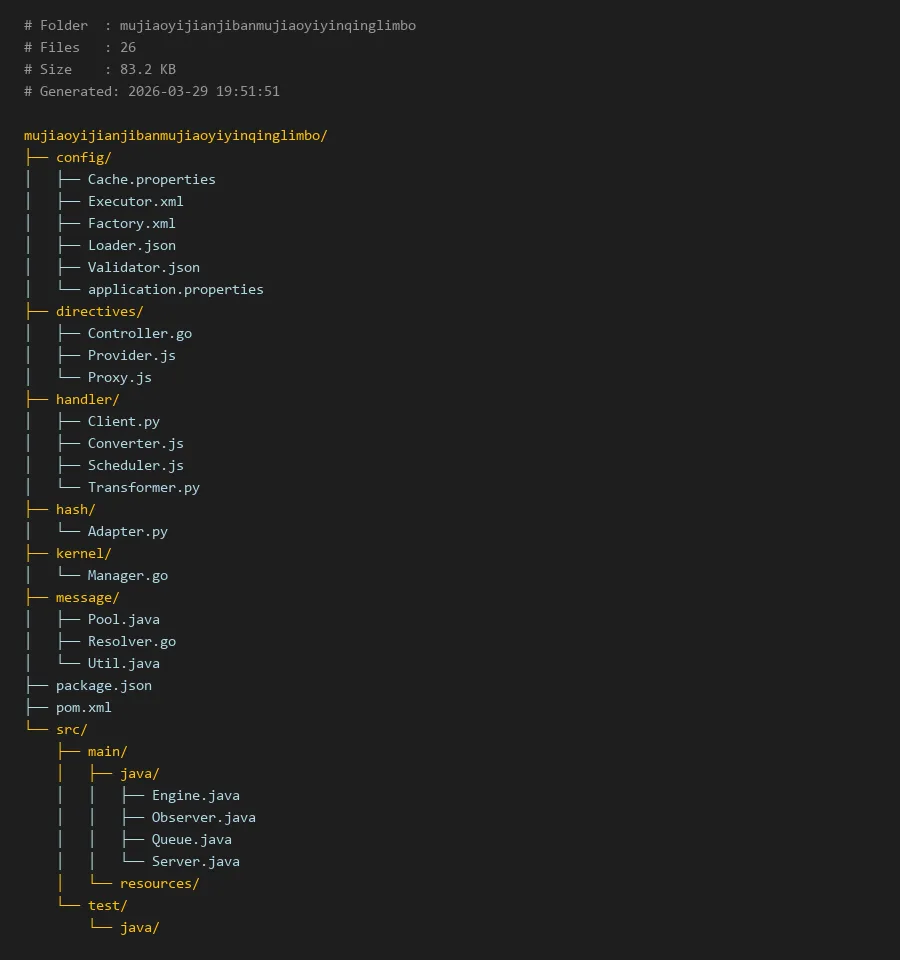
项目编译入口:
package.json
# Folder  : mujiaoyijianjibanmujiaoyiyinqinglimbo
# Files   : 26
# Size    : 83.2 KB
# Generated: 2026-03-29 19:51:51

mujiaoyijianjibanmujiaoyiyinqinglimbo/
├── config/
│   ├── Cache.properties
│   ├── Executor.xml
│   ├── Factory.xml
│   ├── Loader.json
│   ├── Validator.json
│   └── application.properties
├── directives/
│   ├── Controller.go
│   ├── Provider.js
│   └── Proxy.js
├── handler/
│   ├── Client.py
│   ├── Converter.js
│   ├── Scheduler.js
│   └── Transformer.py
├── hash/
│   └── Adapter.py
├── kernel/
│   └── Manager.go
├── message/
│   ├── Pool.java
│   ├── Resolver.go
│   └── Util.java
├── package.json
├── pom.xml
└── src/
    ├── main/
    │   ├── java/
    │   │   ├── Engine.java
    │   │   ├── Observer.java
    │   │   ├── Queue.java
    │   │   └── Server.java
    │   └── resources/
    └── test/
        └── java/
mujiaoyijianjibanmujiaoyiyinqinglimbo:一个轻量级模拟交易引擎
简介
mujiaoyijianjibanmujiaoyiyinqinglimbo(以下简称Limbo)是一个专为金融模拟交易设计的轻量级引擎核心。该项目采用模块化架构,支持多语言组件协同工作,特别适合作为股票模拟交易软件手机版的后端引擎。Limbo的核心设计理念是高性能、低延迟和易扩展,通过精心设计的文件结构,将配置管理、消息处理、业务逻辑等模块清晰分离。
核心模块说明
项目结构清晰地定义了引擎的各个职责域:
config/:存放所有配置文件,支持多种格式(properties, XML, JSON),用于管理缓存、线程池、依赖注入等。directives/:包含控制层和依赖提供层的关键组件,如控制器和代理。handler/:业务处理器,负责客户端请求、数据转换、任务调度等核心逻辑。hash/:提供数据适配功能,例如用于快速查询的哈希表适配器。kernel/:引擎内核,包含核心管理器,协调各模块运行。message/:消息中间件,处理请求与响应的解析与池化管理。
这种结构使得引擎可以轻松集成到不同的前端应用中,包括股票模拟交易软件手机版,为其提供稳定可靠的模拟交易能力。
代码示例
以下将展示几个关键模块的代码片段,以说明Limbo引擎的工作方式。
1. 配置加载(config/)
首先,让我们看看如何从application.properties加载基础配置。这里使用Java示例,但引擎支持多语言。
// 示例:ConfigLoader.java (位于项目根目录,用于演示)
import java.io.InputStream;
import java.util.Properties;

public class ConfigLoader {

    private Properties props;

    public ConfigLoader() {

        props = new Properties();
        try (InputStream input = getClass().getClassLoader()
                .getResourceAsStream("config/application.properties")) {

            if (input != null) {

                props.load(input);
            }
        } catch (Exception ex) {

            ex.printStackTrace();
        }
    }

    public String getProperty(String key) {

        return props.getProperty(key);
    }

    public static void main(String[] args) {

        ConfigLoader loader = new ConfigLoader();
        String appName = loader.getProperty("application.name");
        System.out.println("Loaded application: " + appName);
    }
}
2. 消息处理(message/)
消息池是处理高并发交易请求的关键。以下是一个简化的消息池实现片段。
// 对应 message/Pool.java 的核心逻辑
import java.util.concurrent.BlockingQueue;
import java.util.concurrent.LinkedBlockingQueue;

public class Pool {

    private BlockingQueue<Message> messageQueue;
    private int capacity;

    public Pool(int capacity) {

        this.capacity = capacity;
        this.messageQueue = new LinkedBlockingQueue<>(capacity);
    }

    public boolean offer(Message msg) {

        return messageQueue.offer(msg);
    }

    public Message poll() throws InterruptedException {

        return messageQueue.take();
    }

    public int size() {

        return messageQueue.size();
    }
}

class Message {

    private String type;
    private String content;
    // 省略getter/setter
}
3. 业务处理器(handler/)
调度器负责定时执行任务,如模拟盘的价格更新。以下是JavaScript版本的调度器核心。
// 对应 handler/Scheduler.js
class Scheduler {

    constructor(interval) {

        this.interval = interval; // 毫秒
        this.tasks = new Map();
        this.timer = null;
    }

    addTask(id, taskFn) {

        this.tasks.set(id, taskFn);
    }

    start() {

        if (this.timer) return;
        this.timer = setInterval(() => {

            for (let [id, task] of this.tasks) {

                try {

                    task();
                } catch (err) {

                    console.error(`Task ${
     id} error:`, err);
                }
            }
        }, this.interval);
    }

    stop() {

        if (this.timer) {

            clearInterval(this.timer);
            this.timer = null;
        }
    }
}

// 使用示例:模拟价格更新
const priceScheduler = new Scheduler(1000);
priceScheduler.addTask('updateStockPrice', () => {

    console.log('Updating simulated stock prices...');
});
priceScheduler.start();
4. 内核管理器(kernel/)
内核管理器是引擎的中枢,这里用Go语言展示其简化结构。
```go
// 对应 kernel/Manager.go
package kernel
import "fmt"
type Manager struct {
modules map[string]interface{}
running bool
}
func NewManager() *Manager {
return &Manager{
modules: make(map[string]interface{}),
running: false,
}
}
func (m *Manager) Register(name string, module interface{}) {
m.modules[name] = module
fmt.Printf("Module registered: %s\n", name)
}
func (m *Manager) Start() error {
if m.running {
return fmt.Errorf("manager is already running")
}
fmt.Println("Starting Limbo engine...")
// 初始化所有模块
for name, module := range m.modules {
fmt.Printf("Initializing %s\n", name)
// 实际初始化逻辑
}
m.running = true