spring线程池ThreadPoolExecutor配置并且得到任务执行的结果http://www.bieryun.com/1170.html

用的ThreadPoolExecutor的时候,又想知道被执行的任务的执行情况,这时就可以用FutureTask。
ThreadPoolTask
01 |
package com.zuidaima.threadpool; |
02 |
03 |
import java.io.Serializable; |
04 |
import java.util.concurrent.Callable; |
05 |
06 |
public class ThreadPoolTask implements Callable<String>, Serializable { |
07 |
08 |
private static final long serialVersionUID = 0; |
09 |
10 |
// 保存任务所需要的数据 |
11 |
private Object threadPoolTaskData; |
12 |
13 |
private static int consumeTaskSleepTime = 2000; |
14 |
15 |
public ThreadPoolTask(Object tasks) { |
16 |
this.threadPoolTaskData = tasks; |
17 |
} |
18 |
19 |
public synchronized String call() throws Exception { |
20 |
// 处理一个任务,这里的处理方式太简单了,仅仅是一个打印语句 |
21 |
System.out.println("开始执行任务:" + threadPoolTaskData); |
22 |
String result = ""; |
23 |
// //便于观察,等待一段时间 |
24 |
try { |
25 |
// long r = 5/0; |
26 |
for (int i = 0; i < 100000000; i++) { |
27 |
28 |
} |
29 |
result = "OK"; |
30 |
} catch (Exception e) { |
31 |
e.printStackTrace(); |
32 |
result = "ERROR"; |
33 |
} |
34 |
threadPoolTaskData = null; |
35 |
return result; |
36 |
} |
37 |
} |
模拟客户端提交的线程
01 |
package com.zuidaima.threadpool; |
02 |
03 |
import java.util.concurrent.ExecutionException; |
04 |
import java.util.concurrent.FutureTask; |
05 |
import java.util.concurrent.TimeUnit; |
06 |
07 |
import org.springframework.scheduling.concurrent.ThreadPoolTaskExecutor; |
08 |
09 |
public class StartTaskThread implements Runnable { |
10 |
11 |
private ThreadPoolTaskExecutor threadPoolTaskExecutor; |
12 |
private int i; |
13 |
14 |
public StartTaskThread(ThreadPoolTaskExecutor threadPoolTaskExecutor, int i) { |
15 |
this.threadPoolTaskExecutor = threadPoolTaskExecutor; |
16 |
this.i = i; |
17 |
} |
18 |
19 |
@Override |
20 |
public synchronized void run() { |
21 |
String task = "task@ " + i; |
22 |
System.out.println("创建任务并提交到线程池中:" + task); |
23 |
FutureTask<String> futureTask = new FutureTask<String>( |
24 |
new ThreadPoolTask(task)); |
25 |
threadPoolTaskExecutor.execute(futureTask); |
26 |
// 在这里可以做别的任何事情 |
27 |
String result = null; |
28 |
try { |
29 |
// 取得结果,同时设置超时执行时间为1秒。同样可以用future.get(),不设置执行超时时间取得结果 |
30 |
result = futureTask.get(1000, TimeUnit.MILLISECONDS); |
31 |
} catch (InterruptedException e) { |
32 |
futureTask.cancel(true); |
33 |
} catch (ExecutionException e) { |
34 |
futureTask.cancel(true); |
35 |
} catch (Exception e) { |
36 |
futureTask.cancel(true); |
37 |
// 超时后,进行相应处理 |
38 |
} finally { |
39 |
System.out.println("task@" + i + ":result=" + result); |
40 |
} |
41 |
42 |
} |
43 |
} |
SPRING配置文件
01 |
<?xml version="1.0" encoding="UTF-8"?> |
02 |
<beans xmlns="http://www.springframework.org/schema/beans" |
03 |
xmlns:xsi="http://www.w3.org/2001/XMLSchema-instance" xmlns:mvc="http://www.springframework.org/schema/mvc" |
04 |
xmlns:aop="http://www.springframework.org/schema/aop" xmlns:context="http://www.springframework.org/schema/context" |
05 |
xsi:schemaLocation=" |
06 |
http://www.springframework.org/schema/beans http://www.springframework.org/schema/beans/spring-beans-3.0.xsd |
07 |
http://www.springframework.org/schema/context http://www.springframework.org/schema/context/spring-context-3.0.xsd |
08 |
http://www.springframework.org/schema/mvc http://www.springframework.org/schema/mvc/spring-mvc-3.0.xsd |
09 |
http://www.springframework.org/schema/aop http://www.springframework.org/schema/aop/spring-aop-3.0.xsd |
10 |
"> |
11 |
<bean id="threadPoolTaskExecutor" |
12 |
class="org.springframework.scheduling.concurrent.ThreadPoolTaskExecutor"> |
13 |
14 |
<!-- 核心线程数,默认为1 --> |
15 |
<property name="corePoolSize" value="10" /> |
16 |
17 |
<!-- 最大线程数,默认为Integer.MAX_VALUE --> |
18 |
<property name="maxPoolSize" value="50" /> |
19 |
20 |
<!-- 队列最大长度,一般需要设置值>=notifyScheduledMainExecutor.maxNum;默认为Integer.MAX_VALUE |
21 |
<property name="queueCapacity" value="1000" /> --> |
22 |
23 |
<!-- 线程池维护线程所允许的空闲时间,默认为60s --> |
24 |
<property name="keepAliveSeconds" value="300" /> |
25 |
26 |
<!-- 线程池对拒绝任务(无线程可用)的处理策略,目前只支持AbortPolicy、CallerRunsPolicy;默认为后者 --> |
27 |
<property name="rejectedExecutionHandler"> |
28 |
<!-- AbortPolicy:直接抛出java.util.concurrent.RejectedExecutionException异常 --> |
29 |
<!-- CallerRunsPolicy:主线程直接执行该任务,执行完之后尝试添加下一个任务到线程池中,可以有效降低向线程池内添加任务的速度 --> |
30 |
<!-- DiscardOldestPolicy:抛弃旧的任务、暂不支持;会导致被丢弃的任务无法再次被执行 --> |
31 |
<!-- DiscardPolicy:抛弃当前任务、暂不支持;会导致被丢弃的任务无法再次被执行 --> |
32 |
<bean class="java.util.concurrent.ThreadPoolExecutor$CallerRunsPolicy" /> |
33 |
</property> |
34 |
</bean> |
35 |
</beans> |
测试类
01 |
package com.zuidaima.test; |
02 |
03 |
import org.junit.Test; |
04 |
import org.junit.runner.RunWith; |
05 |
import org.springframework.beans.factory.annotation.Autowired; |
06 |
import org.springframework.scheduling.concurrent.ThreadPoolTaskExecutor; |
07 |
import org.springframework.test.context.ContextConfiguration; |
08 |
import org.springframework.test.context.junit4.AbstractJUnit4SpringContextTests; |
09 |
import org.springframework.test.context.junit4.SpringJUnit4ClassRunner; |
10 |
11 |
import com.zuidaima.threadpool.StartTaskThread; |
12 |
13 |
@RunWith(SpringJUnit4ClassRunner.class) |
14 |
// 指定的运行runner,并且把你所指定的Runner作为参数传递给它 |
15 |
@ContextConfiguration(locations = "classpath*:applicationContext.xml") |
16 |
public class TestThreadPool extends AbstractJUnit4SpringContextTests { |
17 |
18 |
private static int produceTaskSleepTime = 10; |
19 |
20 |
private static int produceTaskMaxNumber = 1000; |
21 |
22 |
@Autowired |
23 |
private ThreadPoolTaskExecutor threadPoolTaskExecutor; |
24 |
25 |
public ThreadPoolTaskExecutor getThreadPoolTaskExecutor() { |
26 |
return threadPoolTaskExecutor; |
27 |
} |
28 |
29 |
public void setThreadPoolTaskExecutor( |
30 |
ThreadPoolTaskExecutor threadPoolTaskExecutor) { |
31 |
this.threadPoolTaskExecutor = threadPoolTaskExecutor; |
32 |
} |
33 |
34 |
@Test |
35 |
public void testThreadPoolExecutor() { |
36 |
for (int i = 1; i <= produceTaskMaxNumber; i++) { |
37 |
try { |
38 |
Thread.sleep(produceTaskSleepTime); |
39 |
} catch (InterruptedException e1) { |
40 |
e1.printStackTrace(); |
41 |
} |
42 |
new Thread(new StartTaskThread(threadPoolTaskExecutor, i)).start(); |
43 |
} |
44 |
45 |
} |
46 |
47 |
} |
原文中有些纰漏,我已经修改
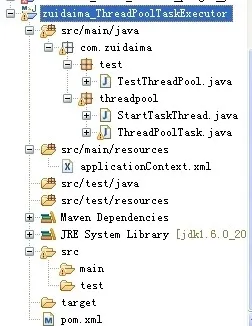
项目截图(基于行家构建)
运行截图:
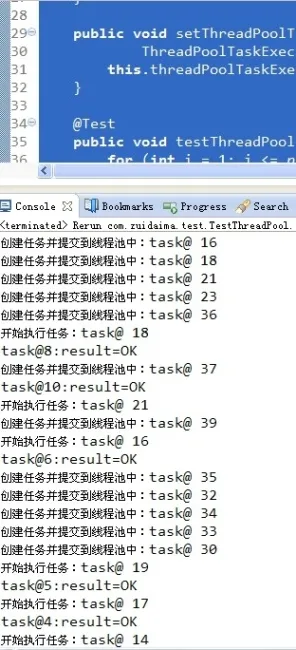
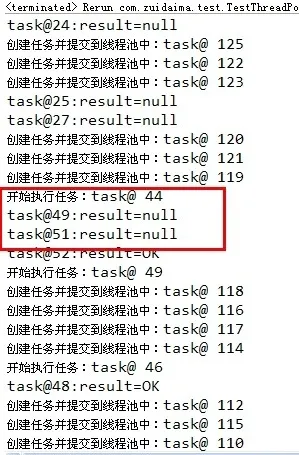
如果遇到CPU忙执行超过1秒的会返回空