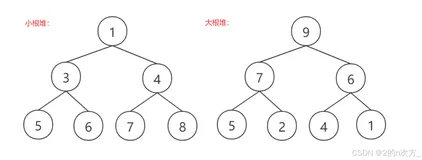
1。概念:堆是一种特殊的二叉树,具备以下两种性质
1)每个节点的值都大于(或者都小于,称为最小堆)其子节点的值
2)树是完全平衡的,并且最后一层的树叶都在最左边
这样就定义了一个最大堆。
2。堆可以用一个数组表示,有如下性质:
heap[i]>=heap[2*i+1] 其中0<=i<=(n-1)/2
heap[i]>=heap[2*i+2] 其中0<=i<=(n-2)/2
3。用数组实现堆,
1)插入操作
自顶向下,伪代码:
 heapEnqueue(el)
将el放在堆尾
while
el不在根节点并且el
>
parent(el)
交换el及其父节点
自底向上,伪代码:
FloydAlgrithm(data[])
for
i
=
最后一个非叶节点的下标,i
>=
0
;i
--
调用moveDown(data,i,n
-
1
)恢复以data[i]为根的树的堆性质
2)moveDown的方法实现,此方法是堆排序的关键,也是删除操作的关键。删除操作,将根节点删除,并把最末的树叶换到根节点,通过moveDown方法找到正确的位置,恢复堆性质。
4。堆的一个实现:
1)每个节点的值都大于(或者都小于,称为最小堆)其子节点的值
2)树是完全平衡的,并且最后一层的树叶都在最左边
这样就定义了一个最大堆。
2。堆可以用一个数组表示,有如下性质:
heap[i]>=heap[2*i+1] 其中0<=i<=(n-1)/2
heap[i]>=heap[2*i+2] 其中0<=i<=(n-2)/2
3。用数组实现堆,
1)插入操作
自顶向下,伪代码:
heapEnqueue(el) 将el放在堆尾
while
el不在根节点并且el
>
parent(el) 交换el及其父节点
自底向上,伪代码:
FloydAlgrithm(data[])
for
i
=
最后一个非叶节点的下标,i
>=
0
;i
--
调用moveDown(data,i,n
-
1
)恢复以data[i]为根的树的堆性质
2)moveDown的方法实现,此方法是堆排序的关键,也是删除操作的关键。删除操作,将根节点删除,并把最末的树叶换到根节点,通过moveDown方法找到正确的位置,恢复堆性质。
4。堆的一个实现:
// heap.java

// demonstrates heaps

// to run this program: C>java HeapApp

import java.io.*;

////////////////////////////////////////////////////////////////

class Node

{

private int iData;             // data item (key)

// -------------------------------------------------------------

public Node(int key)           // constructor

{ iData = key; }

// -------------------------------------------------------------

public int getKey()

{ return iData; }

// -------------------------------------------------------------

public void setKey(int id)

{ iData = id; }

// -------------------------------------------------------------

}  // end class Node

////////////////////////////////////////////////////////////////

class Heap

{

private Node[] heapArray;

private int maxSize;           // size of array

private int currentSize;       // number of nodes in array

// -------------------------------------------------------------

public Heap(int mx)            // constructor

{

maxSize = mx;

currentSize = 0;

heapArray = new Node[maxSize];  // create array

}

// -------------------------------------------------------------

public boolean isEmpty()

{ return currentSize==0; }

// -------------------------------------------------------------

public boolean insert(int key)

{

if(currentSize==maxSize)

return false;

Node newNode = new Node(key);

heapArray[currentSize] = newNode;

trickleUp(currentSize++);

return true;

}  // end insert()

// -------------------------------------------------------------

public void trickleUp(int index)

{

int parent = (index-1) / 2;

Node bottom = heapArray[index];


while( index > 0 &&

heapArray[parent].getKey() < bottom.getKey() )

{

heapArray[index] = heapArray[parent];  // move it down

index = parent;

parent = (parent-1) / 2;

}  // end while

heapArray[index] = bottom;

}  // end trickleUp()

// -------------------------------------------------------------

public Node remove()           // delete item with max key

{                           // (assumes non-empty list)

Node root = heapArray[0];

heapArray[0] = heapArray[--currentSize];

trickleDown(0);

return root;

}  // end remove()

// -------------------------------------------------------------

public void trickleDown(int index)

{

int largerChild;

Node top = heapArray[index];       // save root

while(index < currentSize/2)       // while node has at

{                               //    least one child,

int leftChild = 2*index+1;

int rightChild = leftChild+1;

// find larger child

if(rightChild < currentSize &&  // (rightChild exists?)

heapArray[leftChild].getKey() <

heapArray[rightChild].getKey())

largerChild = rightChild;

else

largerChild = leftChild;

// top >= largerChild?

if( top.getKey() >= heapArray[largerChild].getKey() )

break;

// shift child up

heapArray[index] = heapArray[largerChild];

index = largerChild;            // go down

}  // end while

heapArray[index] = top;            // root to index

}  // end trickleDown()

// -------------------------------------------------------------

public boolean change(int index, int newValue)

{

if(index<0 || index>=currentSize)

return false;

int oldValue = heapArray[index].getKey(); // remember old

heapArray[index].setKey(newValue);  // change to new


if(oldValue < newValue)             // if raised,

trickleUp(index);                // trickle it up

else                                // if lowered,

trickleDown(index);              // trickle it down

return true;

}  // end change()

// -------------------------------------------------------------

public void displayHeap()

{

System.out.print("heapArray: ");    // array format

for(int m=0; m<currentSize; m++)

if(heapArray[m] != null)

System.out.print( heapArray[m].getKey() + " ");

else

System.out.print( "-- ");

System.out.println();

// heap format

int nBlanks = 32;

int itemsPerRow = 1;

int column = 0;

int j = 0;                          // current item

String dots = "...............................";

System.out.println(dots+dots);      // dotted top line


while(currentSize > 0)              // for each heap item

{

if(column == 0)                  // first item in row?

for(int k=0; k<nBlanks; k++)  // preceding blanks

System.out.print(' ');

// display item

System.out.print(heapArray[j].getKey());


if(++j == currentSize)           // done?

break;


if(++column==itemsPerRow)        // end of row?

{

nBlanks /= 2;                 // half the blanks

itemsPerRow *= 2;             // twice the items

column = 0;                   // start over on

System.out.println();         //    new row

}

else                             // next item on row

for(int k=0; k<nBlanks*2-2; k++)

System.out.print(' ');     // interim blanks

}  // end for

System.out.println("/n"+dots+dots); // dotted bottom line

}  // end displayHeap()

// -------------------------------------------------------------

}  // end class Heap

////////////////////////////////////////////////////////////////

class HeapApp

{

public static void main(String[] args) throws IOException

{

int value, value2;

Heap theHeap = new Heap(31);  // make a Heap; max size 31

boolean success;


theHeap.insert(70);           // insert 10 items

theHeap.insert(40);

theHeap.insert(50);

theHeap.insert(20);

theHeap.insert(60);

theHeap.insert(100);

theHeap.insert(80);

theHeap.insert(30);

theHeap.insert(10);

theHeap.insert(90);


while(true)                   // until [Ctrl]-[C]

{

System.out.print("Enter first letter of ");

System.out.print("show, insert, remove, change: ");

int choice = getChar();

switch(choice)

{

case 's':                        // show

theHeap.displayHeap();

break;

case 'i':                        // insert

System.out.print("Enter value to insert: ");

value = getInt();

success = theHeap.insert(value);

if( !success )

System.out.println("Can't insert; heap full");

break;

case 'r':                        // remove

if( !theHeap.isEmpty() )

theHeap.remove();

else

System.out.println("Can't remove; heap empty");

break;

case 'c':                        // change

System.out.print("Enter current index of item: ");

value = getInt();

System.out.print("Enter new key: ");

value2 = getInt();

success = theHeap.change(value, value2);

if( !success )

System.out.println("Invalid index");

break;

default:

System.out.println("Invalid entry/n");

}  // end switch

}  // end while

}  // end main()

//-------------------------------------------------------------

public static String getString() throws IOException

{

InputStreamReader isr = new InputStreamReader(System.in);

BufferedReader br = new BufferedReader(isr);

String s = br.readLine();

return s;

}

//-------------------------------------------------------------

public static char getChar() throws IOException

{

String s = getString();

return s.charAt(0);

}

//-------------------------------------------------------------

public static int getInt() throws IOException

{

String s = getString();

return Integer.parseInt(s);

}

//-------------------------------------------------------------

}  // end class HeapApp

////////////////////////////////////////////////////////////////
文章转自庄周梦蝶 ,原文发布时间5.17