Android使用XML的方式为背景添加渐变,描边,圆角的效果

简介:

使用XML的方式为背景添加渐变的效果
首先,在res/Drawable 文件夹里面添加一个jbshape.xml文件,然后写入如下代码:
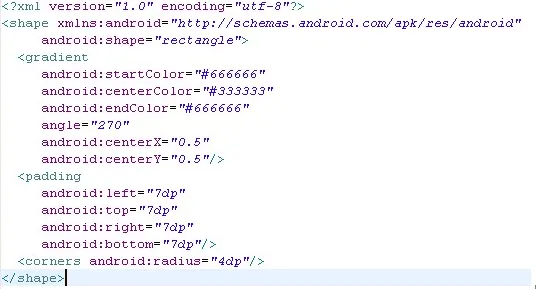

shape 节点配置的是图形的形式,主要包括方形、圆形等,上边代码为方形,

gradient 节点主要配置起点颜色、终点颜色及中间点的颜色、坐标、渐变效果(0,90,180从左到右渐变,270从上到下渐变)默认从左到右
padding 节点主要配置上下左右的间距

corners 节点配置四周园脚的半径

实现这个效果,需要定一个title.xml 内容如下:
复制代码
<?xml version=”1.0″ encoding=”UTF-8″?>
<LinearLayout xmlns:android=”http://schemas.android.com/apk/res/android”
android:orientation=”vertical”
android:layout_width=”fill_parent”
android:layout_height=”fill_parent”
android:background=”@drawable/jbshape”

android:paddingLeft=”0px”
>
复制代码


在实现背景渐变的帖子里

http://androidturing.iteye.com/blog/1238909

有朋友建议看看shape的用法,确实很有帮助。这里我偷懒转一篇比较详细的帖子,和大家一起进步~!

Android中常常使用shape来定义控件的一些显示属性,今天看了一些shape的使用,对shape有了大体的了解,稍作总结:
先看下面的代码:

复制到剪贴板  XML/HTML代码
  1. <shape> 
  2.     <!-- 实心 --> 
  3.     <solidandroid:color="#ff9d77"/> 
  4.     <!-- 渐变 --> 
  5.     <gradient 
  6.         android:startColor="#ff8c00" 
  7.         android:endColor="#FFFFFF" 
  8.         android:angle="270"/> 
  9.     <!-- 描边 --> 
  10.     <stroke 
  11.         android:width="2dp" 
  12.         android:color="#dcdcdc"/> 
  13.     <!-- 圆角 --> 
  14.     <corners 
  15.         android:radius="2dp"/> 
  16.     <padding 
  17.         android:left="10dp" 
  18.         android:top="10dp" 
  19.         android:right="10dp" 
  20.         android:bottom="10dp"/> 
  21. </shape> 


solid:实心,就是填充的意思 android:color指定填充的颜色
gradient:渐变 android:startColor和android:endColor分别为起始和结束颜色,ndroid:angle是渐变角度,必须为45的整数倍。 另外渐变默认的模式为android:type="linear",即线性渐变,可以指定渐变为径向渐变,android:type="radial",径向渐变需要指定半径android:gradientRadius="50"。
stroke:描边 android:width="2dp" 描边的宽度,android:color 描边的颜色。 我们还可以把描边弄成虚线的形式,设置方式为: android:dashWidth="5dp"
android:dashGap="3dp" 其中android:dashWidth表示'-'这样一个横线的宽度,android:dashGap表示之间隔开的距离。
corners:圆角 android:radius为角的弧度,值越大角越圆。 我们还可以把四个角设定成不同的角度,方法为:

XML/HTML代码
  1. <corners 
  2.  
  3.         android:topRightRadius="20dp"    右上角 
  4.         android:bottomLeftRadius="20dp"    右下角 
  5.         android:topLeftRadius="1dp"    左上角 
  6.         android:bottomRightRadius="0dp"    左下角 
  7. /> 

这里有个地方需要注意,bottomLeftRadius是右下角,而不是左下角,这个有点郁闷,不过不影响使用,记得别搞错了就行。 还有网上看到有人说设置成0dp无效,不过我在测试中发现是可以的,我用的是2.2,可能修复了这个问题吧,如果无效的话那就只能设成1dp了。
padding:间隔 这个就不用多说了,XML布局文件中经常用到。
大体的就是这样,以下是一个使用的具体示例:用在Selector中作为Button的背景,分别定义了按钮的一般状态、获得焦点状态和按下时的状态,具体代码如下:


 XML/HTML代码
  1. main.xml: 
  2. <Button 
  3.     android:layout_width="wrap_content" 
  4.     android:layout_height="wrap_content" 
  5.     android:text="TestShapeButton" 
  6.     android:background="@drawable/button_selector" 
  7.     /> 
  8. > 

button_selector.xml:


XML/HTML代码
  1. <?xmlversion="1.0"encoding="utf-8"?> 
  2. <selector 
  3.     xmlns:android="http://schemas.android.com/apk/res/android"> 
  4.     <itemandroid:state_pressed="true"> 
  5.         <shape> 
  6.             <!-- 渐变 --> 
  7.             <gradient 
  8.                 android:startColor="#ff8c00" 
  9.                 android:endColor="#FFFFFF" 
  10.                 android:type="radial" 
  11.                 android:gradientRadius="50"/> 
  12.             <!-- 描边 --> 
  13.             <stroke 
  14.                 android:width="2dp" 
  15.                 android:color="#dcdcdc" 
  16.                 android:dashWidth="5dp" 
  17.                 android:dashGap="3dp"/> 
  18.             <!-- 圆角 --> 
  19.             <corners 
  20.                 android:radius="2dp"/> 
  21.             <padding 
  22.                 android:left="10dp" 
  23.                 android:top="10dp" 
  24.                 android:right="10dp" 
  25.                 android:bottom="10dp"/> 
  26.         </shape> 
  27.     </item> 
  28.     <itemandroid:state_focused="true"> 
  29.         <shape> 
  30.             <gradient 
  31.                 android:startColor="#ffc2b7" 
  32.                 android:endColor="#ffc2b7" 
  33.                 android:angle="270"/> 
  34.             <stroke 
  35.                 android:width="2dp" 
  36.                 android:color="#dcdcdc"/> 
  37.             <corners 
  38.                 android:radius="2dp"/> 
  39.             <padding 
  40.                 android:left="10dp" 
  41.                 android:top="10dp" 
  42.                 android:right="10dp" 
  43.                 android:bottom="10dp"/> 
  44.         </shape> 
  45.     </item> 
  46.     <item>       
  47.         <shape> 
  48.             <solidandroid:color="#ff9d77"/> 
  49.             <stroke 
  50.                 android:width="2dp" 
  51.                 android:color="#fad3cf"/> 
  52.             <corners 
  53.                 android:topRightRadius="5dp" 
  54.                 android:bottomLeftRadius="5dp" 
  55.                 android:topLeftRadius="0dp" 
  56.                 android:bottomRightRadius="0dp" 
  57.             /> 
  58.             <padding 
  59.                 android:left="10dp" 
  60.                 android:top="10dp" 
  61.                 android:right="10dp" 
  62.                 android:bottom="10dp"/> 
  63.         </shape> 
  64.     </item> 
  65. </selector> 


运行效果如下图: 一般状态: 
获得焦点状态: 
按下状态: 

相关文章
|
Android开发
android全透明背景色: android 开发 背景常用透明度
|
Android开发 开发者
Android自定义View之不得不知道的文件attrs.xml(自定义属性)
本文详细介绍了如何通过自定义 `attrs.xml` 文件实现 Android 自定义 View 的属性配置。以一个包含 TextView 和 ImageView 的 DemoView 为例,讲解了如何使用自定义属性动态改变文字内容和控制图片显示隐藏。同时,通过设置布尔值和点击事件,实现了图片状态的切换功能。代码中展示了如何在构造函数中解析自定义属性,并通过方法 `setSetting0n` 和 `setbackeguang` 实现功能逻辑的优化与封装。此示例帮助开发者更好地理解自定义 View 的开发流程与 attrs.xml 的实际应用。
394 2
Android自定义View之不得不知道的文件attrs.xml(自定义属性)
|
XML API PHP
Android使用XML-RPC实现blog客户端
273 2
|
XML JavaScript Android开发
【Android】网络技术知识总结之WebView,HttpURLConnection,OKHttp,XML的pull解析方式
本文总结了Android中几种常用的网络技术,包括WebView、HttpURLConnection、OKHttp和XML的Pull解析方式。每种技术都有其独特的特点和适用场景。理解并熟练运用这些技术,可以帮助开发者构建高效、可靠的网络应用程序。通过示例代码和详细解释,本文为开发者提供了实用的参考和指导。
611 15
|
XML Android开发 UED
"掌握安卓开发新境界:深度解析AndroidManifest.xml中的Intent-filter配置,让你的App轻松响应scheme_url,开启无限交互可能!"
【8月更文挑战第2天】在安卓开发中,scheme_url 通过在`AndroidManifest.xml`中配置`Intent-filter`,使应用能响应特定URL启动或执行操作。基本配置下,应用可通过定义特定URL模式的`Intent-filter`响应相应链接。
565 12
|
存储 Java 数据库
基于全志H713 Android 11:给TvSettings添加default.xml默认值
本文介绍了在全志H713 Android 11平台上为TvSettings应用添加HDMI CEC功能的默认设置值的方法,通过修改SettingsProvider的源码和配置文件来实现默认值的设置,并提供了详细的步骤和测试结果。
916 0
基于全志H713 Android 11:给TvSettings添加default.xml默认值
|
Shell Android开发
安卓scheme_url调端:在AndroidManifest.xml 中如何配置 Intent-filter?
为了使Android应用响应vivo和oppo浏览器的Deep Link或自定义scheme调用,需在`AndroidManifest.xml`中配置`intent-filter`。定义启动的Activity及其支持的scheme和host,并确保Activity可由外部应用启动。示例展示了如何配置HTTP/HTTPS及自定义scheme,以及如何通过浏览器和adb命令进行测试,确保配置正确无误。
|
Android开发
Android中如何动态的调整Dialog的背景深暗
在Android开发中,Dialog和DialogFragment可通过设置`Window`的`backgroundDimAmount`来控制背景变暗,突出对话框。在DialogFragment的`onCreateDialog`或`onViewCreated`中,获取`Dialog`的`Window`,设置`LayoutParams.dimAmount`(例如0.5f)并添加`FLAG_DIM_BEHIND`标志。要动态调整,可保存`LayoutParams`并在需要时更新。对于Dialog,创建时直接设置同样属性。还可以通过定义主题样式设置背景模糊程度。
747 7
|
Android开发 开发者
Android UI设计中,Theme定义了Activity的视觉风格,包括颜色、字体、窗口样式等,定义在`styles.xml`。
【6月更文挑战第26天】Android UI设计中,Theme定义了Activity的视觉风格,包括颜色、字体、窗口样式等,定义在`styles.xml`。要更改主题,首先在该文件中创建新主题,如`MyAppTheme`,覆盖所需属性。然后,在`AndroidManifest.xml`中应用主题至应用或特定Activity。运行时切换主题可通过重新设置并重启Activity实现,或使用`setTheme`和`recreate()`方法。这允许开发者定制界面并与品牌指南匹配,或提供多主题选项。
500 6
|
XML 存储 JavaScript
50. 【Android教程】xml 数据解析
332 1

热门文章

最新文章