
R4-1
在Java中,一个类可同时定义许多同名的方法,这些方法的形式参数个数、类型或顺序各不相同,传回的值也可以不相同。这种面向对象程序的特性称为
重载|override
2 分
R4-2
请写出以下程序运行结果:
class Width {
    public static final int SINGLE = 1;
}
class Shape {
    public void draw(int Width) {
        System.out.println("Shape.draw()"+width);
    }
}
class Circle extends Shape {
    public void draw(Width n) {
        System.out.println("Circle.draw()");
    }
}
public class Test {
    public static void test(Shape s) {
        s.draw(Width.Single);
    }
    public static void main(String[] args) {
        Shape c = new Circle();
        test(c);
    }
}
Shape.draw()1
2 分
R4-3
设计一个动物声音“模拟器”,希望模拟器可以模拟许多动物的叫声,要求如下:
(1)编写接口Animal
Animal接口有2个抽象方法.
(2)编写实现Animal接口的Dog类。
(3)编写主类SimulateTest,在主类SimulateTest的main方法中编写程序进行测试,输出以下结果:
我的名字叫Bob
汪汪
答案:
第1空:interface ||
第2空:cry() ||
第3空: getName() ||
第4空:implements ||
第5空:String ||
第6空:this.name ||
第7空:public ||
第8空:return ||
第9空:SimulateTest ||
第10空:static ||
第11空:main ||
第12空:dog ||
第13空:Bob ||
第14空:getName() ||
第15空:dog ||
R4-4
请写出以下程序运行结果:
public class Test {
    private int i = 0;
    Test increment() {
        i++;
        return this.clone();
    }
    public Test clone() {
        Test t = new Test();
        t.i = i;
        return t;
    }
    public Test() { System.out.print(i); }
    void print() {
        System.out.printf("i = %d", i);
    }
    public static void main(String[] args) {
        Test x = new Test();
        for ( int i=0; i<10; i++ )
            x = x.increment();
        x.print();
    }
}
@@[00000000000i = 10](2)
2 分
R4-5
请写出以下程序运行结果:
package test;
public class Test {
   public static void main(String[] args) {
      Test t = new Test();
      t.show(new Car(){
         public void run(){
            System.out.println("test run");
         }
      });
   }
   public void show(Car c){
      c.run();
      c.show();
}}
abstract class Car{
   public void run(){
      System.out.println("car run");
   }
   public void show(){
       System.out.println(getClass().getName());
}}
test run
2 分
test.Test$1
2 分
R4-6
请写出以下程序运行结果:
class Foo {
    protected class Bar {
        protected Bar() { System.out.println("Foo.Bar"); }
    }
    private Bar b;
    Foo() {
        System.out.println("Foo");
        b = this.new Bar();
    }
}
class FooToo extends Foo  {
    protected class Bar {
        protected Bar() { System.out.println("FootToo.Bar"); }
    }
    public static void main(String[] args) {
        new FooToo();
    }
}
@@[Foo](2)
2 分
@@[Foo.Bar](2)
2 分
R4-7
若要使一个方法能不依赖与该类对象而存在,则需使用的关键字
static
2 分
R4-8
接口中的方法其默认属性为abstract
2 分
和public
R4-9
阅读下列程序:
 class Animal{
       Animal(){ System.out.println("我是动物"); }
       void  shout(){ System.out.println("动物叫"); }
}
class  Dog   extends   Animal{
         void   shout(){
                super.shout();
                System.out.println("汪汪");
          }
}
class  Cat   extends   Animal{
         void  shout(){ System.out.println("喵喵"; }
}
public   class   Test{
          public  static   void   main(String[]args){
                   Animal   dog=newDog();
                   Animal   cat=newCat();
                   dog.shout();
                   cat.shout();
           }
    }
按程序执行顺序输出结果:
(1)@@[我是动物](2)
(2)@@[我是动物](2)
(3)@@[动物叫](2)
(4)@@[汪汪](2)
(5)@@[喵喵](2)
R4-10
若需要定义一个类属性或类方法,应使用
static
2 分
修饰符
R4-11
编写Acount类和CheckingAccount类类AcountTest,具体要求如下:
(1) Account类表示账户对象,包含以下成员
①属性:
balance:私有,double型,表示账户余额;
②方法:
Account(), 构造方法,balance初始化为0;
Account(double balance),构造方法,用参数设置账户余额;
void setBalance(double balance):修改账户金额
double getBalance():返回账户金额
boolean withDraw(double money):从账户提取特定数额,如果余额不足,返回false;否则,修改余额,返回true;
void deposit(double money):向账户存储特定数额。
(2)编写一个Account类的子类CheckingAccount,表示支票账户对象,包含以下成员
①属性:
overdraft:私有,double型,表示透支限定额;
②方法:
CheckingAccount(), 构造方法,balance和overdraft都初始化为0;
CheckingAccount(double balance,double overdraft),构造方法,用参数设置账户编号、余额和透支限定额;
boolean withDraw(double money):从账户提取特定数额,如果超出透支限定额,返回false;否则,修改余额,返回true。
根据以上要求,完善下面的代码。
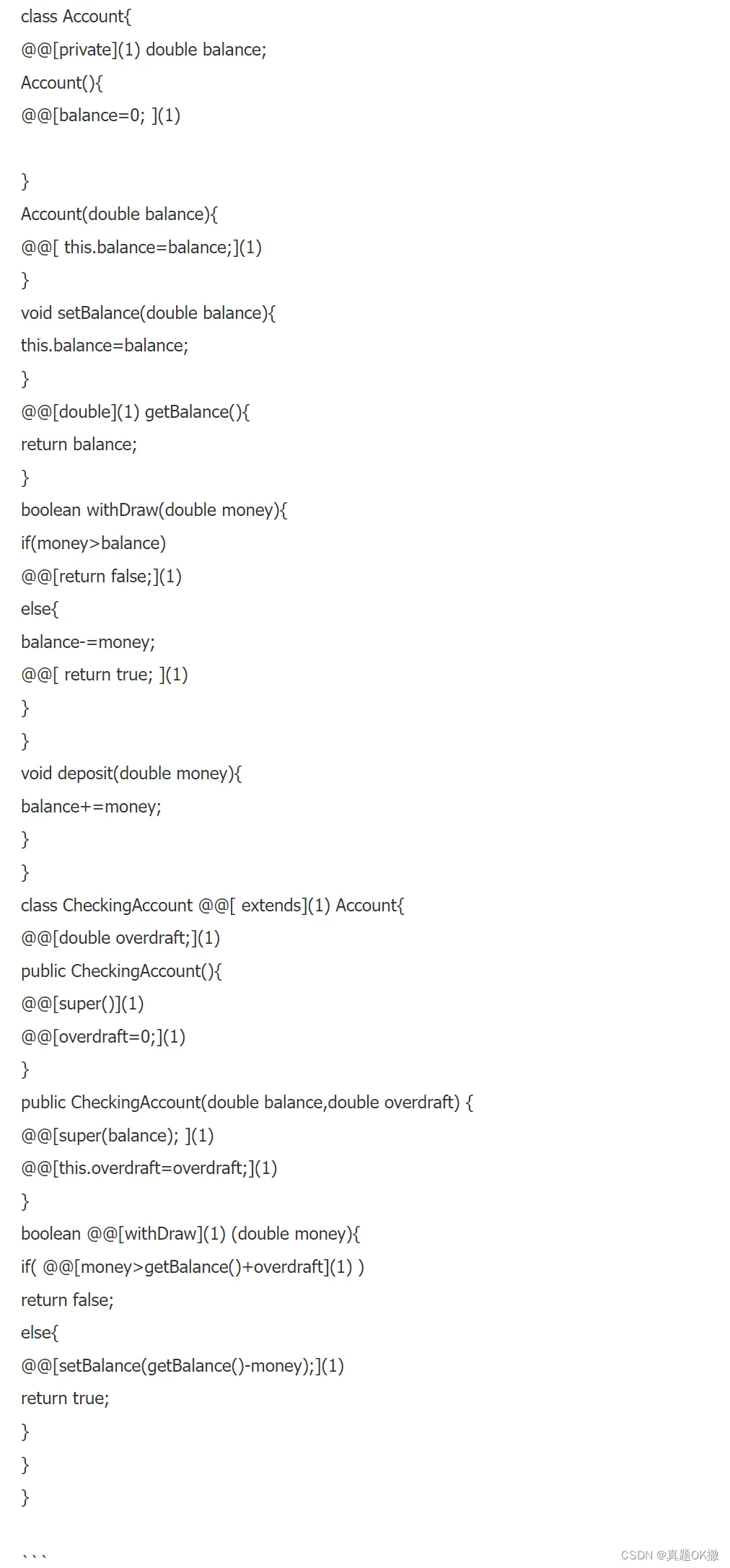
第1空:private ,
第2空:balance=0; ,
第3空: this.balance=balance; ,
第4空:double ,
第5空:return false; ,
第6空: return true; ,
第7空: extends ,
第8空:double overdraft; ,
第9空:super() ,
第10空:overdraft=0; ,
第11空:super(balance); ,
第12空:this.overdraft=overdraft; ,
第13空:withDraw ,
第14空:money>getBalance()+overdraft ,
第15空:setBalance(getBalance()-money); ,
R4-12
说出下列A类中【代码1】~【代码3】的输出结果
class  Fish { int weight=1; }
class  Lake{
   Fish  fish;
   void  setFish(Fish s) { fish=s; }
   void  foodFish(int m){  fish.weight=fish.weight+m; }
 }
 public  class  Main {
    public static void main(String args[]){
         Fish  redFish=new Fish();
         System.out.println(redFish.weight);//【代码1】
         Lake lake=new Lake();
         lake.setFish(redFish);
         lake.foodFish(120);
         System.out.println(redFish.weight);//【代码2】
         System.out.println(lake.fish.weight);//【代码3】
    }
}
【代码1】
1
2 分
【代码2】
121
2 分
【代码3】
121
2 分
R4-13
请写出以下程序运行结果:
class Letter {
    char c;
}
public class Main {
    static void f(Letter y) {
        y.c = 'z';
    }
    public static void main(String[] args) {
        Letter x = new Letter();
        x.c = 'a';
        f(x);
        System.out.println(x.c);
    }
}
z
2 分
R4-14
阅读以下程序,写出输出结果。
public  class   AppleMobilePhone   extends MobilePhone{
     public   static   void   main(String[] args){
           new  AppleMobilePhone();
     }
     public   AppleMobilePhone(){
           System.out.println("This is a Applemobilephone");
     }
}
class    MobilePhone   extends   Phone{
     public   MobilePhone(){
          System.out.println("This is a mobilephone");
     }
}
class   Phone{
     public   Phone(){
          System.out.println("This is a phone");
     }
}
程序运行后输出:
从下列选项中选,在空格处填上相应的序号数字(1、2或3)
(1)This is a phone
(2)This is a Apple mobile phone
(3)This is a mobile phone
第一行输出:
1
2 分
第二行输出:
3
2 分
第三行输出:
2
2 分
R4-15
For a class Class1 in Class1.java as below:
package Testpackage;
public class Class1{
… …
}
The main() is in MainPro.java as below:
import Testpackage.*;
… …
The CLASSPATH is "c:\java\lib\classes.zip;.; ". The MainPro.java is in c:\Testdir. The current directory is c:\Testdir. Where should we put the Class1.class?
c:\Testdir\Testpackage
2 分
R4-16
分析程序的运行结果
public class Father{
       String name,address,tel;
       int age;
       public Father(String name,int age){
                this.name=name;this.age=age;
       }
       void out(){
             System.out.println("姓名:"+name);
             System.out.println("年龄:"+age);
        }
        void outOther(){
              System.out.println("家庭住址:"+address);
               System.out.println("电话:"+tel);
        }
}
class Son extends Father{
       String school;
       public Son(String name,int age){  super(name,age); }
       void out(){
              super.out();
              super.outOther();
              System.out.println ("学校:"+school);
       }
       public static void main(String args[]){
              Son son=new Son("Tom",15);
              son.address="金水区";
              son.school="九中";
              son.tel="66123456";
              son.out();
    }
}
可选项:
(1)家庭住址:金水区
(2)电话:66123456
(3)学校:九中
(4)姓名:Tom
(5) 年龄:15
在下列空行中根据上述可选项按运行顺序写下运行结果(在空格中填入序号1、2、3、4或5):
第1空:4 ,
第2空:5 ,
第3空:1 ,
第4空:2 ,
第5空:3 ,
R4-17
请写出以下程序运行结果:
class ValHold{
        public int i = 10;
}
public class ObParm{
        public static void main(String argv[]){
                ObParm o = new ObParm();
                o.amethod();
        }
        public void amethod(){
                int i = 99;
                ValHold v = new ValHold();
                v.i=30;
                another(v,i);
                System.out.print( v.i );
        }
        public void another(ValHold v, int i){
                i=0;
                v.i = 20;
                ValHold vh = new ValHold();
                v =  vh;
                System.out.print(v.i);
        System.out.print(i);
        }
}
答案:
第1空:10020
2 分
