三、CV方向
1、《ImageNet Classification with Deep Convolutional Neural Networks》
Alex Krizhevsky University of Toronto Ilya Sutskever University of Toronto Geoffrey E. Hinton University of Toronto
REFERENCES
[1] R.M. Bell and Y. Koren. Lessons from the netflix prize challenge. ACM SIGKDD Explorations Newsletter,
9(2):75–79, 2007.
[2] A. Berg, J. Deng, and L. Fei-Fei. Large scale visual recognition challenge 2010. www.imagenet.org/challenges.
2010.
[3] L. Breiman. Random forests. Machine learning, 45(1):5–32, 2001.
[4] D. Cire¸san, U. Meier, and J. Schmidhuber. Multi-column deep neural networks for image classification.
Arxiv preprint arXiv:1202.2745, 2012.
[5] D.C. Cire¸san, U. Meier, J. Masci, L.M. Gambardella, and J. Schmidhuber. High-performance neural
networks for visual object classification. Arxiv preprint arXiv:1102.0183, 2011.
[6] J. Deng, W. Dong, R. Socher, L.-J. Li, K. Li, and L. Fei-Fei. ImageNet: A Large-Scale Hierarchical
Image Database. In CVPR09, 2009.
[7] J. Deng, A. Berg, S. Satheesh, H. Su, A. Khosla, and L. Fei-Fei. ILSVRC-2012, 2012. URL
http://www.image-net.org/challenges/LSVRC/2012/.
[8] L. Fei-Fei, R. Fergus, and P. Perona. Learning generative visual models from few training examples: An
incremental bayesian approach tested on 101 object categories. Computer Vision and Image Understanding,
106(1):59–70, 2007.
[9] G. Griffin, A. Holub, and P. Perona. Caltech-256 object category dataset. Technical Report 7694, California
Institute of Technology, 2007. URL http://authors.library.caltech.edu/7694.
[10] G.E. Hinton, N. Srivastava, A. Krizhevsky, I. Sutskever, and R.R. Salakhutdinov. Improving neural networks
by preventing co-adaptation of feature detectors. arXiv preprint arXiv:1207.0580, 2012.
[11] K. Jarrett, K. Kavukcuoglu, M. A. Ranzato, and Y. LeCun. What is the best multi-stage architecture for
object recognition? In International Conference on Computer Vision, pages 2146–2153. IEEE, 2009.
[12] A. Krizhevsky. Learning multiple layers of features from tiny images. Master’s thesis, Department of
Computer Science, University of Toronto, 2009.
[13] A. Krizhevsky. Convolutional deep belief networks on cifar-10. Unpublished manuscript, 2010.
[14] A. Krizhevsky and G.E. Hinton. Using very deep autoencoders for content-based image retrieval. In
ESANN, 2011.
[15] Y. Le Cun, B. Boser, J.S. Denker, D. Henderson, R.E. Howard, W. Hubbard, L.D. Jackel, et al. Handwritten
digit recognition with a back-propagation network. In Advances in neural information processing
systems, 1990.
[16] Y. LeCun, F.J. Huang, and L. Bottou. Learning methods for generic object recognition with invariance to
pose and lighting. In Computer Vision and Pattern Recognition, 2004. CVPR 2004. Proceedings of the
2004 IEEE Computer Society Conference on, volume 2, pages II–97. IEEE, 2004.
[17] Y. LeCun, K. Kavukcuoglu, and C. Farabet. Convolutional networks and applications in vision. In
Circuits and Systems (ISCAS), Proceedings of 2010 IEEE International Symposium on, pages 253–256.
IEEE, 2010.
[18] H. Lee, R. Grosse, R. Ranganath, and A.Y. Ng. Convolutional deep belief networks for scalable unsupervised
learning of hierarchical representations. In Proceedings of the 26th Annual International Conference
on Machine Learning, pages 609–616. ACM, 2009.
[19] T. Mensink, J. Verbeek, F. Perronnin, and G. Csurka. Metric Learning for Large Scale Image Classifi-
cation: Generalizing to New Classes at Near-Zero Cost. In ECCV - European Conference on Computer
Vision, Florence, Italy, October 2012.
[20] V. Nair and G. E. Hinton. Rectified linear units improve restricted boltzmann machines. In Proc. 27th
International Conference on Machine Learning, 2010.
[21] N. Pinto, D.D. Cox, and J.J. DiCarlo. Why is real-world visual object recognition hard? PLoS computational
biology, 4(1):e27, 2008.
[22] N. Pinto, D. Doukhan, J.J. DiCarlo, and D.D. Cox. A high-throughput screening approach to discovering
good forms of biologically inspired visual representation. PLoS computational biology, 5(11):e1000579,
2009.
[23] B.C. Russell, A. Torralba, K.P. Murphy, and W.T. Freeman. Labelme: a database and web-based tool for
image annotation. International journal of computer vision, 77(1):157–173, 2008.
[24] J. Sánchez and F. Perronnin. High-dimensional signature compression for large-scale image classification.
In Computer Vision and Pattern Recognition (CVPR), 2011 IEEE Conference on, pages 1665–1672. IEEE,
2011.
[25] P.Y. Simard, D. Steinkraus, and J.C. Platt. Best practices for convolutional neural networks applied to
visual document analysis. In Proceedings of the Seventh International Conference on Document Analysis
and Recognition, volume 2, pages 958–962, 2003.
[26] S.C. Turaga, J.F. Murray, V. Jain, F. Roth, M. Helmstaedter, K. Briggman, W. Denk, and H.S. Seung. Convolutional
networks can
2、《Faster R-CNN: Towards Real-Time Object Detection with Region Proposal Networks》
Shaoqing Ren, Kaiming He, Ross Girshick, and Jian Sun
REFERENCES
[1] K. He, X. Zhang, S. Ren, and J. Sun, “Spatial pyramid pooling
in deep convolutional networks for visual recognition,” in
European Conference on Computer Vision (ECCV), 2014.
[2] R. Girshick, “Fast R-CNN,” in IEEE International Conference on
Computer Vision (ICCV), 2015.
[3] K. Simonyan and A. Zisserman, “Very deep convolutionalnetworks for large-scale image recognition,” in International
Conference on Learning Representations (ICLR), 2015.
[4] J. R. Uijlings, K. E. van de Sande, T. Gevers, and A. W. Smeulders,
“Selective search for object recognition,” International
Journal of Computer Vision (IJCV), 2013.
[5] R. Girshick, J. Donahue, T. Darrell, and J. Malik, “Rich feature
hierarchies for accurate object detection and semantic segmentation,”
in IEEE Conference on Computer Vision and Pattern
Recognition (CVPR), 2014.
[6] C. L. Zitnick and P. Dollar, “Edge boxes: Locating object ´
proposals from edges,” in European Conference on Computer
Vision (ECCV), 2014.
[7] J. Long, E. Shelhamer, and T. Darrell, “Fully convolutional
networks for semantic segmentation,” in IEEE Conference on
Computer Vision and Pattern Recognition (CVPR), 2015.
[8] P. F. Felzenszwalb, R. B. Girshick, D. McAllester, and D. Ramanan,
“Object detection with discriminatively trained partbased
models,” IEEE Transactions on Pattern Analysis and Machine
Intelligence (TPAMI), 2010.
[9] P. Sermanet, D. Eigen, X. Zhang, M. Mathieu, R. Fergus,
and Y. LeCun, “Overfeat: Integrated recognition, localization
and detection using convolutional networks,” in International
Conference on Learning Representations (ICLR), 2014.
[10] S. Ren, K. He, R. Girshick, and J. Sun, “Faster R-CNN: Towards real-time object detection with region proposal networks,” in
Neural Information Processing Systems (NIPS), 2015.
[11] M. Everingham, L. Van Gool, C. K. I. Williams, J. Winn, and
A. Zisserman, “The PASCAL Visual Object Classes Challenge
2007 (VOC2007) Results,” 2007.
[12] T.-Y. Lin, M. Maire, S. Belongie, J. Hays, P. Perona, D. Ramanan,
P. Dollar, and C. L. Zitnick, “Microsoft COCO: Com- ´
mon Objects in Context,” in European Conference on Computer
Vision (ECCV), 2014.
[13] S. Song and J. Xiao, “Deep sliding shapes for amodal 3d object
detection in rgb-d images,” arXiv:1511.02300, 2015.
[14] J. Zhu, X. Chen, and A. L. Yuille, “DeePM: A deep part-based
model for object detection and semantic part localization,”
arXiv:1511.07131, 2015.
[15] J. Dai, K. He, and J. Sun, “Instance-aware semantic segmentation
via multi-task network cascades,” arXiv:1512.04412, 2015.
[16] J. Johnson, A. Karpathy, and L. Fei-Fei, “Densecap: Fully
convolutional localization networks for dense captioning,”
arXiv:1511.07571, 2015.
[17] D. Kislyuk, Y. Liu, D. Liu, E. Tzeng, and Y. Jing, “Human curation
and convnets: Powering item-to-item recommendations
on pinterest,” arXiv:1511.04003, 2015.
[18] K. He, X. Zhang, S. Ren, and J. Sun, “Deep residual learning
for image recognition,” arXiv:1512.03385, 2015.
[19] J. Hosang, R. Benenson, and B. Schiele, “How good are detection
proposals, really?” in British Machine Vision Conference
(BMVC), 2014.
[20] J. Hosang, R. Benenson, P. Dollar, and B. Schiele, “What makes ´
for effective detection proposals?” IEEE Transactions on Pattern
Analysis and Machine Intelligence (TPAMI), 2015.
[21] N. Chavali, H. Agrawal, A. Mahendru, and D. Batra,
“Object-Proposal Evaluation Protocol is ’Gameable’,” arXiv:
1505.05836, 2015.
[22] J. Carreira and C. Sminchisescu, “CPMC: Automatic object
segmentation using constrained parametric min-cuts,”
IEEE Transactions on Pattern Analysis and Machine Intelligence
(TPAMI), 2012.
[23] P. Arbelaez, J. Pont-Tuset, J. T. Barron, F. Marques, and J. Malik, ´
“Multiscale combinatorial grouping,” in IEEE Conference on
Computer Vision and Pattern Recognition (CVPR), 2014.
[24] B. Alexe, T. Deselaers, and V. Ferrari, “Measuring the objectness
of image windows,” IEEE Transactions on Pattern Analysis
and Machine Intelligence (TPAMI), 2012.
[25] C. Szegedy, A. Toshev, and D. Erhan, “Deep neural networks
for object detection,” in Neural Information Processing Systems
(NIPS), 2013.
[26] D. Erhan, C. Szegedy, A. Toshev, and D. Anguelov, “Scalable
object detection using deep neural networks,” in IEEE Conference
on Computer Vision and Pattern Recognition (CVPR), 2014.
[27] C. Szegedy, S. Reed, D. Erhan, and D. Anguelov, “Scalable,
high-quality object detection,” arXiv:1412.1441 (v1), 2015.
[28] P. O. Pinheiro, R. Collobert, and P. Dollar, “Learning to
segment object candidates,” in Neural Information Processing
Systems (NIPS), 2015.
[29] J. Dai, K. He, and J. Sun, “Convolutional feature masking
for joint object and stuff segmentation,” in IEEE Conference on
Computer Vision and Pattern Recognition (CVPR), 2015.
[30] S. Ren, K. He, R. Girshick, X. Zhang, and J. Sun, “Object
detection networks on convolutional feature maps,”
arXiv:1504.06066, 2015.
[31] J. K. Chorowski, D. Bahdanau, D. Serdyuk, K. Cho, and
Y. Bengio, “Attention-based models for speech recognition,”
in Neural Information Processing Systems (NIPS), 2015.
[32] M. D. Zeiler and R. Fergus, “Visualizing and understanding
convolutional neural networks,” in European Conference on
Computer Vision (ECCV), 2014.
[33] V. Nair and G. E. Hinton, “Rectified linear units improve
restricted boltzmann machines,” in International Conference on
Machine Learning (ICML), 2010.
[34] C. Szegedy, W. Liu, Y. Jia, P. Sermanet, S. Reed, D. Anguelov,
D. Erhan, and A. Rabinovich, “Going deeper with convolutions,”
in IEEE Conference on Computer Vision and Pattern
Recognition (CVPR), 2015.
[35] Y. LeCun, B. Boser, J. S. Denker, D. Henderson, R. E. Howard,
W. Hubbard, and L. D. Jackel, “Backpropagation applied to
handwritten zip code recognition,” Neural computation, 1989.
[36] O. Russakovsky, J. Deng, H. Su, J. Krause, S. Satheesh, S. Ma,
Z. Huang, A. Karpathy, A. Khosla, M. Bernstein, A. C. Berg,
and L. Fei-Fei, “ImageNet Large Scale Visual Recognition
Challenge,” in International Journal of Computer Vision (IJCV),
2015.
[37] A. Krizhevsky, I. Sutskever, and G. Hinton, “Imagenet classi-
fication with deep convolutional neural networks,” in Neural
Information Processing Systems (NIPS), 2012.
[38] Y. Jia, E. Shelhamer, J. Donahue, S. Karayev, J. Long, R. Girshick,
S. Guadarrama, and T. Darrell, “Caffe: Convolutional
architecture for fast feature embedding,” arXiv:1408.5093, 2014.
[39] K. Lenc and A. Vedaldi, “R-CNN minus R,” in British Machine
Vision Conference (BMVC), 2015.
3、《Mask R-CNN》
Kaiming He Georgia Gkioxari Piotr Dollar Ross Girshick ´
Facebook AI Research (FAIR)
References
[1] M. Andriluka, L. Pishchulin, P. Gehler, and B. Schiele. 2D
human pose estimation: New benchmark and state of the art
analysis. In CVPR, 2014. 8
[2] P. Arbelaez, J. Pont-Tuset, J. T. Barron, F. Marques, and ´
J. Malik. Multiscale combinatorial grouping. In CVPR,
2014. 2
[3] A. Arnab and P. H. Torr. Pixelwise instance segmentation
with a dynamically instantiated network. In CVPR, 2017. 3,
9
[4] M. Bai and R. Urtasun. Deep watershed transform for instance
segmentation. In CVPR, 2017. 3, 9
[5] S. Bell, C. L. Zitnick, K. Bala, and R. Girshick. Insideoutside
net: Detecting objects in context with skip pooling
and recurrent neural networks. In CVPR, 2016. 5
[6] Z. Cao, T. Simon, S.-E. Wei, and Y. Sheikh. Realtime multiperson
2d pose estimation using part affinity fields. In CVPR,
2017. 7, 8
[7] M. Cordts, M. Omran, S. Ramos, T. Rehfeld, M. Enzweiler,
R. Benenson, U. Franke, S. Roth, and B. Schiele. The
Cityscapes dataset for semantic urban scene understanding.
In CVPR, 2016. 9
[8] J. Dai, K. He, Y. Li, S. Ren, and J. Sun. Instance-sensitive
fully convolutional networks. In ECCV, 2016. 2
[9] J. Dai, K. He, and J. Sun. Convolutional feature masking for
joint object and stuff segmentation. In CVPR, 2015. 2
[10] J. Dai, K. He, and J. Sun. Instance-aware semantic segmentation
via multi-task network cascades. In CVPR, 2016. 2, 3,
4, 5, 6
[11] J. Dai, Y. Li, K. He, and J. Sun. R-FCN: Object detection via
region-based fully convolutional networks. In NIPS, 2016. 2
[12] R. Girshick. Fast R-CNN. In ICCV, 2015. 1, 2, 3, 4, 6
[13] R. Girshick, J. Donahue, T. Darrell, and J. Malik. Rich feature
hierarchies for accurate object detection and semantic
segmentation. In CVPR, 2014. 2, 3
[14] R. Girshick, F. Iandola, T. Darrell, and J. Malik. Deformable
part models are convolutional neural networks. In CVPR,
2015. 4
[15] B. Hariharan, P. Arbelaez, R. Girshick, and J. Malik. Simul- ´
taneous detection and segmentation. In ECCV. 2014. 2
[16] B. Hariharan, P. Arbelaez, R. Girshick, and J. Malik. Hyper- ´
columns for object segmentation and fine-grained localization.
In CVPR, 2015. 2
[17] Z. Hayder, X. He, and M. Salzmann. Shape-aware instance
segmentation. In CVPR, 2017. 9
[18] K. He, X. Zhang, S. Ren, and J. Sun. Spatial pyramid pooling
in deep convolutional networks for visual recognition. In
ECCV. 2014. 1, 2
[19] K. He, X. Zhang, S. Ren, and J. Sun. Deep residual learning
for image recognition. In CVPR, 2016. 2, 4, 7, 10
[20] J. Hosang, R. Benenson, P. Dollar, and B. Schiele. What ´
makes for effective detection proposals? PAMI, 2015. 2
[21] J. Huang, V. Rathod, C. Sun, M. Zhu, A. Korattikara,
A. Fathi, I. Fischer, Z. Wojna, Y. Song, S. Guadarrama, et al.
Speed/accuracy trade-offs for modern convolutional object
detectors. In CVPR, 2017. 2, 3, 4, 6, 7
[22] M. Jaderberg, K. Simonyan, A. Zisserman, and
K. Kavukcuoglu. Spatial transformer networks. In
NIPS, 2015. 4
[23] A. Kirillov, E. Levinkov, B. Andres, B. Savchynskyy, and
C. Rother. Instancecut: from edges to instances with multicut.
In CVPR, 2017. 3, 9
[24] A. Krizhevsky, I. Sutskever, and G. Hinton. ImageNet classification
with deep convolutional neural networks. In NIPS,
2012. 2
[25] Y. LeCun, B. Boser, J. S. Denker, D. Henderson, R. E.
Howard, W. Hubbard, and L. D. Jackel. Backpropagation
applied to handwritten zip code recognition. Neural computation,
1989. 2
[26] Y. Li, H. Qi, J. Dai, X. Ji, and Y. Wei. Fully convolutional
instance-aware semantic segmentation. In CVPR, 2017. 2,
3, 5, 6
[27] T.-Y. Lin, P. Dollar, R. Girshick, K. He, B. Hariharan, and ´
S. Belongie. Feature pyramid networks for object detection.
In CVPR, 2017. 2, 4, 5, 7
[28] T.-Y. Lin, M. Maire, S. Belongie, J. Hays, P. Perona, D. Ramanan,
P. Dollar, and C. L. Zitnick. Microsoft COCO: Com- ´
mon objects in context. In ECCV, 2014. 2, 5
[29] S. Liu, J. Jia, S. Fidler, and R. Urtasun. SGN: Sequential
grouping networks for instance segmentation. In ICCV,
2017. 3, 9
[30] J. Long, E. Shelhamer, and T. Darrell. Fully convolutional
networks for semantic segmentation. In CVPR, 2015. 1, 3, 6
[31] V. Nair and G. E. Hinton. Rectified linear units improve restricted
boltzmann machines. In ICML, 2010. 4
[32] G. Papandreou, T. Zhu, N. Kanazawa, A. Toshev, J. Tompson,
C. Bregler, and K. Murphy. Towards accurate multiperson
pose estimation in the wild. In CVPR, 2017. 8
[33] P. O. Pinheiro, R. Collobert, and P. Dollar. Learning to segment
object candidates. In NIPS, 2015. 2, 3
[34] P. O. Pinheiro, T.-Y. Lin, R. Collobert, and P. Dollar. Learn- ´
ing to refine object segments. In ECCV, 2016. 2, 3
[35] I. Radosavovic, P. Dollar, R. Girshick, G. Gkioxari, and ´
K. He. Data distillation: Towards omni-supervised learning.
arXiv:1712.04440, 2017. 10
[36] S. Ren, K. He, R. Girshick, and J. Sun. Faster R-CNN: Towards
real-time object detection with region proposal networks.
In NIPS, 2015. 1, 2, 3, 4, 7
[37] S. Ren, K. He, R. Girshick, and J. Sun. Faster R-CNN: Towards
real-time object detection with region proposal networks.
In TPAMI, 2017. 10
[38] A. Shrivastava, A. Gupta, and R. Girshick. Training regionbased
object detectors with online hard example mining. In
CVPR, 2016. 2, 5
[39] A. Shrivastava, R. Sukthankar, J. Malik, and A. Gupta. Beyond
skip connections: Top-down modulation for object detection.
arXiv:1612.06851, 2016. 4, 7
[40] C. Sun, A. Shrivastava, S. Singh, and A. Gupta. Revisiting
unreasonable effectiveness of data in deep learning era. In
ICCV, 2017. 10
[41] C. Szegedy, S. Ioffe, and V. Vanhoucke. Inception-v4,
inception-resnet and the impact of residual connections on
learning. In ICLR Workshop, 2016. 7
[42] J. R. Uijlings, K. E. van de Sande, T. Gevers, and A. W.
Smeulders. Selective search for object recognition. IJCV,
2013. 2
[43] X. Wang, R. Girshick, A. Gupta, and K. He. Non-local neural
networks. arXiv:1711.07971, 2017. 10
[44] S.-E. Wei, V. Ramakrishna, T. Kanade, and Y. Sheikh. Convolutional
pose machines. In CVPR, 2016. 8
[45] S. Xie, R. Girshick, P. Dollar, Z. Tu, and K. He. Aggregated ´
residual transformations for deep neural networks. In CVPR,
2017. 4, 10
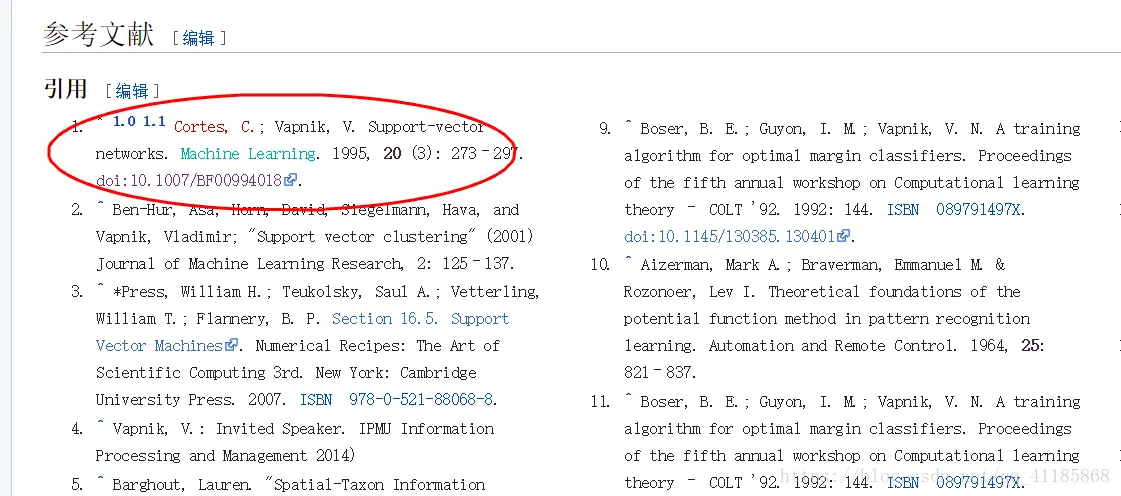
论文导出文献引用正确格式的几个方法
1、使用百度学术

2、Google维基百科