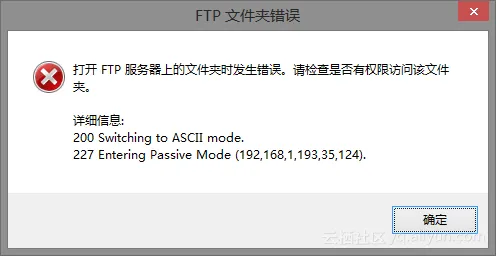
1、阿里云Centos7.4配置完vsftpd,windows文件浏览器和IE浏览器不能访问,但是浏览器或FileZilla能正常访问。
2、解决办法
在/etc/vsftpd/vsftpd.conf中添加被动模式的参数:
pasv_address=*.*.*.* #这里是你服务器的IPv4地址
pasv_enable=YES
pasv_min_port=9000
pasv_max_port=9099
#端口方位也可以自己定义,且要添加安全组
还需要对下面两个listen参数进行修改
listen=YES
listen_ipv6=NO
3、个人理解
ECS服务器有共有IP和私有IP,用ifconfig查看ip是显示的是私有IP。
当不设置pasv_address的时候PASV模式返回的地址是内网地址。
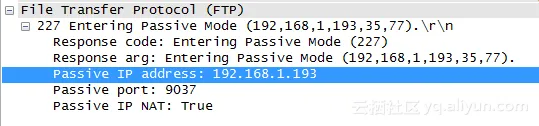
而且默认yum安装的ftp,listen_ipv6=YES,因此设置的IPV4地址将被忽略,所以还需要设置listen_ipv6=NO。
4、参考链接
(1)https://yq.aliyun.com/articles/80449#modal-login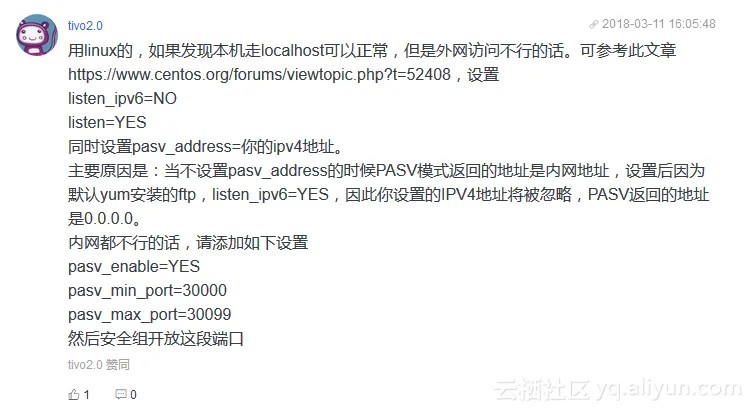
(2)https://www.centos.org/forums/viewtopic.php?t=52408
5、完整的vsftpd.conf
    # Example config file /etc/vsftpd/vsftpd.conf
    #
    # The default compiled in settings are fairly paranoid. This sample file
    # loosens things up a bit, to make the ftp daemon more usable.
    # Please see vsftpd.conf.5 for all compiled in defaults.
    #
    # READ THIS: This example file is NOT an exhaustive list of vsftpd options.
    # Please read the vsftpd.conf.5 manual page to get a full idea of vsftpd's
    # capabilities.
    #
    # Allow anonymous FTP? (Beware - allowed by default if you comment this out).
    anonymous_enable=YES
    #
    # Uncomment this to allow local users to log in.
    # When SELinux is enforcing check for SE bool ftp_home_dir
    local_enable=YES
    #
    # Uncomment this to enable any form of FTP write command.
    write_enable=YES
    #
    # Default umask for local users is 077. You may wish to change this to 022,
    # if your users expect that (022 is used by most other ftpd's)
    local_umask=022
    #
    # Uncomment this to allow the anonymous FTP user to upload files. This only
    # has an effect if the above global write enable is activated. Also, you will
    # obviously need to create a directory writable by the FTP user.
    # When SELinux is enforcing check for SE bool allow_ftpd_anon_write, allow_ftpd_full_access
    #anon_upload_enable=YES
    #
    # Uncomment this if you want the anonymous FTP user to be able to create
    # new directories.
    #anon_mkdir_write_enable=YES
    #
    # Activate directory messages - messages given to remote users when they
    # go into a certain directory.
    dirmessage_enable=YES
    #
    # Activate logging of uploads/downloads.
    xferlog_enable=YES
    #
    # Make sure PORT transfer connections originate from port 20 (ftp-data).
    connect_from_port_20=YES
    #
    # If you want, you can arrange for uploaded anonymous files to be owned by
    # a different user. Note! Using "root" for uploaded files is not
    # recommended!
    #chown_uploads=YES
    #chown_username=whoever
    #
    # You may override where the log file goes if you like. The default is shown
    # below.
    #xferlog_file=/var/log/xferlog
    #
    # If you want, you can have your log file in standard ftpd xferlog format.
    # Note that the default log file location is /var/log/xferlog in this case.
    xferlog_std_format=YES
    #
    # You may change the default value for timing out an idle session.
    #idle_session_timeout=600
    #
    # You may change the default value for timing out a data connection.
    #data_connection_timeout=120
    #
    # It is recommended that you define on your system a unique user which the
    # ftp server can use as a totally isolated and unprivileged user.
    #nopriv_user=ftpsecure
    #
    # Enable this and the server will recognise asynchronous ABOR requests. Not
    # recommended for security (the code is non-trivial). Not enabling it,
    # however, may confuse older FTP clients.
    #async_abor_enable=YES
    #
    # By default the server will pretend to allow ASCII mode but in fact ignore
    # the request. Turn on the below options to have the server actually do ASCII
    # mangling on files when in ASCII mode.
    # Beware that on some FTP servers, ASCII support allows a denial of service
    # attack (DoS) via the command "SIZE /big/file" in ASCII mode. vsftpd
    # predicted this attack and has always been safe, reporting the size of the
    # raw file.
    # ASCII mangling is a horrible feature of the protocol.
    #ascii_upload_enable=YES
    #ascii_download_enable=YES
    #
    # You may fully customise the login banner string:
    #ftpd_banner=Welcome to blah FTP service.
    #
    # You may specify a file of disallowed anonymous e-mail addresses. Apparently
    # useful for combatting certain DoS attacks.
    #deny_email_enable=YES
    # (default follows)
    #banned_email_file=/etc/vsftpd/banned_emails
    #
    # You may specify an explicit list of local users to chroot() to their home
    # directory. If chroot_local_user is YES, then this list becomes a list of
    # users to NOT chroot().
    # (Warning! chroot'ing can be very dangerous. If using chroot, make sure that
    # the user does not have write access to the top level directory within the
    # chroot)
    #chroot_local_user=YES
    #chroot_list_enable=YES
    # (default follows)
    #chroot_list_file=/etc/vsftpd/chroot_list
    #
    # You may activate the "-R" option to the builtin ls. This is disabled by
    # default to avoid remote users being able to cause excessive I/O on large
    # sites. However, some broken FTP clients such as "ncftp" and "mirror" assume
    # the presence of the "-R" option, so there is a strong case for enabling it.
    #ls_recurse_enable=YES
    #
    # When "listen" directive is enabled, vsftpd runs in standalone mode and
    # listens on IPv4 sockets. This directive cannot be used in conjunction
    # with the listen_ipv6 directive.
    listen=YES
    #
    # This directive enables listening on IPv6 sockets. By default, listening
    # on the IPv6 "any" address (::) will accept connections from both IPv6
    # and IPv4 clients. It is not necessary to listen on *both* IPv4 and IPv6
    # sockets. If you want that (perhaps because you want to listen on specific
    # addresses) then you must run two copies of vsftpd with two configuration
    # files.
    # Make sure, that one of the listen options is commented !!
    listen_ipv6=NO

    pam_service_name=vsftpd
    userlist_enable=YES
    tcp_wrappers=YES


    pasv_address=*.*.*.*
    pasv_enable=YES
    pasv_min_port=9000
    pasv_max_port=9099

    dual_log_enable=YES
    vsftpd_log_file=/var/log/vsftpd.log