1.比较重要的注解
@SPI:扩展点接口的标识 :作用域在类上;
@Adaptive:为生成Adaptive实例提供参数,作用域在类或方法上;
Adatpive,字面意思是个适配,但其实是个代理,它的意思是适配合适的对象处理请求。类似jdk的动态代理,因为dubbo底层会大量使用反射,出于性能考虑会默认使用javassist字节码编译生成一个adaptive拦截所有请求,然后由它基于策略动态委派合适的provider进行处理。
SPI接口会动态编译出一个adaptive,用于适配provider处理请求。用户可以自己实现一个adaptive,只需要对某个provider打上@adaptive即可,例如Dubbo自身的AdaptiveExtensionFactory类。
对于默认编译生成Adaptive的方案,需要使用@Adaptive声明接口上的哪些方法是adaptive方法,没有被声明的方法如果被请求会抛出异常非adaptive方法的异常
@Activate:可以被框架中自动激活加载扩展,此Annotation用于配置扩展被自动激活加载条件。
Activate,看起来有点不好理解,它的意思是条件激活,用户通过group和value配置激活条件。被activate注解的扩展点在满足某种条件时会被激活,它一般用来配合filter和Invokelistener,声明他们的使用场景。
1.1 测试对象代码
|
1
2
3
4
5
6
7
8
9
10
11
12
13
14
15
16
17
18
19
20
21
22
23
24
25
26
27
28
29
30
31
32
33
34
35
36
37
38
39
40
41
42
43
44
45
46
47
48
49
50
51
52
53
54
55
56
57
58
|
#
1
.声明SPI 默认为imp1
@SPI
(
"impl1"
)
public
interface
SimpleExt {
// 没有使用key的@Adaptive !
@Adaptive
String echo(URL url, String s);
@Adaptive
({
"key1"
,
"key2"
})
String yell(URL url, String s);
// 无@Adaptive !
String bang(URL url,
int
i);
}
//实现类1
public
class
SimpleExtImpl1
implements
SimpleExt {
public
String echo(URL url, String s) {
return
"Ext1Impl1-echo"
;
}
public
String yell(URL url, String s) {
return
"Ext1Impl1-yell"
;
}
public
String bang(URL url,
int
i) {
return
"bang1"
;
}
}
//实现类2
public
class
SimpleExtImpl2
implements
SimpleExt {
public
String echo(URL url, String s) {
return
"Ext1Impl2-echo"
;
}
public
String yell(URL url, String s) {
return
"Ext1Impl2-yell"
;
}
public
String bang(URL url,
int
i) {
return
"bang2"
;
}
}
//实现类3
public
class
SimpleExtImpl3
implements
SimpleExt {
public
String echo(URL url, String s) {
return
"Ext1Impl3-echo"
;
}
public
String yell(URL url, String s) {
return
"Ext1Impl3-yell"
;
}
public
String bang(URL url,
int
i) {
return
"bang3"
;
}
}
|
1.2 配置文件com.alibaba.dubbo.common.extensionloader.ext1.SimpleExt
位置要放在如下位置
|
1
2
3
4
5
|
private
static
final
String SERVICES_DIRECTORY =
"META-INF/services/"
;
private
static
final
String DUBBO_DIRECTORY =
"META-INF/dubbo/"
;
private
static
final
String DUBBO_INTERNAL_DIRECTORY = DUBBO_DIRECTORY +
"internal/"
;
|
具体内容如下
|
1
2
3
4
|
# Comment 1
impl1=com.alibaba.dubbo.common.extensionloader.ext1.impl.SimpleExtImpl1#Hello World
impl2=com.alibaba.dubbo.common.extensionloader.ext1.impl.SimpleExtImpl2 # Comment 2
impl3=com.alibaba.dubbo.common.extensionloader.ext1.impl.SimpleExtImpl3 # with head space
|
定义3个实现。
1.4 测试
|
1
2
3
4
5
6
7
8
|
@Test
public
void
test_getDefaultExtension()
throws
Exception {
SimpleExt ext = ExtensionLoader.getExtensionLoader(SimpleExt.
class
).getDefaultExtension();
assertThat(ext, instanceOf(SimpleExtImpl1.
class
));
String name = ExtensionLoader.getExtensionLoader(SimpleExt.
class
).getDefaultExtensionName();
assertEquals(
"impl1"
, name);
}
|
由于@SPI("impl1"),定义了默认实现的名称为imp1.
|
1
2
3
4
5
|
@Test
public
void
test_getExtension()
throws
Exception {
assertTrue(ExtensionLoader.getExtensionLoader(SimpleExt.
class
).getExtension(
"impl1"
)
instanceof
SimpleExtImpl1);
assertTrue(ExtensionLoader.getExtensionLoader(SimpleExt.
class
).getExtension(
"impl2"
)
instanceof
SimpleExtImpl2);
}
|
getExtensionLoader(Class<T> type):根据类名,返回具体实现类。这些配置信息在META对应文件中配置。当然,也可以使用@Extention注解配置(只不过,这个注解已经废弃了)
|
1
2
3
4
5
6
7
8
9
10
11
12
13
14
15
16
17
18
19
20
21
22
23
24
25
|
@Test
public
void
test_getAdaptiveExtension_defaultAdaptiveKey()
throws
Exception {
{
SimpleExt ext = ExtensionLoader.getExtensionLoader(SimpleExt.
class
).getAdaptiveExtension();
Map<String, String> map =
new
HashMap<String, String>();
//没有指定具体parameters参数,所以选用默认实现,最后返回impl1
URL url =
new
URL(
"p1"
,
"1.2.3.4"
,
1010
,
"path1"
, map);
//如果不设置默认的SPI实现类,则报异常
//java.lang.IllegalStateException: Fail to get extension(com.alibaba.dubbo.common.extensionloader.ext1.SimpleExt) name from url(p1://1.2.3.4:1010/path1) use keys([simple.ext])
String echo = ext.echo(url,
"haha"
);
assertEquals(
"Ext1Impl1-echo"
, echo);
}
{
SimpleExt ext = ExtensionLoader.getExtensionLoader(SimpleExt.
class
).getAdaptiveExtension();
Map<String, String> map =
new
HashMap<String, String>();
map.put(
"simple.ext"
,
"impl2"
);
//手动在参数中配置impl2,参数为simple.ext
URL url =
new
URL(
"p1"
,
"1.2.3.4"
,
1010
,
"path1"
, map);
String echo = ext.echo(url,
"haha"
);
assertEquals(
"Ext1Impl2-echo"
, echo);
}
}
|
@Adaptive 测试
由于 yell方法声明了,@Adaptive({"key1", "key2"})
|
1
2
3
4
5
6
7
8
9
10
11
12
13
14
15
|
@Test
public
void
test_getAdaptiveExtension_customizeAdaptiveKey()
throws
Exception {
SimpleExt ext = ExtensionLoader.getExtensionLoader(SimpleExt.
class
).getAdaptiveExtension();
Map<String, String> map =
new
HashMap<String, String>();
map.put(
"key2"
,
"impl2"
);
URL url =
new
URL(
"p1"
,
"1.2.3.4"
,
1010
,
"path1"
, map);
String echo = ext.yell(url,
"haha"
);
assertEquals(
"Ext1Impl2-yell"
, echo);
url = url.addParameter(
"key1"
,
"impl3"
);
// 注意: URL是值类型
echo = ext.yell(url,
"haha"
);
assertEquals(
"Ext1Impl3-yell"
, echo);
}
|
如果参数不是key1,key2,即使参数值输入impl1,impl2也是无意义的。
由于bang方法,没有被@Adaptive 修饰,所以以下代码,会报异常
ExtensionLoader.getExtensionLoader(SimpleExt.class).getAdaptiveExtension().bang(..);
of interface com.alibaba.dubbo.common.extensionloader.ext1.SimpleExt is not adaptive method!
2.@Activate注解
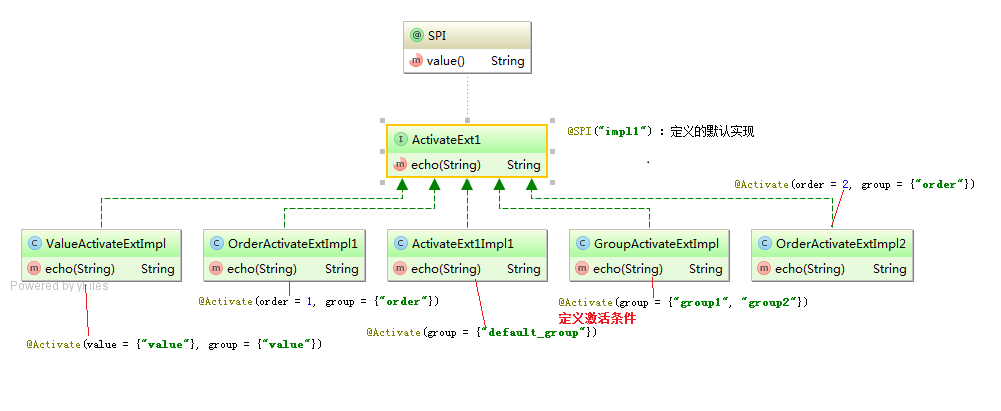
配置文件
|
1
2
3
4
5
|
group=com.alibaba.dubbo.common.extensionloader.activate.impl.GroupActivateExtImpl
value=com.alibaba.dubbo.common.extensionloader.activate.impl.ValueActivateExtImpl
order1=com.alibaba.dubbo.common.extensionloader.activate.impl.OrderActivateExtImpl1
order2=com.alibaba.dubbo.common.extensionloader.activate.impl.OrderActivateExtImpl2
com.alibaba.dubbo.common.extensionloader.activate.impl.ActivateExt1Impl1
|
|
1
2
3
4
5
6
7
8
9
10
11
12
13
14
15
16
17
18
19
20
21
22
23
24
25
26
27
28
29
30
31
32
33
34
35
36
37
38
|
@SPI
(
"impl1"
)
public
interface
ActivateExt1 {
String echo(String msg);
}
@Activate
(group = {
"default_group"
})
public
class
ActivateExt1Impl1
implements
ActivateExt1 {
public
String echo(String msg) {
return
msg;
}
}
@Activate
(group = {
"group1"
,
"group2"
})
public
class
GroupActivateExtImpl
implements
ActivateExt1 {
public
String echo(String msg) {
return
msg;
}
}
@Activate
(order =
1
, group = {
"order"
})
public
class
OrderActivateExtImpl1
implements
ActivateExt1 {
public
String echo(String msg) {
return
msg;
}
}
@Activate
(order =
2
, group = {
"order"
})
public
class
OrderActivateExtImpl2
implements
ActivateExt1 {
public
String echo(String msg) {
return
msg;
}
}
@Activate
(value = {
"value"
}, group = {
"value"
})
public
class
ValueActivateExtImpl
implements
ActivateExt1 {
public
String echo(String msg) {
return
msg;
}
}
|
2.2测试代码
|
1
2
3
4
5
6
7
8
9
10
11
12
13
14
15
16
17
18
19
20
21
22
23
24
25
26
27
28
29
30
31
32
33
34
|
@Test
public
void
testLoadActivateExtension()
throws
Exception {
// test default
URL url = URL.valueOf(
"test://localhost/test"
);
List<ActivateExt1> list = ExtensionLoader.getExtensionLoader(ActivateExt1.
class
)
.getActivateExtension(url,
new
String[]{},
"default_group"
);
Assert.assertEquals(
1
, list.size());
Assert.assertTrue(list.get(
0
).getClass() == ActivateExt1Impl1.
class
);
// test group
// url = url.addParameter(Constants.GROUP_KEY, "group1");
list = ExtensionLoader.getExtensionLoader(ActivateExt1.
class
)
.getActivateExtension(url,
new
String[]{},
"group1"
);
Assert.assertEquals(
1
, list.size());
Assert.assertTrue(list.get(
0
).getClass() == GroupActivateExtImpl.
class
);
// test value
url = url.removeParameter(Constants.GROUP_KEY);
// url = url.addParameter(Constants.GROUP_KEY, "value");
url = url.addParameter(
"value"
,
"value"
);
list = ExtensionLoader.getExtensionLoader(ActivateExt1.
class
)
.getActivateExtension(url,
new
String[]{},
"value"
);
Assert.assertEquals(
1
, list.size());
Assert.assertTrue(list.get(
0
).getClass() == ValueActivateExtImpl.
class
);
// test order
url = URL.valueOf(
"test://localhost/test"
);
// url = url.addParameter(Constants.GROUP_KEY, "order");
list = ExtensionLoader.getExtensionLoader(ActivateExt1.
class
)
.getActivateExtension(url,
new
String[]{},
"order"
);
Assert.assertEquals(
2
, list.size());
Assert.assertTrue(list.get(
0
).getClass() == OrderActivateExtImpl1.
class
);
Assert.assertTrue(list.get(
1
).getClass() == OrderActivateExtImpl2.
class
);
}
|
以上内容,是通过代码演练的方式,讲解了dubbo SPI机制的威力。
如果对底层实现感兴趣,可参看博客。
本文转自 randy_shandong 51CTO博客,原文链接:http://blog.51cto.com/dba10g/1880962,如需转载请自行联系原作者