引入:
虽然已经用了Apache CXF一段时间了,但是毕竟只是在项目中运用其部分能力,没有系统的学习,其实CXF还有许多强大的功能,这里我准备用一些文章系统的介绍Apache CXF的各个特征。
例子介绍:
演示用Apache CXF对JAX-WS的支持来创建“code first”的web service.
实践
首先我们进行架构设计,我们假设按照传统惯例,搭建一个maven应用,所以它的pom.xml应该如下:
|
1
2
3
4
5
6
7
8
9
10
11
12
13
14
15
16
17
18
19
20
21
22
23
24
25
26
27
28
29
30
31
32
33
34
35
36
37
38
39
40
41
42
43
44
45
46
47
48
49
50
51
52
|
<
project
xmlns
=
"http://maven.apache.org/POM/4.0.0"
xmlns:xsi
=
"http://www.w3.org/2001/XMLSchema-instance"
xsi:schemaLocation
=
"http://maven.apache.org/POM/4.0.0 http://maven.apache.org/maven-v4_0_0.xsd"
>
<
modelVersion
>4.0.0</
modelVersion
>
<
groupId
>com.charles.cxfstudy</
groupId
>
<
artifactId
>cxf_jaxws_server</
artifactId
>
<
packaging
>war</
packaging
>
<
name
>CXF demo using JAX-WS APIs</
name
>
<
description
>>CXF demo using JAX-WS APIs</
description
>
<
version
>1.0.0</
version
>
<
properties
>
<
cxf.version
>${project.version}</
cxf.version
>
<
cxf.release.base
>${basedir}/../..</
cxf.release.base
>
<
spring.version
>3.0.7.RELEASE</
spring.version
>
</
properties
>
<
build
>
<
plugins
>
<
plugin
>
<
artifactId
>maven-compiler-plugin</
artifactId
>
<
configuration
>
<
source
>1.6</
source
>
<
target
>1.6</
target
>
</
configuration
>
</
plugin
>
<
plugin
>
<
artifactId
>maven-war-plugin</
artifactId
>
<
version
>2.1</
version
>
<
configuration
>
<
webXml
>src/main/webapp/WEB-INF/web.xml</
webXml
>
</
configuration
>
</
plugin
>
</
plugins
>
<
finalName
>cxf_jaxws_server</
finalName
>
</
build
>
<
dependencies
>
<
dependency
>
<
groupId
>org.apache.cxf</
groupId
>
<
artifactId
>cxf-rt-frontend-jaxws</
artifactId
>
<
version
>2.7.10</
version
>
</
dependency
>
<
dependency
>
<
groupId
>org.apache.cxf</
groupId
>
<
artifactId
>cxf-rt-transports-http</
artifactId
>
<
version
>2.7.10</
version
>
</
dependency
>
<
dependency
>
<
groupId
>org.springframework</
groupId
>
<
artifactId
>spring-web</
artifactId
>
<
version
>${spring.version}</
version
>
</
dependency
>
</
dependencies
>
</
project
>
|
这里没什么技术含量,主要就是添加一些Apache CXF的依赖的jar包的支持,当然了,我们还考虑到用了spring web(接下来会讲),所以也添加了对spring web的支持。
因为是web应用,所以我们去编辑web.xml,这里特别要注意的是,我们的Apache CXF框架的入口Servlet是CXFServlet,它是一个基于Spring框架的Servlet,它符合拦截和转发web service的请求,并且调用业务方法进行服务,按照国际惯例,我们还必须为其配置url-pattern,从而让系统知道它会拦截何种请求。(我们这里设为拦截所有 /services/开头的请求):
|
1
2
3
4
5
6
7
8
9
10
11
12
13
14
15
16
17
18
19
20
21
|
<?
xml
version
=
"1.0"
encoding
=
"UTF-8"
?>
<
web-app
version
=
"2.5"
xmlns
=
"http://java.sun.com/xml/ns/javaee"
xmlns:xsi
=
"http://www.w3.org/2001/XMLSchema-instance"
xsi:schemaLocation="http://java.sun.com/xml/ns/javaee
http://java.sun.com/xml/ns/javaee/web-app_2_5.xsd">
<
display-name
>cxf demo for "code first" webservice</
display-name
>
<
servlet
>
<
description
>Apache CXF Endpoint</
description
>
<
servlet-name
>cxf-endpoint</
servlet-name
>
<!-- CXFServlet 用于拦截和转发web service 请求-->
<
servlet-class
>org.apache.cxf.transport.servlet.CXFServlet</
servlet-class
>
<
load-on-startup
>1</
load-on-startup
>
</
servlet
>
<
servlet-mapping
>
<
servlet-name
>cxf-endpoint</
servlet-name
>
<
url-pattern
>/services/*</
url-pattern
>
</
servlet-mapping
>
<
session-config
>
<
session-timeout
>60</
session-timeout
>
</
session-config
>
</
web-app
>
|
下面我们要写一个spring 配置文件,叫WEB-INF/cxf-servlet.xml,为什么要写这个文件呢?我们来看下Apache CXF的核心Servlet ,CXFServlet的实现:
|
1
2
3
4
5
6
7
8
9
10
11
12
13
14
15
16
17
18
19
20
21
22
23
24
25
26
27
28
29
30
31
32
33
34
|
public
class
CXFServlet
extends
CXFNonSpringServlet
implements
ApplicationListener<ContextRefreshedEvent> {
private
static
final
long
serialVersionUID = -5922443981969455305L;
private
static
final
String BUS_PARAMETER =
"bus"
;
private
boolean
busCreated;
private
XmlWebApplicationContext createdContext;
public
CXFServlet() {
}
@Override
protected
void
loadBus(ServletConfig servletConfig) {
ApplicationContext wac = WebApplicationContextUtils.
getWebApplicationContext(servletConfig.getServletContext());
if
(wac
instanceof
AbstractApplicationContext) {
addListener((AbstractApplicationContext)wac);
}
String configLocation = servletConfig.getInitParameter(
"config-location"
);
if
(configLocation ==
null
) {
try
{
InputStream is = servletConfig.getServletContext().getResourceAsStream(
"/WEB-INF/cxf-servlet.xml"
);
if
(is !=
null
&& is.available() >
0
) {
is.close();
configLocation =
"/WEB-INF/cxf-servlet.xml"
;
}
}
catch
(Exception ex) {
//ignore
}
}
if
(configLocation !=
null
) {
wac = createSpringContext(wac, servletConfig, configLocation);
}
|
可以看出,它会去读取config-location的配置文件路径,默认为/WEB-INF/cxf-servlet.xml,从而创建Spring的上下文。所以我们可以想象,这个cxf-servlet.xml(或者其他名字的配置文件)肯定是配置了关于web服务的定义 ,并且将这些服务定义为spring的bean,如下:
|
1
2
3
4
5
6
7
8
9
10
11
12
13
14
15
16
|
<?
xml
version
=
"1.0"
encoding
=
"UTF-8"
?>
<
beans
xmlns
=
"http://www.springframework.org/schema/beans"
xmlns:xsi
=
"http://www.w3.org/2001/XMLSchema-instance"
xmlns:jaxws
=
"http://cxf.apache.org/jaxws"
xmlns:soap
=
"http://cxf.apache.org/bindings/soap"
xsi:schemaLocation="
http://www.springframework.org/schema/beans http://www.springframework.org/schema/beans/spring-beans.xsd
http://cxf.apache.org/bindings/soap http://cxf.apache.org/schemas/configuration/soap.xsd
http://cxf.apache.org/jaxws
http://cxf.apache.org/schemas/jaxws.xsd">
<
jaxws:server
id
=
"cxfJaxwsService"
serviceClass
=
"com.charles.cxfstudy.server.services.IGreetingService"
address
=
"/greeting"
>
<
jaxws:serviceBean
>
<
bean
class
=
"com.charles.cxfstudy.server.services.GreetingServiceImpl"
/>
</
jaxws:serviceBean
>
</
jaxws:server
>
</
beans
>
|
所以我们这里就用jaxws的名字空间来声明提供服务的服务全限定接口,服务的地址和服务的实现全限定类,所以一旦web service部署在spring容器中,就可以为外界提供服务了。
接下来就是编码工作,我们必须让我们的代码和我们在cxf-servlet.xml中的配置一样。所以,我们定义了IGreetingService的接口:
|
1
2
3
4
5
6
7
8
9
10
11
12
13
14
15
16
17
18
|
/**
* 这是 web service的接口
*/
package
com.charles.cxfstudy.server.services;
import
javax.jws.WebService;
import
com.charles.cxfstudy.server.vo.Person;
/**
* @author charles.wang
*
*/
@WebService
public
interface
IGreetingService {
/**
* 对某个Person发起问候
*/
String sayGreetingToPerson(Person person);
}
|
并且在这个接口中提供业务方法。因为我们的服务是Web服务,所以必须用@WebService注解将其标示。 我们的接口中可以出现非java内定类型的类,比如自定义类(这里的Person类),他们会被JAXB框架(Apache CXF默认支持的绑定框架)来转为对应的xml类型定义。
所以我们的 Person 类就如下:
|
1
2
3
4
5
6
7
8
9
10
11
12
13
14
15
16
17
18
19
20
21
22
23
24
25
26
27
28
29
|
/**
* 这个一个VO,我们定义了一个Person类型,接下来,我们会用JAXB框架将其映射为wsdl文件中的类型定义
*/
package
com.charles.cxfstudy.server.vo;
import
javax.xml.bind.annotation.XmlType;
/**
* 我们定义一个有姓名(name)和年龄(age)的Person类
* @author charles.wang
*
*/
@XmlType
(name=
"person"
)
public
class
Person {
private
String name;
private
int
age;
public
String getName() {
return
name;
}
public
void
setName(String name) {
this
.name = name;
}
public
int
getAge() {
return
age;
}
public
void
setAge(
int
age) {
this
.age = age;
}
}
|
可以看出,这个Person类和一般的Bean没有区别,唯一区别在于我们用了注解@XmlType,它会被JAXB识别并且把这个类转为对应的xml格式的类型定义。
接下来我们就来编写服务实现bean了,根据我们在cxf-servlet.xml中的定义,我们开发了GreetingServiceImpl的实现类:
|
1
2
3
4
5
6
7
8
9
10
11
12
13
14
15
16
17
18
19
20
21
22
|
/**
* 这是web service的实现类
*/
package
com.charles.cxfstudy.server.services;
import
javax.jws.WebService;
import
com.charles.cxfstudy.server.vo.Person;
/**
* @author charles.wang
*
*/
@WebService
(endpointInterface=
"com.charles.cxfstudy.server.services.IGreetingService"
, serviceName=
"GreetingService"
)
public
class
GreetingServiceImpl
implements
IGreetingService {
/**
* 对某个Person发起问候
*/
public
String sayGreetingToPerson(Person person) {
System.out.println(
"calling SayGreetingToPerson(Person) method"
);
String name = person.getName();
int
age = person.getAge();
return
"Hello ,this is greeting from Charles to: "
+name+
", and his age is: "
+age;
}
}
|
从这里看出,它也和一般具体类没区别,就是多了一个@WebService注解来表示自己是一个服务实现类。这里看到其中还有endpointInterface和serviceName属性,他们都会映射到最终的wsdl文件。
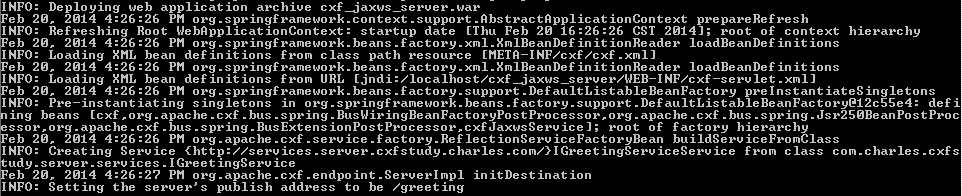
开发完了之后,就足够了(因为我们的逻辑太简单了),我们maven构建war包,然后部署在tomcat容器上(或者其他web容器), 就可以通过URL来测试我们的应用了。从服务器日志可以清楚的看到发布Web服务的过程:
比如访问http://localhost:8080/cxf_jaxws_server/services/greeting?wsdl (因为/services请求会被CXFServlet拦截作为web service请求, /greeting是我们开发的web service的具体请求,定义在cxf-servlet.xml中)
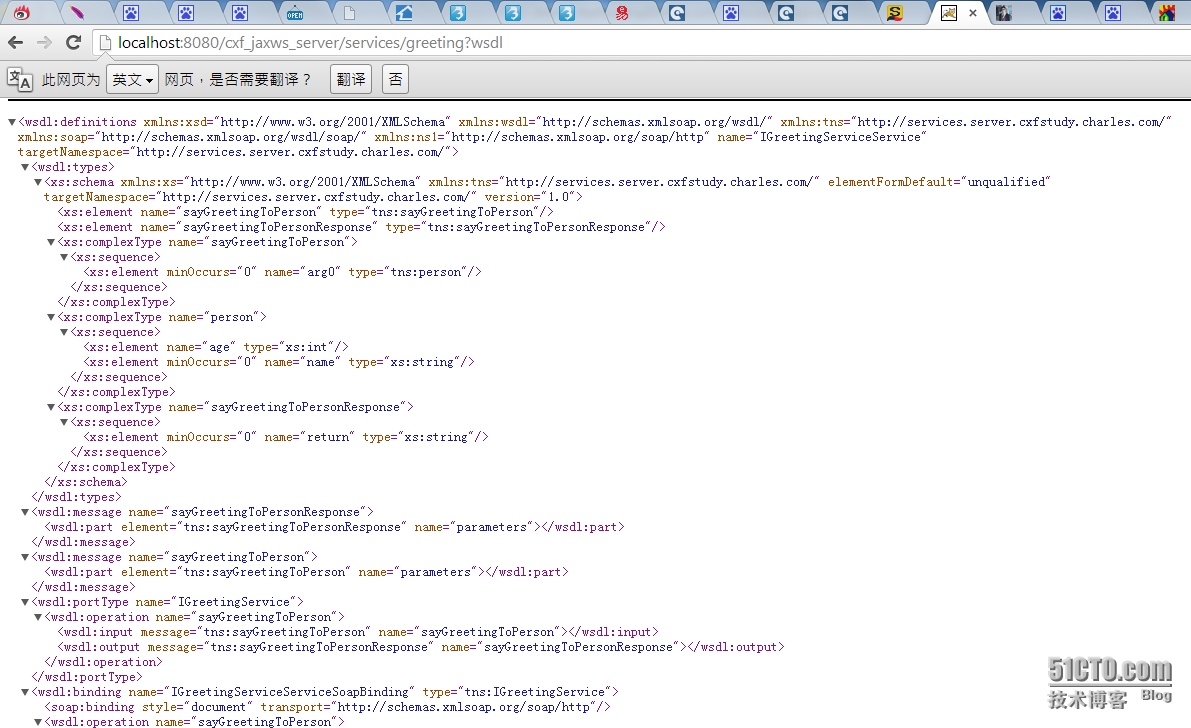
从上图可以看出,这个wsdl文件上部分的 <wsdl:types>中就包含person类型的定义,它是通过JAXB完成的。而下部分则是对我们的业务方法的定义,其中业务方法中用的入参,返回值类型都有在<wsdl:types>中定义。
对于我们生成的这个wsdl,我们可以很容易用各种工具(比如soapUI)测试其正确性,这里就不描述了,大家都会。