XMLStatementBuilder:对单个XNode节点进行解析,得到具体的SqlSource并以此生成MappedStatement
parseStatementNode方法:
private final MapperBuilderAssistant builderAssistant; // 记录了当前mapper的namespace等基础信息
private final XNode context; // 对应当前要解析的语句
private final String requiredDatabaseId;

public void parseStatementNode() {
        // 1. 通过xnode.getStringAttribute获取id、databaseId、节点名称
        String id = this.context.getStringAttribute("id");
        String databaseId = this.context.getStringAttribute("databaseId");
        if (this.databaseIdMatchesCurrent(id, databaseId, this.requiredDatabaseId)) {
            String nodeName = this.context.getNode().getNodeName();
            // 2. 将节点名称转换为SqlCommandType类型
            SqlCommandType sqlCommandType = SqlCommandType.valueOf(nodeName.toUpperCase(Locale.ENGLISH));
            // 3. 判断是否为SELECT、是否需要使用缓存、是否清空缓存、是否对结果排序
            boolean isSelect = sqlCommandType == SqlCommandType.SELECT;
            boolean flushCache = this.context.getBooleanAttribute("flushCache", !isSelect);
            boolean useCache = this.context.getBooleanAttribute("useCache", isSelect);
            boolean resultOrdered = this.context.getBooleanAttribute("resultOrdered", false);
            // 4. 构造XMLIncludeTransformer,解析include节点
            XMLIncludeTransformer includeParser = new XMLIncludeTransformer(this.configuration, this.builderAssistant); // 获取基础配置信息
            includeParser.applyIncludes(this.context.getNode());
            // 5. lang属性指定LanguageDriver,解析<selectKey>节点
            String parameterType = this.context.getStringAttribute("parameterType");
            Class<?> parameterTypeClass = this.resolveClass(parameterType);
            String lang = this.context.getStringAttribute("lang");
            LanguageDriver langDriver = this.getLanguageDriver(lang);
            this.processSelectKeyNodes(id, parameterTypeClass, langDriver);
            //  6. 拼接当前mapper的namespace和当前XNode的id作为当前语句的keyStatementId
            String keyStatementId = id + "!selectKey";
            keyStatementId = this.builderAssistant.applyCurrentNamespace(keyStatementId, true);
            Object keyGenerator;
            if (this.configuration.hasKeyGenerator(keyStatementId)) {
                keyGenerator = this.configuration.getKeyGenerator(keyStatementId);
            } else {
                keyGenerator = this.context.getBooleanAttribute("useGeneratedKeys", this.configuration.isUseGeneratedKeys() && SqlCommandType.INSERT.equals(sqlCommandType)) ? Jdbc3KeyGenerator.INSTANCE : NoKeyGenerator.INSTANCE;
            }
            // 7. 创建具体SqlSource
            SqlSource sqlSource = langDriver.createSqlSource(this.configuration, this.context, parameterTypeClass);
            // 8. 构造MappedStatement并插入MapperBuilderAssistant的configuration
            StatementType statementType = StatementType.valueOf(this.context.getStringAttribute("statementType", StatementType.PREPARED.toString()));
            Integer fetchSize = this.context.getIntAttribute("fetchSize");
            Integer timeout = this.context.getIntAttribute("timeout");
            String parameterMap = this.context.getStringAttribute("parameterMap");
            String resultType = this.context.getStringAttribute("resultType");
            Class<?> resultTypeClass = this.resolveClass(resultType);
            String resultMap = this.context.getStringAttribute("resultMap");
            String resultSetType = this.context.getStringAttribute("resultSetType");
            ResultSetType resultSetTypeEnum = this.resolveResultSetType(resultSetType);
            if (resultSetTypeEnum == null) {
                resultSetTypeEnum = this.configuration.getDefaultResultSetType();
            }

            String keyProperty = this.context.getStringAttribute("keyProperty");
            String keyColumn = this.context.getStringAttribute("keyColumn");
            String resultSets = this.context.getStringAttribute("resultSets");
            this.builderAssistant.addMappedStatement(id, sqlSource, statementType, sqlCommandType, fetchSize, timeout, parameterMap, parameterTypeClass, resultMap, resultTypeClass, resultSetTypeEnum, flushCache, useCache, resultOrdered, (KeyGenerator)keyGenerator, keyProperty, keyColumn, databaseId, langDriver, resultSets);
        }
}- 通过xnode.getStringAttribute获取id、databaseId、节点名称
- 将节点名称转换为SqlCommandType类型,SqlCommandType包含update、insert、delete、select、flush和unknown
- 判断是否为SELECT、是否需要使用缓存、是否清空缓存、是否对结果排序
- 构造XMLIncludeTransformer,调用applyIncludes方法解析include节点
public void applyIncludes(Node source) {
        Properties variablesContext = new Properties();
        Properties configurationVariables = this.configuration.getVariables();
        Optional var10000 = Optional.ofNullable(configurationVariables);
        Objects.requireNonNull(variablesContext);
        var10000.ifPresent(variablesContext::putAll);
        // 递归处理子节点,将include节点,替换为sqlFragment节点,将文本TEXT节点中的${}占位符进行替换
        this.applyIncludes(source, variablesContext, false);
}- 通过Xnode的lang属性指定LanguageDriver,并对\<selectKey>节点进行解析
- 拼接当前mapper的namespace和当前XNode的id作为当前语句的keyStatementId
- 创建具体SqlSource:XMLLanguageDriver调用XMLScriptBuilder进行构建
public class XMLLanguageDriver implements LanguageDriver{
    public SqlSource createSqlSource(Configuration configuration, XNode script, Class<?> parameterType) {
        XMLScriptBuilder builder = new XMLScriptBuilder(configuration, script, parameterType);
        return builder.parseScriptNode();
    }
}- 构造MappedStatement,插入MapperBuilderAssistant的configuration,configuration的插入会根据key是否可缩写来插入一次或两次:
public V put(String key, V value) {
            // 判断是否要抛异常
            if (key.contains(".")) {
                    String shortKey = this.getShortName(key);
                    if (super.get(shortKey) == null) {
                        super.put(shortKey, value);
                    } else {
                        super.put(shortKey, new Ambiguity(shortKey));
                    }
                }
                return super.put(key, value);
        }
例如要插入com.xx.xx.xxxMapper.deleteByPrimaryKey,会插入(com.xx.xx.xxxMapper.deleteByPrimaryKey, ms) 和 (deleteByPrimaryKey, ms)
XMLScriptBuilder:继承BaseBuilder,用于创建SqlSource
SqlSource:构造xml表达式对应的具体sql
- Represents the content of a mapped statement read from an XML file or an annotation.
- It creates the SQL that will be passed to the database out of the input parameter received from the user.
SqlSource 接口只有一个方法:根据参数对象获取BoundSql对象
public interface SqlSource {
    BoundSql getBoundSql(Object var1);
}
SqlSource有四个实现类:
- DynamicSqlSource: 处理动态sql语句
- ProviderSqlSource: 处理注解形式的sql。
- RawSqlSource:处理静态sql语句,内部调用了StaticSqlSource
- StaticSqlSource:不会对原 SQL 语句进行任何处理
XMLScriptBuilder 内部类:将XNode转为对应的SqlNode
NodeHandler
XMLScriptBuilder定义类内部接口NodeHandler和实现这个接口的内部类xxxHandler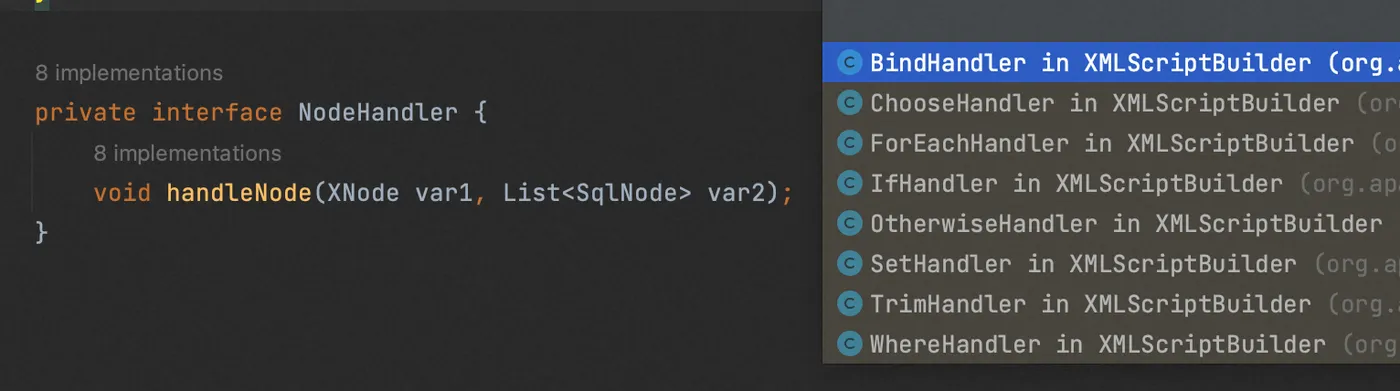
xxxHandler的handleNode方法逻辑:
- 调用parseDynamicTags方法得到MixedSqlNode
//parseDynamicTags判断是否是动态sql
protected MixedSqlNode parseDynamicTags(XNode node){
        List<SqlNode> contents = new ArrayList();
        // 获取当前节点的所有子节点(子标签)
        NodeList children = node.getNode().getChildNodes();
        for(int i = 0; i < children.getLength(); ++i) {
            XNode child = node.newXNode(children.item(i));
            String nodeName;
            // 判断是否是普通的文本sql
            if (child.getNode().getNodeType() != 4 && child.getNode().getNodeType() != 3) {
                if (child.getNode().getNodeType() == 1) {
                    // 对于标签节点,根据nodeName获取NodeHandler
                    nodeName = child.getNode().getNodeName();
                    NodeHandler handler = (NodeHandler)this.nodeHandlerMap.get(nodeName);
                    if (handler == null) {
                        throw new BuilderException("Unknown element <" + nodeName + "> in SQL statement.");
                    }
                    // 对当前标签进行处理
                    handler.handleNode(child, contents);
                    // 有标签则为动态sql
                    this.isDynamic = true;
                }
            } else {
                // 对文本节点进行处理
                nodeName = child.getStringBody("");
                TextSqlNode textSqlNode = new TextSqlNode(nodeName);
                // 根据文本中是否有${}判断是否是静态的文本节点
                if (textSqlNode.isDynamic()) {
                    contents.add(textSqlNode);
                    this.isDynamic = true;
                } else {
                    contents.add(new StaticTextSqlNode(nodeName));
                }
            }
        }
}- 对标签进行处理
- 根据标签和MixedSqlNode来初始化对应的xxxSqlNode
- 将xxxSqlNode当入List列表
以ForEachHandler为例:
private class ForEachHandler implements NodeHandler {
        public ForEachHandler() {
        }

        public void handleNode(XNode nodeToHandle, List<SqlNode> targetContents) {
            // 1. 调用parseDynamicTags方法得到MixedSqlNode
            MixedSqlNode mixedSqlNode = XMLScriptBuilder.this.parseDynamicTags(nodeToHandle);
            // 2. 解析foreach的XNode中的标签和属性
            String collection = nodeToHandle.getStringAttribute("collection");
            String item = nodeToHandle.getStringAttribute("item");
            String index = nodeToHandle.getStringAttribute("index");
            String open = nodeToHandle.getStringAttribute("open");
            String close = nodeToHandle.getStringAttribute("close");
            String separator = nodeToHandle.getStringAttribute("separator");
            // 3. 根据标签和MixedSqlNode来初始化对应的ForEachSqlNode
            ForEachSqlNode forEachSqlNode = new ForEachSqlNode(XMLScriptBuilder.this.configuration, mixedSqlNode, collection, index, item, open, close, separator);
            // 4. 将ForEachSqlNode当入List<SqlNode>列表
            targetContents.add(forEachSqlNode);
        }
    }
SqlNode
SqlNode有以下实现:
- 标签节点:
- TrimSqlNode: trim标签,TrimHandler处理
- WhereSqlNode: where 标签,WhereHandler处理
- SetSqlNode:对应 set 标签,SetHandler处理
- ForEachSqlNode :foreach 标签,ForEachHandler处理
- IfSqlNode:对应 if 、when标签,IfHandler处理
- ChooseSqlNode:choose 标签,ChooseHandler处理
- VarDeclSqlNode : bind 标签,BindHandler处理
- 文本节点:
- StaticTextSqlNode:纯文本SQL
- TextSqlNode:包含 ${} 的SQL
XMLScriptBuilder 创建方法:初始化内部NodeHandler类
public class XMLScriptBuilder extends BaseBuilder {
    private final XNode context;
    private boolean isDynamic;
    private final Class<?> parameterType;
    private final Map<String, NodeHandler> nodeHandlerMap;

    public XMLScriptBuilder(Configuration configuration, XNode context) {
        this(configuration, context, (Class)null);
    }

    public XMLScriptBuilder(Configuration configuration, XNode context, Class<?> parameterType) {
        super(configuration);
        this.nodeHandlerMap = new HashMap();
        this.context = context;
        this.parameterType = parameterType;
        this.initNodeHandlerMap();
    }

    private void initNodeHandlerMap() {
        // 初始化XMLScriptBuilder时对NodeHandler的map进行初始化
        this.nodeHandlerMap.put("trim", new TrimHandler());
        this.nodeHandlerMap.put("where", new WhereHandler());
        this.nodeHandlerMap.put("set", new SetHandler());
        this.nodeHandlerMap.put("foreach", new ForEachHandler());
        this.nodeHandlerMap.put("if", new IfHandler());
        this.nodeHandlerMap.put("choose", new ChooseHandler());
        this.nodeHandlerMap.put("when", new IfHandler());
        this.nodeHandlerMap.put("otherwise", new OtherwiseHandler());
        this.nodeHandlerMap.put("bind", new BindHandler());
    }

    private interface NodeHandler {
        void handleNode(XNode var1, List<SqlNode> var2);
    }
}
XMLScriptBuilder 解析方法:构造SqlSource
public SqlSource parseScriptNode() {
        // 1. 查看是sql是否需要动态生成,对this.isDynamic赋值
        MixedSqlNode rootSqlNode = this.parseDynamicTags(this.context);
        Object sqlSource;
        // 2. 根据是否需要动态生成来初始化不同的SqlSource
        if (this.isDynamic) {
            // 动态则生成 DynamicSqlSource
            sqlSource = new DynamicSqlSource(this.configuration, rootSqlNode);
        } else {
            // 否则生成RawSqlSource
            sqlSource = new RawSqlSource(this.configuration, rootSqlNode, this.parameterType);
        }

        return (SqlSource)sqlSource;
    }