ClassInstrumenter
Adapter that instruments a class for coverage tracing.
适配器为类覆盖率跟踪。
@Override
  public FieldVisitor visitField(final int access, final String name,
      final String desc, final String signature, final Object value) {
    InstrSupport.assertNotInstrumented(name, className);
    return super.visitField(access, name, desc, signature, value);
  }
  @Override
  public MethodProbesVisitor visitMethod(final int access, final String name,
      final String desc, final String signature, final String[] exceptions) {
    InstrSupport.assertNotInstrumented(name, className);
    final MethodVisitor mv = cv.visitMethod(access, name, desc, signature,
        exceptions);
    if (mv == null) {
      return null;
    }
    final MethodVisitor frameEliminator = new DuplicateFrameEliminator(mv);
    final ProbeInserter probeVariableInserter = new ProbeInserter(access,
        name, desc, frameEliminator, probeArrayStrategy);
    return new MethodInstrumenter(probeVariableInserter,
        probeVariableInserter);
  }
在jacoco对类和方法进行植入的时候,会
instrumenter - 对类的植入锁定进行判断
Several APIs to instrument Java class definitions for coverage tracing.
几个API可以对覆盖范围跟踪的Java类定义进行检测。
public byte[] instrument(final ClassReader reader) {
    final ClassWriter writer = new ClassWriter(reader, 0) {
      @Override
      protected String getCommonSuperClass(final String type1,
          final String type2) {
        throw new IllegalStateException();
      }
    };
    final IProbeArrayStrategy strategy = ProbeArrayStrategyFactory
        .createFor(reader, accessorGenerator);
    final ClassVisitor visitor = new ClassProbesAdapter(
        new ClassInstrumenter(strategy, writer), true);
    reader.accept(visitor, ClassReader.EXPAND_FRAMES);
    return writer.toByteArray();
  }
  public byte[] instrument(final byte[] buffer, final String name)
      throws IOException {
    try {
      return instrument(new ClassReader(buffer));
    } catch (final RuntimeException e) {
      throw instrumentError(name, e);
    }
  }
  public byte[] instrument(final InputStream input, final String name)
      throws IOException {
    final byte[] bytes;
    try {
      bytes = InputStreams.readFully(input);
    } catch (final IOException e) {
      throw instrumentError(name, e);
    }
    return instrument(bytes, name);
  }
  public void instrument(final InputStream input, final OutputStream output,
      final String name) throws IOException {
    output.write(instrument(input, name));
  }
  private IOException instrumentError(final String name,
      final Exception cause) {
    final IOException ex = new IOException(
        String.format("Error while instrumenting %s.", name));
    ex.initCause(cause);
    return ex;
  }
instrument(input,output,string) => instrument(input,string) => instrument([],string) => instrument(classreader)
所以最终的出口在于最下面的instrument(input,output,string),下面是剩余部分代码:
public int instrumentAll(final InputStream input, final OutputStream output,
      final String name) throws IOException {
    final ContentTypeDetector detector;
    try {
      detector = new ContentTypeDetector(input);
    } catch (final IOException e) {
      throw instrumentError(name, e);
    }
    switch (detector.getType()) {
    case ContentTypeDetector.CLASSFILE:
      instrument(detector.getInputStream(), output, name);
      return 1;
    case ContentTypeDetector.ZIPFILE:
      return instrumentZip(detector.getInputStream(), output, name);
    case ContentTypeDetector.GZFILE:
      return instrumentGzip(detector.getInputStream(), output, name);
    case ContentTypeDetector.PACK200FILE:
      return instrumentPack200(detector.getInputStream(), output, name);
    default:
      copy(detector.getInputStream(), output, name);
      return 0;
    }
  }
  private int instrumentZip(final InputStream input,
      final OutputStream output, final String name) throws IOException {
    final ZipInputStream zipin = new ZipInputStream(input);
    final ZipOutputStream zipout = new ZipOutputStream(output);
    ZipEntry entry;
    int count = 0;
    while ((entry = nextEntry(zipin, name)) != null) {
      final String entryName = entry.getName();
      if (signatureRemover.removeEntry(entryName)) {
        continue;
      }
      zipout.putNextEntry(new ZipEntry(entryName));
      if (!signatureRemover.filterEntry(entryName, zipin, zipout)) {
        count += instrumentAll(zipin, zipout, name + "@" + entryName);
      }
      zipout.closeEntry();
    }
    zipout.finish();
    return count;
  }
  private ZipEntry nextEntry(final ZipInputStream input,
      final String location) throws IOException {
    try {
      return input.getNextEntry();
    } catch (final IOException e) {
      throw instrumentError(location, e);
    }
  }
  private int instrumentGzip(final InputStream input,
      final OutputStream output, final String name) throws IOException {
    final GZIPInputStream gzipInputStream;
    try {
      gzipInputStream = new GZIPInputStream(input);
    } catch (final IOException e) {
      throw instrumentError(name, e);
    }
    final GZIPOutputStream gzout = new GZIPOutputStream(output);
    final int count = instrumentAll(gzipInputStream, gzout, name);
    gzout.finish();
    return count;
  }
  private int instrumentPack200(final InputStream input,
      final OutputStream output, final String name) throws IOException {
    final InputStream unpackedInput;
    try {
      unpackedInput = Pack200Streams.unpack(input);
    } catch (final IOException e) {
      throw instrumentError(name, e);
    }
    final ByteArrayOutputStream buffer = new ByteArrayOutputStream();
    final int count = instrumentAll(unpackedInput, buffer, name);
    Pack200Streams.pack(buffer.toByteArray(), output);
    return count;
  }
  private void copy(final InputStream input, final OutputStream output,
      final String name) throws IOException {
    final byte[] buffer = new byte[1024];
    int len;
    while ((len = read(input, buffer, name)) != -1) {
      output.write(buffer, 0, len);
    }
  }
  private int read(final InputStream input, final byte[] buffer,
      final String name) throws IOException {
    try {
      return input.read(buffer);
    } catch (final IOException e) {
      throw instrumentError(name, e);
    }
  }
核心关键是instrumentAll这个方法,根据文件包是class还是zip,或者gz等,不同的加载方式。
loadclass入口类:CoverageTransformer
public class CoverageTransformer
  implements ClassFileTransformer
{
  private static final String AGENT_PREFIX;
  private final Instrumenter instrumenter;
  private final IExceptionLogger logger;
  private final WildcardMatcher includes;
  private final WildcardMatcher excludes;
  private final WildcardMatcher exclClassloader;
  private final ClassFileDumper classFileDumper;
  private final boolean inclBootstrapClasses;
  private final boolean inclNoLocationClasses;
  static
  {
    String name = CoverageTransformer.class.getName();
    AGENT_PREFIX = toVMName(name.substring(0, name.lastIndexOf('.')));
  }
  public CoverageTransformer(IRuntime runtime, AgentOptions options, IExceptionLogger logger)
  {
    this.instrumenter = new Instrumenter(runtime);
    this.logger = logger;
    this.includes = new WildcardMatcher(toVMName(options.getIncludes()));
    this.excludes = new WildcardMatcher(toVMName(options.getExcludes()));
    this.exclClassloader = new WildcardMatcher(options.getExclClassloader());
    this.classFileDumper = new ClassFileDumper(options.getClassDumpDir());
    this.inclBootstrapClasses = options.getInclBootstrapClasses();
    this.inclNoLocationClasses = options.getInclNoLocationClasses();
  }
  public byte[] transform(ClassLoader loader, String classname, Class<?> classBeingRedefined, ProtectionDomain protectionDomain, byte[] classfileBuffer)
    throws IllegalClassFormatException
  {
    if (classBeingRedefined != null) {
      return null;
    }
    if (!filter(loader, classname, protectionDomain)) {
      return null;
    }
    try
    {
      this.classFileDumper.dump(classname, classfileBuffer);
      return this.instrumenter.instrument(classfileBuffer, classname);
    }
    catch (Exception ex)
    {
      IllegalClassFormatException wrapper = new IllegalClassFormatException(ex.getMessage());
      wrapper.initCause(ex);
      this.logger.logExeption(wrapper);
      throw wrapper;
    }
  }
  boolean filter(ClassLoader loader, String classname, ProtectionDomain protectionDomain)
  {
    if (loader == null)
    {
      if (!this.inclBootstrapClasses) {
        return false;
      }
    }
    else
    {
      if ((!this.inclNoLocationClasses) && (!hasSourceLocation(protectionDomain))) {
        return false;
      }
      if (this.exclClassloader.matches(loader.getClass().getName())) {
        return false;
      }
    }
    return (!classname.startsWith(AGENT_PREFIX)) && (this.includes.matches(classname)) && (!this.excludes.matches(classname));
  }
  private boolean hasSourceLocation(ProtectionDomain protectionDomain)
  {
    if (protectionDomain == null) {
      return false;
    }
    CodeSource codeSource = protectionDomain.getCodeSource();
    if (codeSource == null) {
      return false;
    }
    return codeSource.getLocation() != null;
  }
  private static String toVMName(String srcName)
  {
    return srcName.replace('.', '/');
  }
}
核心的两条代码:transform
try{
  this.classFileDumper.dump(classname, classfileBuffer);
  return this.instrumenter.instrument(classfileBuffer, classname);
}
Jaococ使用asm实现字节码植入,是对指令级别上的字节码植入,从而可以定位到执行的代码行,以达到覆盖率的统计。
flow 包分析
接着看
Instruction
/*******************************************************************************
 * Copyright (c) 2009, 2018 Mountainminds GmbH & Co. KG and Contributors
 * All rights reserved. This program and the accompanying materials
 * are made available under the terms of the Eclipse Public License v1.0
 * which accompanies this distribution, and is available at
 * http://www.eclipse.org/legal/epl-v10.html
 *
 * Contributors:
 *    Marc R. Hoffmann - initial API and implementation
 *
 *******************************************************************************/
package org.jacoco.core.internal.flow;
import org.objectweb.asm.tree.AbstractInsnNode;
import java.util.BitSet;
/**
 * Representation of a byte code instruction for analysis. Internally used for
 * analysis.
 */
public class Instruction {
  private final AbstractInsnNode node;
  private final int line;
  private int branches;
  private final BitSet coveredBranches;
  private Instruction predecessor;
  private int predecessorBranch;
  /**
   * New instruction at the given line.
   *
   * @param node
   *            corresponding node
   * @param line
   *            source line this instruction belongs to
   */
  public Instruction(final AbstractInsnNode node, final int line) {
    this.node = node;
    this.line = line;
    this.branches = 0;
    this.coveredBranches = new BitSet();
  }
  /**
   * @return corresponding node
   */
  public AbstractInsnNode getNode() {
    return node;
  }
  /**
   * Adds an branch to this instruction.
   */
  public void addBranch() {
    branches++;
  }
  /**
   * Sets the given instruction as a predecessor of this instruction and adds
   * branch to the predecessor. Probes are inserted in a way that every
   * instruction has at most one direct predecessor.
   *
   * @see #addBranch()
   * @param predecessor
   *            predecessor instruction
   * @param branch
   *            branch number in predecessor that should be marked as covered
   *            when this instruction marked as covered
   */
  public void setPredecessor(final Instruction predecessor,
      final int branch) {
    this.predecessor = predecessor;
    predecessor.addBranch();
    this.predecessorBranch = branch;
  }
  /**
   * Marks one branch of this instruction as covered. Also recursively marks
   * all predecessor instructions as covered if this is the first covered
   * branch.
   *
   * @param branch
   *            branch number to mark as covered
   */
  public void setCovered(final int branch) {
    Instruction i = this;
    int b = branch;
    while (i != null) {
      if (!i.coveredBranches.isEmpty()) {
        i.coveredBranches.set(b);
        break;
      }
      i.coveredBranches.set(b);
      b = i.predecessorBranch;
      i = i.predecessor;
    }
  }
  /**
   * Returns the source line this instruction belongs to.
   *
   * @return corresponding source line
   */
  public int getLine() {
    return line;
  }
  /**
   * Returns the total number of branches starting from this instruction.
   *
   * @return total number of branches
   */
  public int getBranches() {
    return branches;
  }
  /**
   * Returns the number of covered branches starting from this instruction.
   *
   * @return number of covered branches
   */
  public int getCoveredBranches() {
    return coveredBranches.cardinality();
  }
  /**
   * Merges information about covered branches of given instruction into this
   * instruction.
   *
   * @param instruction
   *            instruction from which to merge
   */
  public void merge(Instruction instruction) {
    this.coveredBranches.or(instruction.coveredBranches);
  }
  @Override
  public String toString() {
    return coveredBranches.toString();
  }
}
记录对应指令的代码行,记录在跳转的label处对应的代码行数,那么类推可以等到整个覆盖和未覆盖的代码行。
接着看看具体植入的是什么指令
org.jacoco.core.internal.instr.ProbeArrayStrategyFactory
工厂:用于寻找合适的策略来访问给定类的探针数组
createFor()
为给定 reader 描述的 class 创建合适的策略实例。 创建的实例只能用于处理为其创建了实例的类或接口,并且只能使用一次。
  /**
   * @param classId
   *            class identifier
   * @param reader
   *            reader to get information about the class
   * @param accessorGenerator
   *            accessor to the coverage runtime
   * @return strategy instance
   */
  public static IProbeArrayStrategy createFor(final long classId,
      final ClassReader reader,
      final IExecutionDataAccessorGenerator accessorGenerator) {
    final String className = reader.getClassName();
    final int version = InstrSupport.getMajorVersion(reader);
    if (isInterfaceOrModule(reader)) {
      final ProbeCounter counter = getProbeCounter(reader);
      if (counter.getCount() == 0) {
        return new NoneProbeArrayStrategy();
      }
      if (version >= Opcodes.V11 && counter.hasMethods()) {
        return new CondyProbeArrayStrategy(className, true, classId,
            accessorGenerator);
      }
      if (version >= Opcodes.V1_8 && counter.hasMethods()) {
        return new InterfaceFieldProbeArrayStrategy(className, classId,
            counter.getCount(), accessorGenerator);
      } else {
        return new LocalProbeArrayStrategy(className, classId,
            counter.getCount(), accessorGenerator);
      }
    } else {
      if (version >= Opcodes.V11) {
        return new CondyProbeArrayStrategy(className, false, classId,
            accessorGenerator);
      }
      return new ClassFieldProbeArrayStrategy(className, classId,
          InstrSupport.needsFrames(version), accessorGenerator);
    }
  }
IProbeArrayStrategy
其实现类如下:
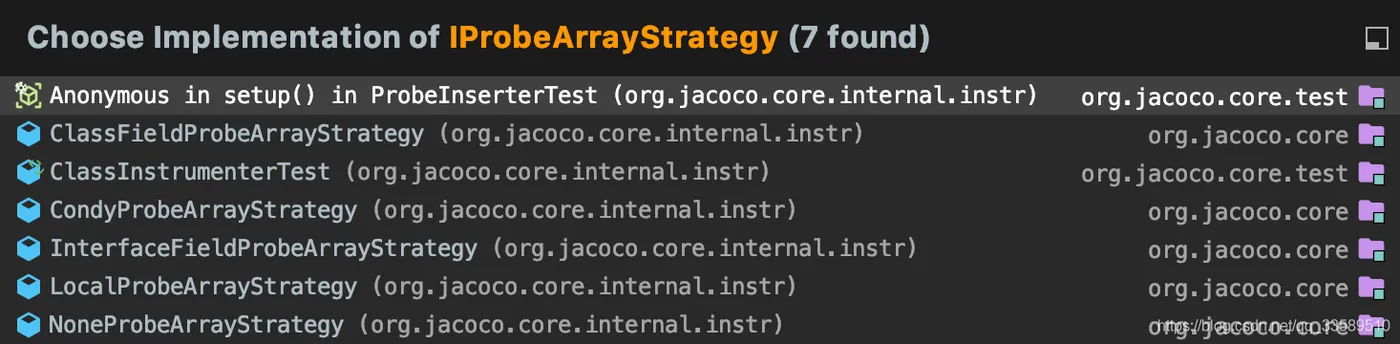
isInterfaceOrModule
private static boolean isInterfaceOrModule(final ClassReader reader) {
    return (reader.getAccess()
        & (Opcodes.ACC_INTERFACE | Opcodes.ACC_MODULE)) != 0;
}
ClassFieldProbeArrayStrategy
常规类的策略添加了一个用于保存探针数组的 static 字段和一个从运行时请求探针数组的静态初始化方法。
属性
/**
 * Frame stack with a single boolean array.
 */
private static final Object[] FRAME_STACK_ARRZ = new Object[] {
    InstrSupport.DATAFIELD_DESC };
/**
 * Empty frame locals.
 */
private static final Object[] FRAME_LOCALS_EMPTY = new Object[0];
private final String className;
private final long classId;
private final boolean withFrames;
private final IExecutionDataAccessorGenerator accessorGenerator;