title: 博弈论 斯坦福game theory stanford week 6-2
tags: note
notebook: 6- 英文课程-15-game theory
---
博弈论 斯坦福game theory stanford week 6-3
1。第 1 个问题
War Game
Two opposed armies are poised to seize an island.
Each army can either "attack" or "not-attack".
Also, Army 1 is either "weak" or "strong" with probability p and (1−p), respectively. Army 2 is always "weak".
Army's 1 type is known only to its general.
An army can capture the island either by attacking when its opponent does not or by attacking when its rival does if it is strong and its rival is weak. If two armies of equal strength both attack, neither captures the island.
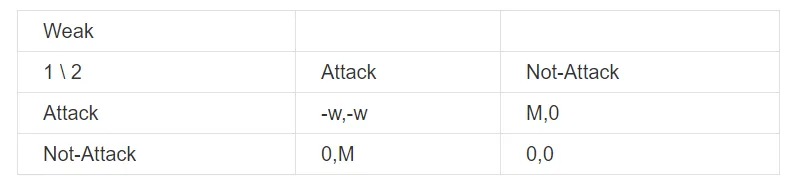
The payoffs are as follows
The island is worth M if captured.
An army has a "cost" of fighting, which is equal to s>0 if it is strong and w>0 if it is weak (where s<w<M).
There is no cost of attacking if its rival does not attack.
These payoffs are pictured in the payoff matrices below:
Weak
Strong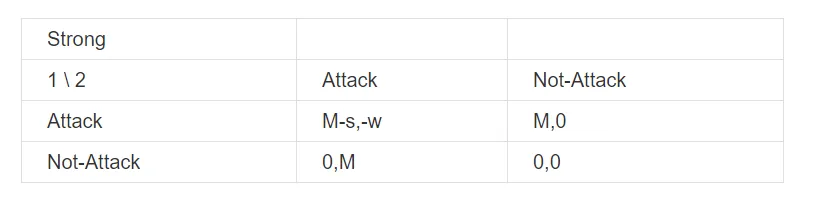
When p=1/2p=1/2, which is a pure strategy Bayesian equilibrium (there could be other equilibria that are not listed as one of the options):
Strategies listed in format: (1's type - 1's strategy; 2's strategy)
a) (Weak - Not-Attack, Strong - Attack; Attack);
b) (Weak - Not-Attack, Strong - Attack; Not-Attack);
c) (Weak - Attack, Strong - Attack; Attack);
d) It does not exist.
这个选项的答案不正确
第 2 个问题
正确
1 / 1 分
2。第 2 个问题
Consider the following variation to the Rock (R), Paper (P),Scissors (S) game:
Suppose that with probability p player 1 faces a Normal opponent and with probability 1−p, he faces a Simple opponent that will always play P.
Player 2 knows whether he is Normal or Simple, but player 1 does not.
The payoffs are pictured in the payoff matrices below:
Normal
1 2 R P S
R 0,0 -1,1 1,-1
P 1,-1 0,0 -1,1
S -1,1 1,-1 0,0
with probability p
Simple
1 2 P
R -1,1
P 0,0
S 1,-1
with probability 1−p.
Suppose p = 1/3p=1/3, select all pure strategy Bayesian equilibria (there may be more than one):
(Form: 1's strategy; 2's type - 2's strategy)
a) (S; Normal - P, Simple - P)
未选择的是正确的 b) (R; Normal - P, Simple - P)
未选择的是正确的 c) (S; Normal - R, Simple - P)
正确
(c) is true.

Check (c): If 1 chooses S, Normal type prefers R and Simple type plays P. If 2 chooses R with 1/3 and and P with 2/3 probability (depending on the type), 1 is indifferent between P (with payoff =1/3*1) and S (with payoff =1/3*(-1)+2/3*1=1/3) and prefers P or S to R (with payoff = 2/3*(-1)).
It is easy to check by similar calculations that for each of the other answers (a), (b) and (d) some player would like to deviate.
d) (P; Normal - P, Simple - P)
未选择的是正确的 第 3 个问题
正确
1 / 1 分
3。第 3 个问题
Consider the following variation to the Rock (R), Paper (P),Scissors (S) game:
Suppose that with probability p player 1 faces a Normal opponent and with probability 1−p, he faces a Simple opponent that will always play P.
Player 2 knows whether he is Normal or Simple, but player 1 does not.
The payoffs are pictured in the payoff matrices below:
Normal
1 2 R P S
R 0,0 -1,1 1,-1
P 1,-1 0,0 -1,1
S -1,1 1,-1 0,0
with probability p
Simple
1 2 P
R -1,1
P 0,0
S 1,-1
with probability 1−p.
Suppose p = 2/3p=2/3, select all pure strategy Bayesian equilibria (there may be more than one):
(Form: 1's strategy; 2's type - 2's strategy)
none
正确
There is no pure strategy Bayesian equilibria.

Check (a): If 1 chooses R, Normal type prefers P and Simple type plays P. If 2 chooses P with 2/3 and and P with 1/3 probability (depending on the type), 1 prefers S (with payoff =1) instead of R (with payoff = -1) or P (with payoff=0).
Check (b): If 1 chooses P, Normal type prefers S and Simple type plays P. If 2 chooses S with 2/3 and and P with 1/3 probability (depending on the type), 1 is indifferent between R (with payoff =2/3 * 1+1/3 *(-1)=1/3) and S (with payoff = 2/3*(0)+1/3*1=1/3) and prefers R or S to P (with payoff = 2/3 * (-1)+1/3 * (0)=-2/3).
Check (c): If 1 chooses S, Normal type prefers R and Simple type plays P. If 2 chooses R with 2/3 and and P with 1/3 probability (depending on the type), 1 prefers P (with payoff =2/3*(1)+1/3 * 0=2/3) instead of R (with payoff = 2/3*(0)+1/3*(-1)=-1/3) or S (with payoff=2/3*(-1)+1/3*(1)=-1/3).
Thus it doesn't exist, as (a), (b) and (c) are the only possible pure equilibria given 2's best responses.
a) (R; Normal - P, Simple - P)
未选择的是正确的 b) (P; Normal - S, Simple - P)
未选择的是正确的 c) (S; Normal - R, Simple - P)
未选择的是正确的 第 4 个问题
正确
1 / 1 分
4。第 4 个问题
An engineer has a talent t in {1,2} with equal probability (prob=1/2), and the value of t is private information to the engineer.
The engineer's pure strategies are applying for a job or being an entrepreneur and doing a startup.
The company's pure strategies are either hiring or not hiring the engineer.
If the engineer applies for the job and the company does not hire, then the engineer becomes an entrepreneur and does a startup.
The utility of the engineer is t (talent) from being an entrepreneur, and w (wage) from being hired.
The utility of the company is (t−w) from hiring the engineer and 0 otherwise.
These are pictured in the payoff matrices below, with the engineer being the row player and the company being the column player.
t=2 Hire Not
Startup 2,0 2,0
Work w,2-w 2,0
t=1 Hire Not
Startup 1,0 1,0
Work w,1-w 1,0
Suppose w=2w=2, which of the below are pure strategy Bayesian equilibria, there may be more than one and check all that apply. (Form: Engineer's strategy, company's strategy)
a) (t=2t=2 Work, t=1t=1 Work, Not);
    正确
(a) and (c) are true.

Because w=2, type t=1 prefers to work if the company hires and type t=2 is indifferent between work and startup.
Given that type t=1 prefers to work, the company prefers not to hire since it loses money from type t=1 and only breaks even from t=2.
Thus (a) and (c) are true.
b) (t=2t=2 Work, t=1t=1 Work, Hire);
未选择的是正确的 c) (t=2t=2 Startup, t=1t=1 Work, Not);
正确
(a) and (c) are true.

Because w=2, type t=1 prefers to work if the company hires and type t=2 is indifferent between work and startup.
Given that type t=1 prefers to work, the company prefers not to hire since it loses money from type t=1 and only breaks even from t=2.
Thus (a) and (c) are true.
d) (t=2t=2 Startup, t=1t=1 Work, Hire);
未选择的是正确的
第 5 个问题
正确
1 / 1 分
5。第 5 个问题
An engineer has a talent t in {1,2} with equal probability (prob=1/2), and the value of t is private information to the engineer.
The engineer's pure strategies are applying for a job or being an entrepreneur and doing a startup.
The company's pure strategies are either hiring or not hiring the engineer.
If the engineer applies for the job and the company does not hire, then the engineer becomes an entrepreneur and does a startup.
The utility of the engineer is t (talent) from being an entrepreneur, and w (wage) from being hired.
The utility of the company is (t−w) from hiring the engineer and 0 otherwise.
These are pictured in the payoff matrices below, with the engineer being the row player and the company being the column player.
t=2 Hire Not
Startup 2,0 2,0
Work w,2-w 2,0
t=1 Hire Not
Startup 1,0 1,0
Work w,1-w 1,0
Suppose w=1w=1, which of the below are pure strategy Bayesian equilibria, there may be more than one and check all that apply.
(Form: Engineer's strategy, company's strategy)
a) (t=2t=2 Work, t=1t=1 Startup, Hire);
未选择的是正确的 b) (t=2t=2 Startup, t=1t=1 Work, Hire);
正确
(b) and (c) are true.

Because w=1, t=1 is indifferent between work and startup and t=2 prefers to startup.
Given t=1 is indifferent and t=2 prefers not to work, the company is indifferent between hire or not since w−t=1−1=0.
Thus (b) and (c) are true.
c) (t=2t=2 Startup, t=1t=1 Work, Not);
正确
(b) and (c) are true.

Because w=1, t=1 is indifferent between work and startup and t=2 prefers to startup.
Given t=1 is indifferent and t=2 prefers not to work, the company is indifferent between hire or not since w−t=1−1=0.
Thus (b) and (c) are true.
d) (t=2t=2 Work, t=1t=1 Startup, Not);
未选择的是正确的 第 6 个问题
正确
1 / 1 分
6。第 6 个问题
Change the Battle of Sexes to have incomplete information:
There are two possible types of player 2 (column):
"Meet" player 2 wishes to be at the same movie as player 1, just as in the usual game. (This type has probability pp)
"Avoid" 2 wishes to avoid player 1 and go to the other movie. (This type has probability 1−p)
2 knows her type, and 1 does not.
They simultaneously choose P or L.
These payoffs are shown in the matrices below.
Meet
1 2 L P
L 2,1 0,0
P 0,1 1,0
with probability pp
Avoid
1 2 L P
L 2,0 0,2
P 0,1 1,0
with probability 1−p.
When p=1/2p=1/2, which is a pure strategy Bayesian equilibrium:
(1's strategy; 2's type - 2's strategy)
a) (L; Meet - L, Avoid - P);
正确
(a) is true.

Check (a): If 1 chooses L, indeed the Meet type prefers L and Avoid type prefers P. Thus with probability=1/2, 2 is a Meet type who chooses L and with probability=1/2, 2 is a Avoid types who chooses P. Thus, 1 prefers L with a payoff of 1/2*2, while P gives a lower payoff of 1/2*1.
(b) is not a Bayesian equilibrium because when L and P are chosen by 2 (depending on the type) with 1/2 probability, 1 prefers L instead of P.
(c) is not a Bayesian equilibrium because when 1 chooses L, the Meet type prefers L instead of P.
b) (P; Meet - P, Avoid - L);
c) (L; Meet - P, Avoid - P);
d) It does not exist.
第 7 个问题
正确
1 / 1 分
7。第 7 个问题
Modify the Battle of Sexes to have incomplete information:
There are two possible types of player 2 (column):
"Meet" player 2 wishes to be at the same movie as player 1, just as in the usual game. (This type has probability p)
"Avoid" 2 wishes to avoid player 1 and go to the other movie. (This type has probability 1−p)
2 knows her type, and 1 does not.
They simultaneously choose P or L.
These payoffs are shown in the matrices below.
Meet
1 2 L P
L 2,1 0,0
P 0,1 1,0
with probability pp
Avoid
1 2 L P
L 2,0 0,2
P 0,1 1,0
with probability 1−p.
When p=1/4p=1/4, which is a pure strategy Bayesian equilibrium :
(1's strategy; 2's type - 2's strategy)
a) (L; Meet - L, Avoid - P);
b) (P; Meet - P, Avoid - L);
c) (L; Meet - P, Avoid - P);
d) It does not exist.
正确
(d) is true.

Check (a): if 1 chooses L, Meet type prefers L and Avoid type prefers P. If 2 chooses L with 1/4 and P with 3/4 probability (depending on the type), 1 prefers P (with payoff = 3/4*1) instead of L (with payoff = 1/4*2).
Check (b): if 1 chooses P, Meet type prefers P and Avoid type prefers L. If 2 chooses L with 3/4 and P with 1/4 probability (depending on the type), 1 prefers L (with payoff 3/4*2) instead of P (with payoff = 1/4*1).
(c) is not a Bayesian equilibrium because when 1 chooses L, Meet type prefers L instead of P.
Thus it doesn't exist, as (a) and (b) are the only possible pure equilibria given 2's best responses.