链表是C语言编程中常用的数据结构,比如我们要建一个整数链表,一般可能这么定义:
1
2
3
4
struct int_node {
int val;
struct int_node *next;
};
为了实现链表的插入、删除、遍历等功能,另外要再实现一系列函数,比如:
1
2
3
4
5
6
7
8
9
void insert_node(struct int_node *head, struct int_node *current);
void delete_node(struct int_node *head, struct int_node *current);
void access_node(struct int_node *head)
{
struct int_node *node;
for (node = head; node != NULL; node = node->next) {
// do something here
}
}
如果我们的代码里只有这么一个数据结构的话,这样做当然没有问题,但是当代码的规模足够大,需要管理很多种链表,难道需要为每一种链表都要实现一套插入、删除、遍历等功能函数吗?熟悉C++的同学可能会说,我们可以用标准模板库啊,但是,我们这里谈的是C,在C语言里有没有比较好的方法呢?
Mr.Dave在他的博客里介绍了自己的实现,这个实现是个很好的方案,各位不妨可以参考一下。在本文中,我们把目光投向当今开源界最大的C项目--Linux Kernel,看看Linux内核如何解决这个问题。
Linux内核中一般使用双向链表,声明为struct list_head,这个结构体是在include/linux/types.h中定义的,链表的访问是以宏或者内联函数的形式在include/linux/list.h中定义。
1
2
3
struct list_head {
struct list_head *next, *prev;
};
Linux内核为链表提供了一致的访问接口。
1
2
3
4
5
void INIT_LIST_HEAD(struct list_head *list);
void list_add(struct list_head *new, struct list_head *head);
void list_add_tail(struct list_head *new, struct list_head *head);
void list_del(struct list_head *entry);
int list_empty(const struct list_head *head);
以上只是从Linux内核里摘选的几个常用接口,更多的定义请参考Linux内核源代码。我们先通过一个简单的实作来对Linux内核如何处理链表建立一个感性的认识。
1
2
3
4
5
6
7
8
9
10
11
12
13
14
15
16
17
18
19
20
21
#include <stdio.h>
#include "list.h"
struct int_node {
int val;
struct list_head list;
};
int main()
{
struct list_head head, *plist;
struct int_node a, b;
a.val = 2;
b.val = 3;
INIT_LIST_HEAD(&head);
list_add(&a.list, &head);
list_add(&b.list, &head);
list_for_each(plist, &head) {
struct int_node *node = list_entry(plist, struct int_node, list);
printf("val = %d\n", node->val);
}
return 0;
}
看完这个实作,是不是觉得在C代码里管理一个链表也很简单呢?代码中包含的头文件list.h是我从Linux内核里抽取出来并做了一点修改的链表处理代码,现附在这里给大家参考,使用的时候只要把这个头文件包含到自己的工程里即可。
#ifndef __C_LIST_H
#define __C_LIST_H
typedef unsigned char u8;
typedef unsigned short u16;
typedef unsigned int u32;
typedef unsigned long size_t;
#define offsetof(TYPE, MEMBER) ((size_t) &((TYPE *)0)->MEMBER)
/**
* container_of - cast a member of a structure out to the containing structure
* @ptr: the pointer to the member.
* @type: the type of the container struct this is embedded in.
* @member: the name of the member within the struct.
*
*/
#define container_of(ptr, type, member) (type *)((char *)ptr -offsetof(type,member))
/*
* These are non-NULL pointers that will result in page faults
* under normal circumstances, used to verify that nobody uses
* non-initialized list entries.
*/
#define LIST_POISON1 ((void *) 0x00100100)
#define LIST_POISON2 ((void *) 0x00200200)
struct list_head {
struct list_head *next, *prev;
};
/**
* list_entry - get the struct for this entry
* @ptr: the &struct list_head pointer.
* @type: the type of the struct this is embedded in.
* @member: the name of the list_struct within the struct.
*/
#define list_entry(ptr, type, member) \
container_of(ptr, type, member)
#define LIST_HEAD_INIT(name) { &(name), &(name) }
#define LIST_HEAD(name) \
struct list_head name = LIST_HEAD_INIT(name)
static inline void INIT_LIST_HEAD(struct list_head *list)
{
list->next = list;
list->prev = list;
}
/**
* list_for_each - iterate over a list
* @pos: the &struct list_head to use as a loop counter.
* @head: the head for your list.
*/
#define list_for_each(pos, head) \
for (pos = (head)->next; pos != (head); pos = pos->next)
/**
* list_for_each_r - iterate over a list reversely
* @pos: the &struct list_head to use as a loop counter.
* @head: the head for your list.
*/
#define list_for_each_r(pos, head) \
for (pos = (head)->prev; pos != (head); pos = pos->prev)
/*
* Insert a new entry between two known consecutive entries.
*
* This is only for internal list manipulation where we know
* the prev/next entries already!
*/
static inline void __list_add(struct list_head *new,
struct list_head *prev,
struct list_head *next)
{
next->prev = new;
new->next = next;
new->prev = prev;
prev->next = new;
}
/**
* list_add - add a new entry
* @new: new entry to be added
* @head: list head to add it after
*
* Insert a new entry after the specified head.
* This is good for implementing stacks.
*/
static inline void list_add(struct list_head *new, struct list_head *head)
{
__list_add(new, head, head->next);
}
/**
* list_add_tail - add a new entry
* @new: new entry to be added
* @head: list head to add it before
*
* Insert a new entry before the specified head.
* This is useful for implementing queues.
*/
static inline void list_add_tail(struct list_head *new, struct list_head *head)
{
__list_add(new, head->prev, head);
}
/*
* Delete a list entry by making the prev/next entries
* point to each other.
*
* This is only for internal list manipulation where we know
* the prev/next entries already!
*/
static inline void __list_del(struct list_head * prev, struct list_head * next)
{
next->prev = prev;
prev->next = next;
}
/**
* list_del - deletes entry from list.
* @entry: the element to delete from the list.
* Note: list_empty on entry does not return true after this, the entry is
* in an undefined state.
*/
static inline void list_del(struct list_head *entry)
{
__list_del(entry->prev, entry->next);
entry->next = LIST_POISON1;
entry->prev = LIST_POISON2;
}
/**
* list_empty - tests whether a list is empty
* @head: the list to test.
*/
static inline int list_empty(const struct list_head *head)
{
return head->next == head;
}
static inline void __list_splice(struct list_head *list,
struct list_head *head)
{
struct list_head *first = list->next;
struct list_head *last = list->prev;
struct list_head *at = head->next;
first->prev = head;
head->next = first;
last->next = at;
at->prev = last;
}
/**
* list_splice - join two lists
* @list: the new list to add.
* @head: the place to add it in the first list.
*/
static inline void list_splice(struct list_head *list, struct list_head *head)
{
if (!list_empty(list))
__list_splice(list, head);
}
#endif // __C_LIST_H
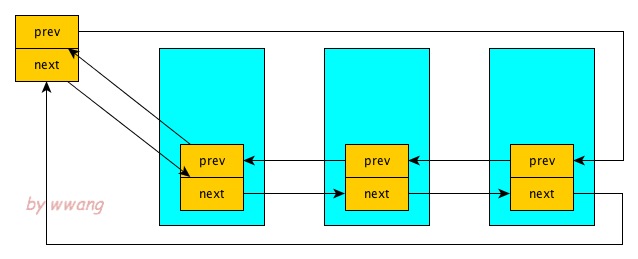
list_head通常是嵌在数据结构内使用,在上文的实作中我们还是以整数链表为例,int_node的定义如下:
1
2
3
4
struct int_node {
int val;
struct list_head list;
};
使用list_head组织的链表的结构如下图所示:
遍历链表是用宏list_for_each来完成。
1
2
3
#define list_for_each(pos, head) \
for (pos = (head)->next; prefetch(pos->next), pos != (head); \
pos = pos->next)
在这里,pos和head均是struct list_head。在遍历的过程中如果需要访问节点,可以用list_entry来取得这个节点的基址。
1
2
#define list_entry(ptr, type, member) \
container_of(ptr, type, member)
我们来看看container_of是如何实现的。如下图所示,我们已经知道TYPE结构中MEMBER的地址,如果要得到这个结构体的地址,只需要知道MEMBER在结构体中的偏移量就可以了。如何得到这个偏移量地址呢?这里用到C语言的一个小技巧,我们不妨把结构体投影到地址为0的地方,那么成员的绝对地址就是偏移量。得到偏移量之后,再根据ptr指针指向的地址,就可以很容易的计算出结构体的地址。
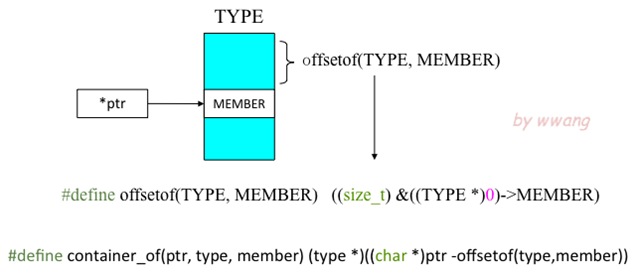
list_entry就是通过上面的方法从ptr指针得到我们需要的type结构体。
Linux内核代码博大精深,陈莉君老师曾把它形容为“覆压三百余里,隔离天日”(摘自《阿房宫赋》),可见其内容之丰富、结构之庞杂。内核里有着众多重要的数据结构,具有相关性的数据结构之间很多都是用本文介绍的链表组织在一起,看来list_head结构虽小,作用可真不小。
Linux内核是个伟大的工程,其源代码里还有很多精妙之处,值得C/C++程序员认真去阅读,即使我们不去做内核相关的工作,阅读精彩的代码对程序员自我修养的提高也是大有裨益的。
kernel中list的定义:http://lxr.oss.org.cn/source//include/linux/list.h?v=2.6.30
本文转自feisky博客园博客,原文链接:http://www.cnblogs.com/feisky/archive/2012/04/09/2438849.html,如需转载请自行联系原作者