原文:
乐在其中设计模式(C#) - 迭代器模式(Iterator Pattern)
作者: webabcd
介绍
提供一种方法顺序访问一个聚合对象中各个元素,而又不需暴露该对象的内部表示。
示例
有一个Message实体类,某聚合对象内的各个元素均为该实体对象,现在要提供一种方法顺序地访问这个聚合对象中的各个元素。
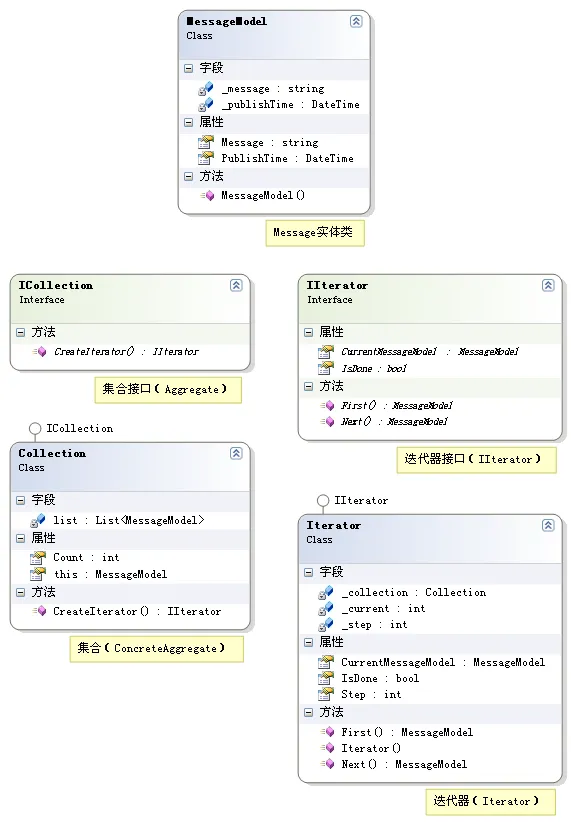
MessageModel
 using
System;
using
System;
using
System.Collections.Generic;
using
System.Text;
namespace
Pattern.Iterator

 {
{

 /// <summary>
 /// Message实体类
 /// </summary>
public class MessageModel
{
/// <summary>
/// 构造函数
/// </summary>
/// <param name="msg">Message内容</param>
/// <param name="pt">Message发布时间</param>
public MessageModel(string msg, DateTime pt)
{
this._message = msg;
this._publishTime = pt;
}
private string _message;
/// <summary>
/// Message内容
/// </summary>
public string Message
{
get { return _message; }
set { _message = value; }
}
private DateTime _publishTime;
/// <summary>
/// Message发布时间
/// </summary>
public DateTime PublishTime
{
get { return _publishTime; }
set { _publishTime = value; }
}
}
 }
}
ICollection
using
System;
using
System.Collections.Generic;
using
System.Text;
namespace
Pattern.Iterator
{
/// <summary>
/// 集合接口(Aggregate)
/// </summary>
public interface ICollection
{
/// <summary>
/// 创建迭代器对象
/// </summary>
/// <returns></returns>
IIterator CreateIterator();
}
}
Collection
using
System;
using
System.Collections.Generic;
using
System.Text;
namespace
Pattern.Iterator
{
/// <summary>
/// 集合(ConcreteAggregate)
/// </summary>
public class Collection : ICollection
{
private List<MessageModel> list = new List<MessageModel>();
/// <summary>
/// 创建迭代器对象
/// </summary>
/// <returns></returns>
public IIterator CreateIterator()
{
return new Iterator(this);
}
/// <summary>
/// 集合内的对象总数
/// </summary>
public int Count
{
get { return list.Count; }
}
/// <summary>
/// 索引器
/// </summary>
/// <param name="index">index</param>
/// <returns></returns>
public MessageModel this[int index]
{
get { return list[index]; }
set { list.Add(value); }
}
}
}
IIterator
using
System;
using
System.Collections.Generic;
using
System.Text;
namespace
Pattern.Iterator
{
/// <summary>
/// 迭代器接口(IIterator)
/// </summary>
public interface IIterator
{
/// <summary>
/// 第一个对象
/// </summary>
/// <returns></returns>
MessageModel First();
/// <summary>
/// 下一个对象
/// </summary>
/// <returns></returns>
MessageModel Next();
/// <summary>
/// 当前对象
/// </summary>
MessageModel CurrentMessageModel { get; }
/// <summary>
/// 是否迭代完毕
/// </summary>
bool IsDone { get; }
}
}
Iterator
using
System;
using
System.Collections.Generic;
using
System.Text;
namespace
Pattern.Iterator
{
/// <summary>
/// 迭代器(Iterator)
/// </summary>
public class Iterator : IIterator
{
private Collection _collection;
private int _current = 0;
private int _step = 1;
/// <summary>
/// 构造函数
/// </summary>
/// <param name="collection"></param>
public Iterator(Collection collection)
{
this._collection = collection;
}
/// <summary>
/// 第一个对象
/// </summary>
/// <returns></returns>
public MessageModel First()
{
_current = 0;
return _collection[_current];
}
/// <summary>
/// 下一个对象
/// </summary>
/// <returns></returns>
public MessageModel Next()
{
_current += _step;
if (!IsDone)
{
return _collection[_current];
}
else
{
return null;
}
}
/// <summary>
/// 当前对象
/// </summary>
public MessageModel CurrentMessageModel
{
get { return _collection[_current]; }
}
/// <summary>
/// 是否迭代完毕
/// </summary>
public bool IsDone
{
get { return _current >= _collection.Count ? true : false; }
}
/// <summary>
/// 步长
/// </summary>
public int Step
{
get { return _step; }
set { _step = value; }
}
}
}
Test
using
System;
using
System.Data;
using
System.Configuration;
using
System.Collections;
using
System.Web;
using
System.Web.Security;
using
System.Web.UI;
using
System.Web.UI.WebControls;
using
System.Web.UI.WebControls.WebParts;
using
System.Web.UI.HtmlControls;
using
I
=
Pattern.Iterator;
public
partial
class
Iterator : System.Web.UI.Page
{
protected void Page_Load(object sender, EventArgs e)
{
I::Collection collection = new I::Collection();
collection[0] = new I::MessageModel("第1条信息", DateTime.Now);
collection[1] = new I::MessageModel("第2条信息", DateTime.Now);
collection[2] = new I::MessageModel("第3条信息", DateTime.Now);
collection[3] = new I::MessageModel("第4条信息", DateTime.Now);
collection[4] = new I::MessageModel("第5条信息", DateTime.Now);
collection[5] = new I::MessageModel("第6条信息", DateTime.Now);
collection[6] = new I::MessageModel("第7条信息", DateTime.Now);
collection[7] = new I::MessageModel("第8条信息", DateTime.Now);
collection[8] = new I::MessageModel("第9条信息", DateTime.Now);
I::Iterator iterator = new I::Iterator(collection);
iterator.Step = 2;
for (I::MessageModel mm = iterator.First(); !iterator.IsDone; mm = iterator.Next())
{
Response.Write(mm.Message);
Response.Write("<br />");
}
}
}
运行结果
第1条信息
第3条信息
第5条信息
第7条信息
第9条信息
参考
http://www.dofactory.com/Patterns/PatternIterator.aspx
OK
[源码下载]
乐在其中设计模式(C#) - 迭代器模式(Iterator Pattern)
作者: webabcd
介绍
提供一种方法顺序访问一个聚合对象中各个元素,而又不需暴露该对象的内部表示。
示例
有一个Message实体类,某聚合对象内的各个元素均为该实体对象,现在要提供一种方法顺序地访问这个聚合对象中的各个元素。
MessageModel
using
System;
using
System.Collections.Generic;
using
System.Text;
namespace
Pattern.Iterator
{ /// <summary> /// Message实体类 /// </summary> public class MessageModel { /// <summary> /// 构造函数 /// </summary> /// <param name="msg">Message内容</param> /// <param name="pt">Message发布时间</param> public MessageModel(string msg, DateTime pt) { this._message = msg; this._publishTime = pt; } private string _message; /// <summary> /// Message内容 /// </summary> public string Message { get { return _message; } set { _message = value; } } private DateTime _publishTime; /// <summary> /// Message发布时间 /// </summary> public DateTime PublishTime { get { return _publishTime; } set { _publishTime = value; } } }}
ICollection
using
System;
using
System.Collections.Generic;
using
System.Text;
namespace
Pattern.Iterator
{ /// <summary> /// 集合接口(Aggregate) /// </summary> public interface ICollection { /// <summary> /// 创建迭代器对象 /// </summary> /// <returns></returns> IIterator CreateIterator(); }}
Collection
using
System;
using
System.Collections.Generic;
using
System.Text;
namespace
Pattern.Iterator
{ /// <summary> /// 集合(ConcreteAggregate) /// </summary> public class Collection : ICollection { private List<MessageModel> list = new List<MessageModel>(); /// <summary> /// 创建迭代器对象 /// </summary> /// <returns></returns> public IIterator CreateIterator() { return new Iterator(this); } /// <summary> /// 集合内的对象总数 /// </summary> public int Count { get { return list.Count; } } /// <summary> /// 索引器 /// </summary> /// <param name="index">index</param> /// <returns></returns> public MessageModel this[int index] { get { return list[index]; } set { list.Add(value); } } }}
IIterator
using
System;
using
System.Collections.Generic;
using
System.Text;
namespace
Pattern.Iterator
{ /// <summary> /// 迭代器接口(IIterator) /// </summary> public interface IIterator { /// <summary> /// 第一个对象 /// </summary> /// <returns></returns> MessageModel First(); /// <summary> /// 下一个对象 /// </summary> /// <returns></returns> MessageModel Next(); /// <summary> /// 当前对象 /// </summary> MessageModel CurrentMessageModel { get; } /// <summary> /// 是否迭代完毕 /// </summary> bool IsDone { get; } }}
Iterator
using
System;
using
System.Collections.Generic;
using
System.Text;
namespace
Pattern.Iterator
{ /// <summary> /// 迭代器(Iterator) /// </summary> public class Iterator : IIterator { private Collection _collection; private int _current = 0; private int _step = 1; /// <summary> /// 构造函数 /// </summary> /// <param name="collection"></param> public Iterator(Collection collection) { this._collection = collection; } /// <summary> /// 第一个对象 /// </summary> /// <returns></returns> public MessageModel First() { _current = 0; return _collection[_current]; } /// <summary> /// 下一个对象 /// </summary> /// <returns></returns> public MessageModel Next() { _current += _step; if (!IsDone) { return _collection[_current]; } else { return null; } } /// <summary> /// 当前对象 /// </summary> public MessageModel CurrentMessageModel { get { return _collection[_current]; } } /// <summary> /// 是否迭代完毕 /// </summary> public bool IsDone { get { return _current >= _collection.Count ? true : false; } } /// <summary> /// 步长 /// </summary> public int Step { get { return _step; } set { _step = value; } } }}
Test
using
System;
using
System.Data;
using
System.Configuration;
using
System.Collections;
using
System.Web;
using
System.Web.Security;
using
System.Web.UI;
using
System.Web.UI.WebControls;
using
System.Web.UI.WebControls.WebParts;
using
System.Web.UI.HtmlControls;
using
I
=
Pattern.Iterator;
public
partial
class
Iterator : System.Web.UI.Page
{ protected void Page_Load(object sender, EventArgs e) { I::Collection collection = new I::Collection(); collection[0] = new I::MessageModel("第1条信息", DateTime.Now); collection[1] = new I::MessageModel("第2条信息", DateTime.Now); collection[2] = new I::MessageModel("第3条信息", DateTime.Now); collection[3] = new I::MessageModel("第4条信息", DateTime.Now); collection[4] = new I::MessageModel("第5条信息", DateTime.Now); collection[5] = new I::MessageModel("第6条信息", DateTime.Now); collection[6] = new I::MessageModel("第7条信息", DateTime.Now); collection[7] = new I::MessageModel("第8条信息", DateTime.Now); collection[8] = new I::MessageModel("第9条信息", DateTime.Now); I::Iterator iterator = new I::Iterator(collection); iterator.Step = 2; for (I::MessageModel mm = iterator.First(); !iterator.IsDone; mm = iterator.Next()) { Response.Write(mm.Message); Response.Write("<br />"); } }}
运行结果
第1条信息
第3条信息
第5条信息
第7条信息
第9条信息
参考
http://www.dofactory.com/Patterns/PatternIterator.aspx
OK
[源码下载]