下载地址:http://pan37.cn/i0cc479ba
项目编译入口:
package.json
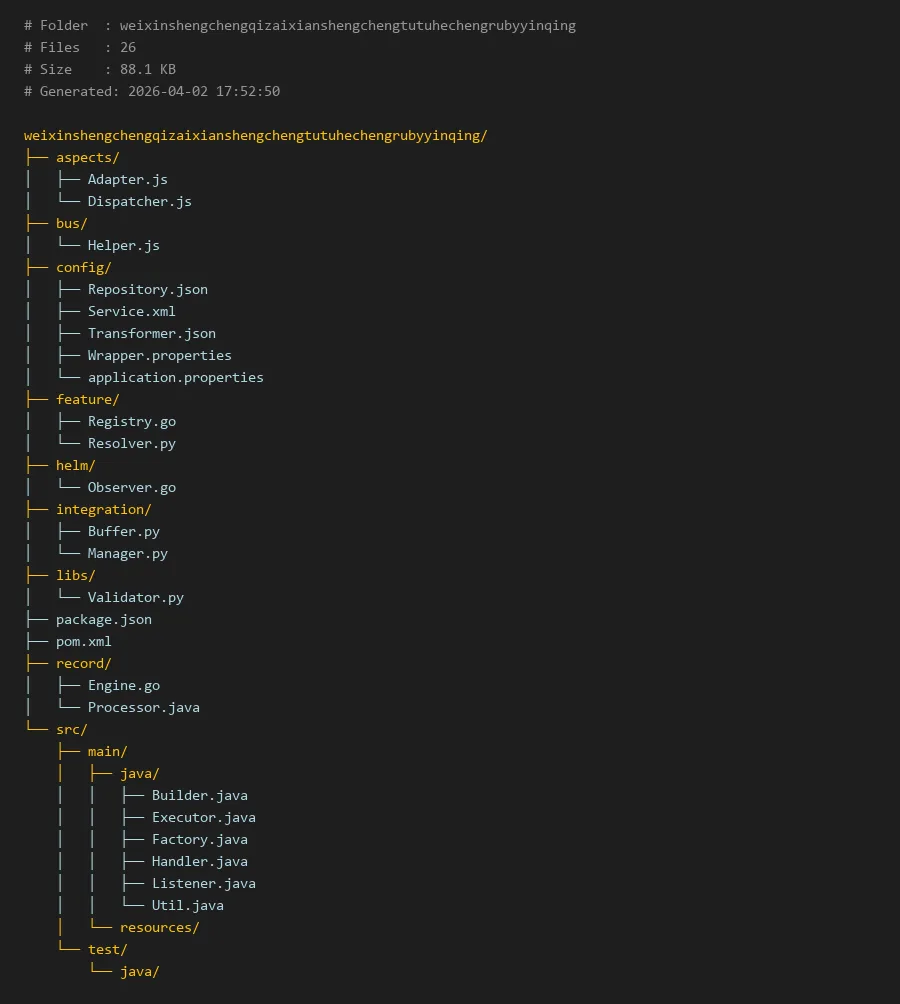
# Folder  : weixinshengchengqizaixianshengchengtutuhechengrubyyinqing
# Files   : 26
# Size    : 88.1 KB
# Generated: 2026-04-02 17:52:50

weixinshengchengqizaixianshengchengtutuhechengrubyyinqing/
├── aspects/
│   ├── Adapter.js
│   └── Dispatcher.js
├── bus/
│   └── Helper.js
├── config/
│   ├── Repository.json
│   ├── Service.xml
│   ├── Transformer.json
│   ├── Wrapper.properties
│   └── application.properties
├── feature/
│   ├── Registry.go
│   └── Resolver.py
├── helm/
│   └── Observer.go
├── integration/
│   ├── Buffer.py
│   └── Manager.py
├── libs/
│   └── Validator.py
├── package.json
├── pom.xml
├── record/
│   ├── Engine.go
│   └── Processor.java
└── src/
    ├── main/
    │   ├── java/
    │   │   ├── Builder.java
    │   │   ├── Executor.java
    │   │   ├── Factory.java
    │   │   ├── Handler.java
    │   │   ├── Listener.java
    │   │   └── Util.java
    │   └── resources/
    └── test/
        └── java/
微信生成器在线生成图片和Gruby引擎
简介
在当今社交媒体盛行的时代,快速生成吸引人的图片内容成为了许多运营者和开发者的需求。微信生成器在线生成图片工具应运而生,它结合了现代Web技术和后端处理引擎,为用户提供了一站式的图片生成解决方案。本项目采用模块化架构设计,通过Gruby引擎(一个基于Ruby和Go混合技术栈的渲染引擎)实现高效的图片合成和处理能力。本文将深入探讨该项目的核心模块,并通过具体的代码示例展示其实现原理。
核心模块说明
项目采用分层架构,主要包含以下几个核心模块:
配置管理模块(config/):负责管理应用程序的各种配置,包括服务配置、转换规则和包装参数等。支持多种格式的配置文件,如JSON、XML和Properties文件。
功能注册与解析模块(feature/):提供动态功能注册和依赖解析能力。Registry.go负责功能组件的注册管理,Resolver.py处理依赖关系的解析。
集成处理模块(integration/):包含缓冲区和管理器组件,用于处理图片生成过程中的数据流和任务调度。
切面编程模块(aspects/):实现横切关注点的处理,如适配器模式和事件分发机制,增强系统的可扩展性。
验证库模块(libs/):提供数据验证功能,确保输入参数的合法性和安全性。
Helm监控模块(helm/):实现系统监控和观察者模式,用于跟踪图片生成过程中的状态变化。
代码示例
1. 配置管理模块示例
首先,让我们查看配置文件的结构。config/Repository.json定义了图片生成模板的存储配置:
{

  "templates": {

    "wechat_moment": {

      "width": 1080,
      "height": 1920,
      "background": "#FFFFFF",
      "layers": [
        {

          "type": "text",
          "font": "PingFang SC",
          "size": 36,
          "color": "#333333"
        },
        {

          "type": "image",
          "max_width": 800,
          "max_height": 600
        }
      ]
    },
    "article_cover": {

      "width": 900,
      "height": 500,
      "background": "gradient"
    }
  },
  "storage": {

    "local_path": "/var/data/weixin_templates",
    "cloud_bucket": "weixin-generator-assets"
  }
}
config/Service.xml配置了Gruby引擎的服务参数:
<services>
  <gruby_engine>
    <name>ImageGenerationEngine</name>
    <version>2.1.0</version>
    <thread_pool>
      <core_size>10</core_size>
      <max_size>50</max_size>
      <queue_capacity>1000</queue_capacity>
    </thread_pool>
    <rendering>
      <default_format>PNG</default_format>
      <quality>95</quality>
      <timeout_ms>30000</timeout_ms>
    </rendering>
  </gruby_engine>

  <wechat_integration>
    <api_endpoint>https://api.weixin.qq.com</api_endpoint>
    <auth_type>oauth2</auth_type>
    <rate_limit>100</rate_limit>
  </wechat_integration>
</services>
2. 功能注册模块示例
feature/Registry.go展示了Go语言实现的功能注册器:
package feature

import (
    "sync"
    "errors"
)

// TemplateRegistry 管理图片生成模板
type TemplateRegistry struct {

    templates map[string]*ImageTemplate
    mu        sync.RWMutex
}

// ImageTemplate 定义图片模板结构
type ImageTemplate struct {

    ID          string
    Name        string
    Width       int
    Height      int
    Layers      []LayerConfig
    CreatedAt   int64
    UpdatedAt   int64
}

// LayerConfig 定义图层配置
type LayerConfig struct {

    Type        string
    Position    Position
    Content     interface{
   }
    Style       map[string]interface{
   }
}

// Position 定义元素位置
type Position struct {

    X int
    Y int
}

// RegisterTemplate 注册新模板
func (r *TemplateRegistry) RegisterTemplate(template *ImageTemplate) error {

    r.mu.Lock()
    defer r.mu.Unlock()

    if template.ID == "" {

        return errors.New("template ID cannot be empty")
    }

    if _, exists := r.templates[template.ID]; exists {

        return errors.New("template already exists")
    }

    r.templates[template.ID] = template
    return nil
}

// GetTemplate 获取模板
func (r *TemplateRegistry) GetTemplate(id string) (*ImageTemplate, error) {

    r.mu.RLock()
    defer r.mu.RUnlock()

    template, exists := r.templates[id]
    if !exists {

        return nil, errors.New("template not found")
    }

    return template, nil
}

// NewTemplateRegistry 创建新的注册器实例
func NewTemplateRegistry() *TemplateRegistry {

    return &TemplateRegistry{

        templates: make(map[string]*ImageTemplate),
    }
}
3. 图片生成处理器示例
integration/Manager.py展示了Python实现的图片生成管理器:
```python
import asyncio
import json
from datetime import datetime