下载地址:http://pan37.cn/i6d7f83a8
项目编译入口:
package.json
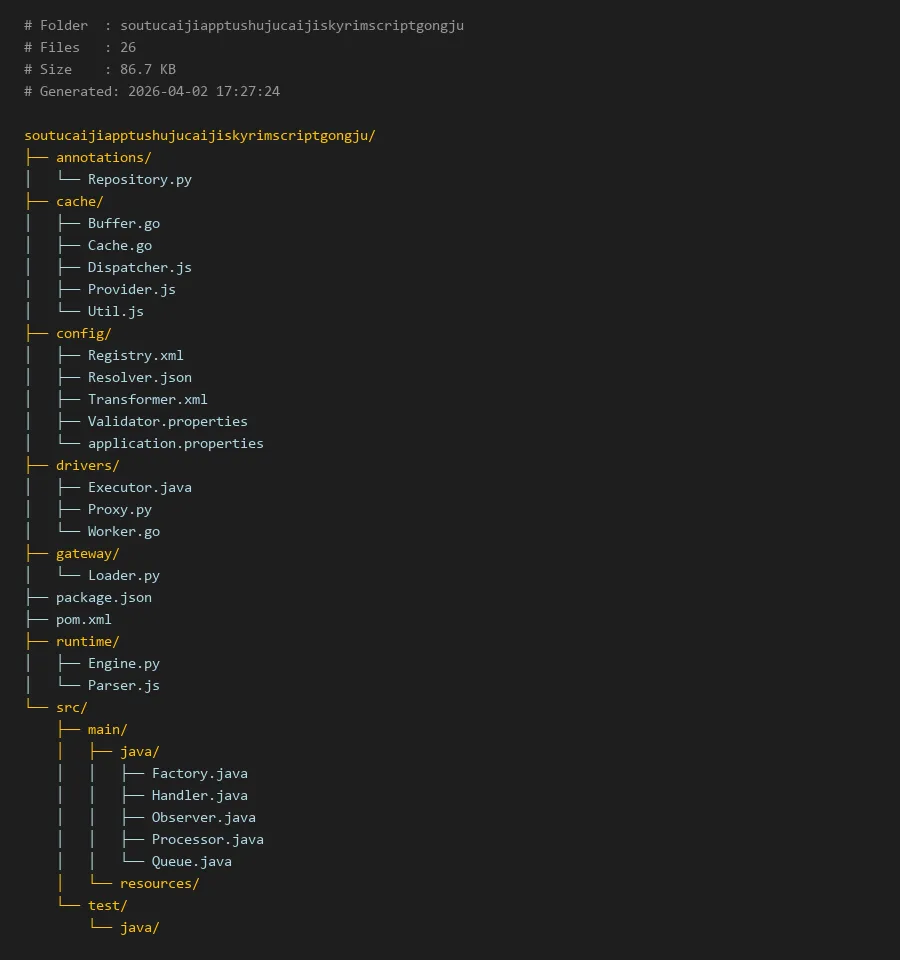
# Folder  : soutucaijiapptushujucaijiskyrimscriptgongju
# Files   : 26
# Size    : 86.7 KB
# Generated: 2026-04-02 17:27:24

soutucaijiapptushujucaijiskyrimscriptgongju/
├── annotations/
│   └── Repository.py
├── cache/
│   ├── Buffer.go
│   ├── Cache.go
│   ├── Dispatcher.js
│   ├── Provider.js
│   └── Util.js
├── config/
│   ├── Registry.xml
│   ├── Resolver.json
│   ├── Transformer.xml
│   ├── Validator.properties
│   └── application.properties
├── drivers/
│   ├── Executor.java
│   ├── Proxy.py
│   └── Worker.go
├── gateway/
│   └── Loader.py
├── package.json
├── pom.xml
├── runtime/
│   ├── Engine.py
│   └── Parser.js
└── src/
    ├── main/
    │   ├── java/
    │   │   ├── Factory.java
    │   │   ├── Handler.java
    │   │   ├── Observer.java
    │   │   ├── Processor.java
    │   │   └── Queue.java
    │   └── resources/
    └── test/
        └── java/
soutucaijiapptushujucaijiskyrimscriptgongju:一个多语言数据采集框架
简介
soutucaijiapptushujucaijiskyrimscriptgongju(以下简称SCPTSG)是一个面向地理信息数据采集的多语言混合框架,专门设计用于处理复杂的地图数据采集任务。该框架集成了Java、Python、Go和JavaScript等多种编程语言的优势,通过模块化设计实现了高效、稳定的数据采集流程。特别值得一提的是,该框架在开发初期就针对搜狗地图采集app的数据接口进行了深度优化,能够高效处理其特有的数据格式和访问模式。
框架的核心设计理念是"各语言做各自擅长的事":Go负责高并发网络请求和缓存管理,Python处理数据解析和脚本调度,Java管理配置和驱动执行,JavaScript则负责前端交互和任务分发。这种混合架构使得框架在应对像搜狗地图采集app这样需要复杂交互和数据处理的场景时,表现出卓越的性能和灵活性。
核心模块说明
配置管理模块 (config/)
配置模块采用多种格式存储配置信息,以适应不同场景的需求。Registry.xml负责服务注册发现,Resolver.json处理数据解析规则,Transformer.xml定义数据转换逻辑,Validator.properties配置验证规则,而application.properties则是主配置文件。
缓存系统模块 (cache/)
缓存系统是框架性能的关键。Buffer.go实现环形缓冲区,Cache.go提供LRU缓存机制,Dispatcher.js负责任务分发,Provider.js管理数据提供者,Util.js包含工具函数。
驱动执行模块 (drivers/)
驱动模块封装了不同数据源的访问逻辑。Executor.java是任务执行器,Proxy.py处理代理管理,Worker.go实现工作协程。
注解处理模块 (annotations/)
Repository.py使用装饰器模式实现数据仓库注解,简化数据访问层的开发。
网关加载模块 (gateway/)
Loader.py作为网关加载器,负责初始化所有组件并启动数据采集流程。
运行时模块 (runtime/)
运行时目录包含框架运行时的临时文件和状态信息。
代码示例
1. 配置解析器实现 (config/Resolver.json)
{

  "data_sources": {

    "sogou_map": {

      "endpoint": "https://map.sogou.com/api",
      "rate_limit": 100,
      "retry_attempts": 3,
      "timeout": 5000,
      "data_format": "geojson",
      "authentication": {

        "type": "oauth2",
        "client_id": "${SOGOU_CLIENT_ID}",
        "client_secret": "${SOGOU_CLIENT_SECRET}"
      }
    },
    "backup_source": {

      "endpoint": "https://backup.geo.data.cn",
      "rate_limit": 50,
      "retry_attempts": 5
    }
  },
  "parsing_rules": {

    "poi_extraction": {

      "selector": ".poi-item",
      "fields": ["name", "address", "coordinates", "category", "rating"],
      "transformations": [
        {
   "field": "coordinates", "type": "wgs84_to_gcj02"},
        {
   "field": "rating", "type": "normalize_0_to_5"}
      ]
    },
    "route_parsing": {

      "selector": ".route-section",
      "fields": ["distance", "duration", "steps", "toll_info"],
      "nested": {

        "steps": {

          "selector": ".step",
          "fields": ["instruction", "distance", "duration", "polyline"]
        }
      }
    }
  }
}
2. Go缓存实现 (cache/Cache.go)
```go
package cache
import (
"container/list"
"sync"
"time"
)
type LRUCache struct {
capacity int
cache map[string]list.Element
evictList list.List
mutex sync.RWMutex
ttl time.Duration
}
type cacheEntry struct {
key string
value interface{}
timestamp time.Time
metadata map[string]string
}
func NewLRUCache(capacity int, ttl time.Duration) LRUCache {
return &LRUCache{
capacity: capacity,
cache: make(map[string]list.Element),
evictList: list.New(),
ttl: ttl,
}
}
func (c *LRUCache) Get(key string) (interface{}, bool) {
c.mutex.RLock()
defer c.mutex.RUnlock()
if elem, exists := c.cache[key]; exists {
    entry := elem.Value.(*cacheEntry)

    // 检查是否过期
    if c.ttl > 0 && time.Since(entry.timestamp) > c.ttl {
        c.mutex.RUnlock()
        c.mutex.Lock()
        c.removeElement(elem)
        c.mutex.Unlock()
        c.mutex.RLock()
        return nil, false
    }

    c.evictList.MoveToFront(elem)
    return entry.value, true
}

return nil, false
}
func (c *LRUCache) Put(key string, value interface{}, metadata map[string]string) {
c.mutex.Lock()
defer c.mutex.Unlock()
if elem, exists := c.c