下载地址:http://pan38.cn/ia534b221
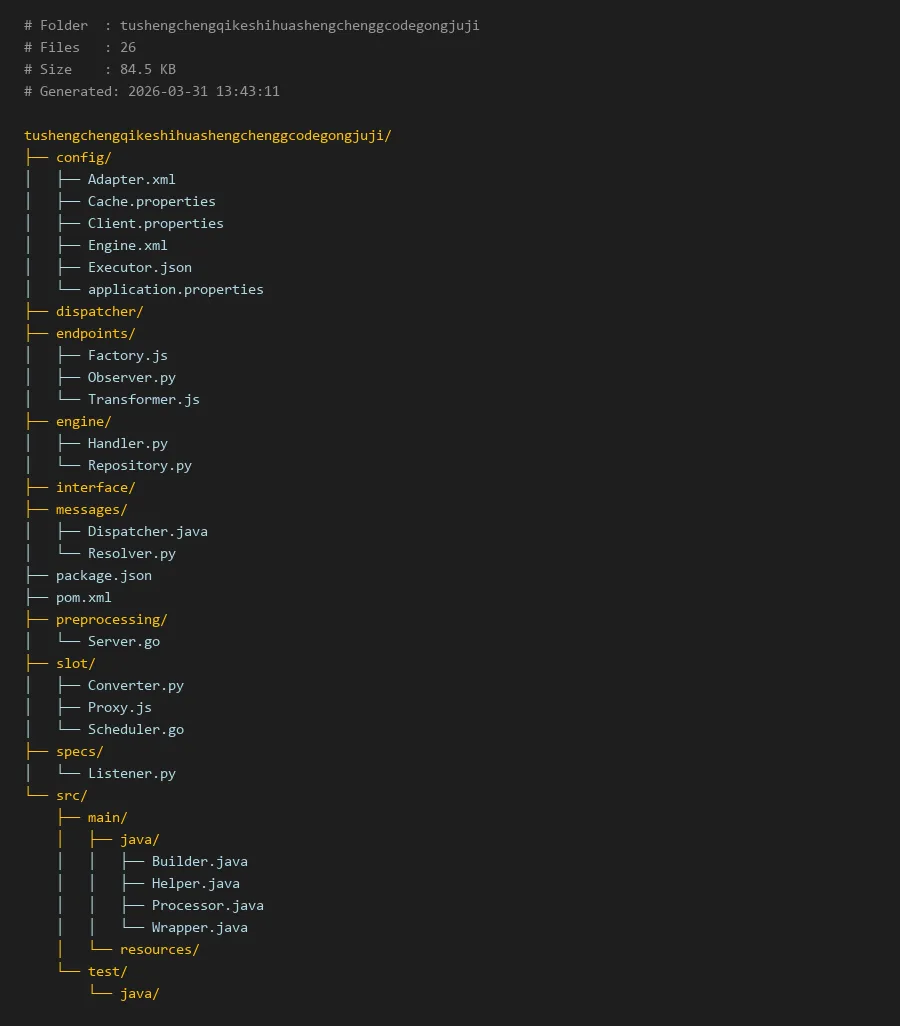
项目编译入口:
package.json
# Folder  : tushengchengqikeshihuashengchenggcodegongjuji
# Files   : 26
# Size    : 84.5 KB
# Generated: 2026-03-31 13:43:11

tushengchengqikeshihuashengchenggcodegongjuji/
├── config/
│   ├── Adapter.xml
│   ├── Cache.properties
│   ├── Client.properties
│   ├── Engine.xml
│   ├── Executor.json
│   └── application.properties
├── dispatcher/
├── endpoints/
│   ├── Factory.js
│   ├── Observer.py
│   └── Transformer.js
├── engine/
│   ├── Handler.py
│   └── Repository.py
├── interface/
├── messages/
│   ├── Dispatcher.java
│   └── Resolver.py
├── package.json
├── pom.xml
├── preprocessing/
│   └── Server.go
├── slot/
│   ├── Converter.py
│   ├── Proxy.js
│   └── Scheduler.go
├── specs/
│   └── Listener.py
└── src/
    ├── main/
    │   ├── java/
    │   │   ├── Builder.java
    │   │   ├── Helper.java
    │   │   ├── Processor.java
    │   │   └── Wrapper.java
    │   └── resources/
    └── test/
        └── java/
tushengchengqikeshihuashengchenggcodegongjuji:从配置到生成的完整代码解析
简介
tushengchengqikeshihuashengchenggcodegongjuji是一个专门用于生成可视化收益图表的代码生成工具集。该项目采用模块化设计,通过配置文件驱动代码生成过程,能够根据不同的业务需求快速生成相应的G-code指令和可视化组件。这个工具集特别适合需要批量生成收益分析图表的金融科技场景,开发者可以借助这个"一键收益图生成器"大幅提升开发效率。
核心模块说明
项目结构清晰地划分为配置管理、消息处理、端点转换和引擎执行四大核心模块。config目录存放所有配置文件,包括适配器配置、缓存设置和客户端参数。messages模块负责消息的分发与解析,endpoints处理不同端点的数据转换,engine则是整个生成过程的核心执行引擎。
预处理模块虽然当前为空,但为未来的数据清洗和格式化功能预留了扩展空间。整个架构支持插件化扩展,使得这个"一键收益图生成器"能够适应不断变化的业务需求。
代码示例
配置文件解析
首先查看核心配置文件,这些文件定义了代码生成的基本规则和参数:
# config/application.properties
# 收益图生成基础配置
generator.chart.type=line
generator.chart.resolution=300dpi
generator.output.format=svg
generator.color.scheme=financial
generator.data.source=database

# 代码生成参数
gcode.precision=0.01
gcode.unit=millimeter
gcode.speed=1000
gcode.acceleration=500
// config/Executor.json
{

  "execution": {

    "mode": "batch",
    "concurrent": true,
    "max_threads": 4,
    "timeout": 30000
  },
  "validation": {

    "syntax_check": true,
    "semantic_check": true,
    "optimization_level": 2
  },
  "output": {

    "directory": "./generated",
    "backup_count": 5,
    "compress": true
  }
}
消息分发机制
消息模块负责处理生成请求和响应:
// messages/Dispatcher.java
package messages;

import java.util.concurrent.BlockingQueue;
import java.util.concurrent.LinkedBlockingQueue;

public class Dispatcher {

    private BlockingQueue<GenerationRequest> requestQueue;
    private BlockingQueue<GenerationResponse> responseQueue;

    public Dispatcher() {

        this.requestQueue = new LinkedBlockingQueue<>(1000);
        this.responseQueue = new LinkedBlockingQueue<>(1000);
    }

    public void dispatchRequest(GenerationRequest request) {

        try {

            requestQueue.put(request);
            log("Request dispatched: " + request.getId());
        } catch (InterruptedException e) {

            Thread.currentThread().interrupt();
            throw new DispatchException("Failed to dispatch request", e);
        }
    }

    public GenerationResponse awaitResponse(String requestId, long timeout) {

        // 等待特定请求的响应
        long startTime = System.currentTimeMillis();
        while (System.currentTimeMillis() - startTime < timeout) {

            for (GenerationResponse response : responseQueue) {

                if (response.getRequestId().equals(requestId)) {

                    responseQueue.remove(response);
                    return response;
                }
            }
            try {

                Thread.sleep(100);
            } catch (InterruptedException e) {

                Thread.currentThread().interrupt();
                break;
            }
        }
        throw new TimeoutException("Response timeout for request: " + requestId);
    }

    private void log(String message) {

        System.out.println("[Dispatcher] " + message);
    }
}
端点转换器
端点模块负责将不同格式的数据转换为统一的内部表示:
```python
endpoints/Transformer.js
const ChartType = {
LINE: 'line',
BAR: 'bar',
PIE: 'pie',
SCATTER: 'scatter'
};
class DataTransformer {
constructor(config) {
this.config = config;
this.validators = new Map();
this.initializeValidators();
}
initializeValidators() {
    this.validators.set(ChartType.LINE, this.validateLineData.bind(this));
    this.validators.set(ChartType.BAR, this.validateBarData.bind(this));
    this.validators.set(ChartType.PIE, this.validatePieData.bind(this));
}

transform(rawData, chartType) {
    const validator = this.validators.get(chartType);
    if (!validator) {
        throw new Error(`Unsupported chart type: ${chartType}`);
    }

    if (!validator(rawData)) {
        throw new Error(`Invalid data for chart type: ${chartType}`);
    }

    return this.normalizeData(rawData, chartType);
}

validateLineData(data) {
    return Array.isArray(data.points) &&
           data.points.every(p =>
               typeof p.x === 'number' &&
               typeof p.y === 'number'
           );
}

normalizeData(data, chartType) {
    const normalized = {
        metadata: {
            chartType: chartType,
            timestamp: Date.now(),
            version: '1.0'
        },
        dataset: []
    };

    switch(chartType) {
        case ChartType.LINE:
            normalized.dataset = data.points.map(point => ({
                x: this.round(point.x, 2),
                y: this.round