下载地址:http://pan38.cn/id1d33444
项目编译入口:
package.json
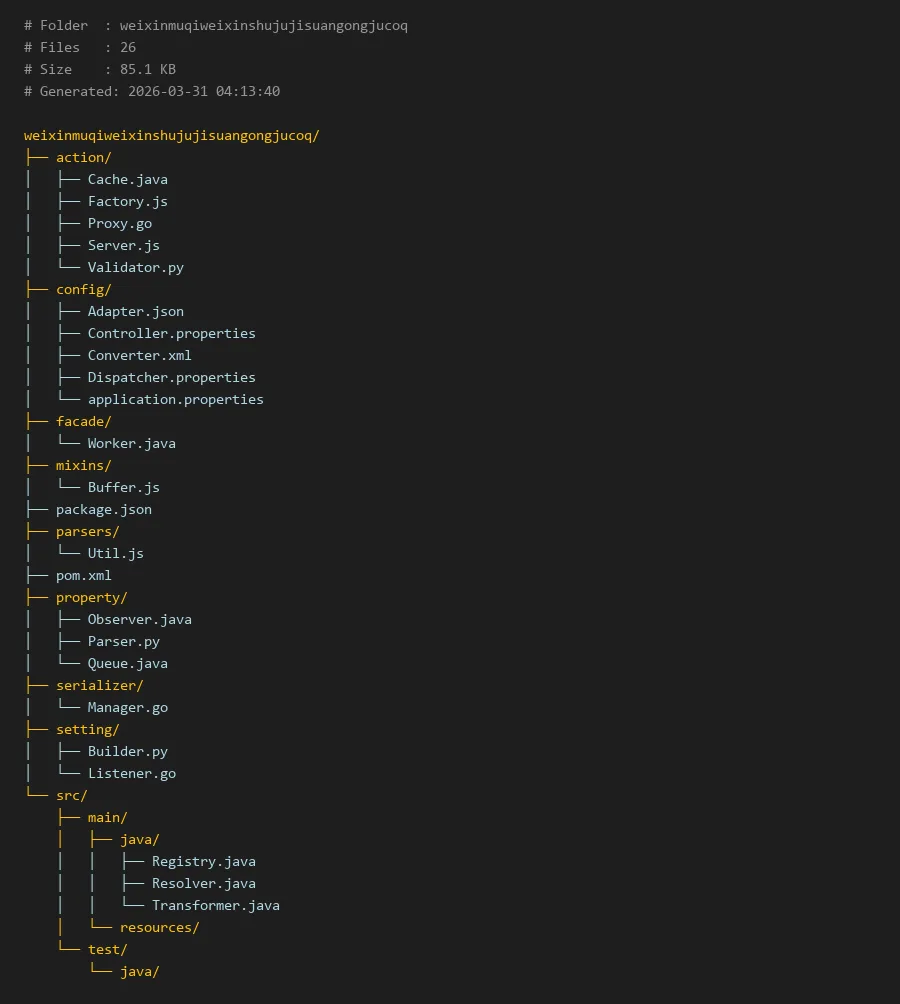
# Folder  : weixinmuqiweixinshujujisuangongjucoq
# Files   : 26
# Size    : 85.1 KB
# Generated: 2026-03-31 04:13:40

weixinmuqiweixinshujujisuangongjucoq/
├── action/
│   ├── Cache.java
│   ├── Factory.js
│   ├── Proxy.go
│   ├── Server.js
│   └── Validator.py
├── config/
│   ├── Adapter.json
│   ├── Controller.properties
│   ├── Converter.xml
│   ├── Dispatcher.properties
│   └── application.properties
├── facade/
│   └── Worker.java
├── mixins/
│   └── Buffer.js
├── package.json
├── parsers/
│   └── Util.js
├── pom.xml
├── property/
│   ├── Observer.java
│   ├── Parser.py
│   └── Queue.java
├── serializer/
│   └── Manager.go
├── setting/
│   ├── Builder.py
│   └── Listener.go
└── src/
    ├── main/
    │   ├── java/
    │   │   ├── Registry.java
    │   │   ├── Resolver.java
    │   │   └── Transformer.java
    │   └── resources/
    └── test/
        └── java/
微信模拟器微信数据计算工具簇
简介
在微信生态系统的开发与测试过程中,我们经常需要模拟用户行为并计算相关数据。weixinmuqiweixinshujujisuangongjucoq项目正是为此而生——它是一个集成了微信模拟器功能与数据计算能力的工具集合。通过这个工具,开发者可以在本地环境中模拟微信客户端的各种操作,并实时计算生成的数据指标,极大提升了开发测试效率。如果你正在寻找可靠的微信模拟器下载资源,这个项目的代码实现将为你提供核心思路。
项目采用多语言混合架构,充分利用了Java、Python、JavaScript和Go等语言的优势,形成了模块化、可扩展的工具簇。下面我们将深入解析其核心模块。
核心模块说明
项目结构清晰地划分为几个功能区域:
- action/ - 行为模拟层:包含各种模拟微信客户端行为的组件
- config/ - 配置管理层:统一管理项目配置和适配器设置
- facade/ - 外观层:提供简化的统一接口
- property/ - 属性处理层:负责数据解析和队列管理
- parsers/ - 解析器层:专门处理数据解析逻辑
每个模块都有明确的职责边界,通过标准接口进行通信。这种设计使得工具簇既能够协同工作,又可以独立使用。
代码示例
1. 微信行为模拟工厂(Factory.js)
位于action/Factory.js的工厂类负责创建不同类型的微信模拟行为:
class WeChatActionFactory {

    constructor(config) {

        this.config = config;
        this.actions = new Map();
    }

    createAction(actionType, params) {

        switch(actionType) {

            case 'message':
                return new MessageAction(params);
            case 'payment':
                return new PaymentAction(params);
            case 'login':
                return new LoginAction(params);
            case 'friend_request':
                return new FriendRequestAction(params);
            default:
                throw new Error(`Unsupported action type: ${
     actionType}`);
        }
    }

    async simulateUserSession(userProfile, actionsSequence) {

        const session = new UserSession(userProfile);
        for (const actionDef of actionsSequence) {

            const action = this.createAction(actionDef.type, actionDef.params);
            await action.execute(session);
            this.calculateMetrics(session);
        }
        return session.getMetrics();
    }

    calculateMetrics(session) {

        // 计算消息频率、响应时间等指标
        const metrics = {

            messageCount: session.messages.length,
            avgResponseTime: this.calculateAvgResponseTime(session),
            interactionScore: this.calculateInteractionScore(session)
        };
        session.metrics = {
    ...session.metrics, ...metrics };
    }
}

module.exports = WeChatActionFactory;
2. 数据缓存管理(Cache.java)
action/Cache.java实现了微信数据的高效缓存机制:
package action;

import java.util.LinkedHashMap;
import java.util.Map;
import java.util.concurrent.ConcurrentHashMap;

public class WeChatDataCache {

    private static final int MAX_CACHE_SIZE = 1000;
    private final Map<String, CacheEntry> cache;

    public WeChatDataCache() {

        this.cache = new ConcurrentHashMap<>();
    }

    public static class CacheEntry {

        private final Object data;
        private final long timestamp;
        private final String dataType;

        public CacheEntry(Object data, String dataType) {

            this.data = data;
            this.dataType = dataType;
            this.timestamp = System.currentTimeMillis();
        }

        public boolean isExpired(long ttl) {

            return System.currentTimeMillis() - timestamp > ttl;
        }
    }

    public void put(String key, Object data, String dataType) {

        if (cache.size() >= MAX_CACHE_SIZE) {

            evictOldEntries();
        }
        cache.put(key, new CacheEntry(data, dataType));
    }

    public Object get(String key) {

        CacheEntry entry = cache.get(key);
        if (entry == null) {

            return null;
        }

        // 根据数据类型设置不同的TTL
        long ttl = getTTLForType(entry.dataType);
        if (entry.isExpired(ttl)) {

            cache.remove(key);
            return null;
        }

        return entry.data;
    }

    private long getTTLForType(String dataType) {

        switch(dataType) {

            case "message": return 300000; // 5分钟
            case "user_info": return 3600000; // 1小时
            case "session": return 1800000; // 30分钟
            default: return 600000; // 10分钟
        }
    }

    private void evictOldEntries() {

        cache.entrySet().stream()
            .sorted((e1, e2) -> Long.compare(
                e1.getValue().timestamp,
                e2.getValue().timestamp
            ))
            .limit(100)
            .forEach(entry -> cache.remove(entry.getKey()));
    }
}
3. 配置适配器(Adapter.json)
config/Adapter.json定义了不同微信版本的适配规则:
```json
{
"wechat_adapters": {
"version_8_0": {
"api_endpoints": {
"send_message": "/api/v8/message/send",
"get_user_info": "/api/v8/user/info",
"payment": "/api/v8/payment/create"
},
"data_formats