下载地址:http://lanzou.co/i9724ada0
项目编译入口:
package.json
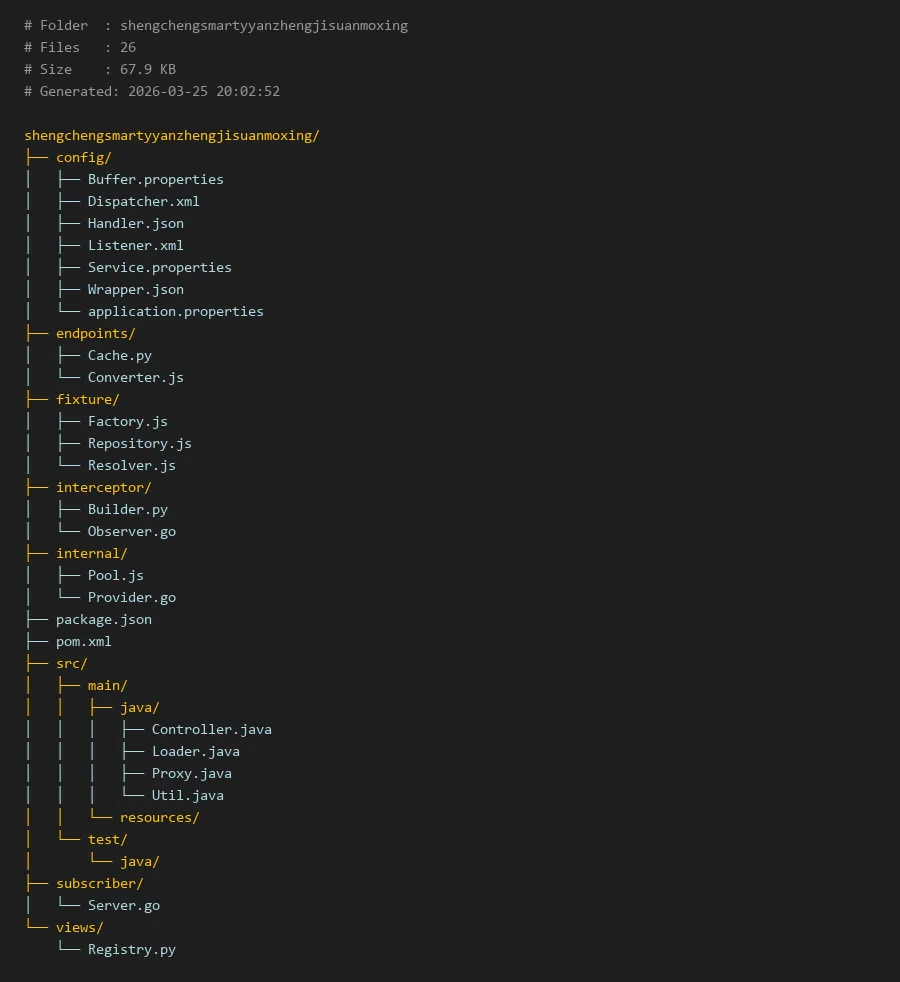
# Folder  : shengchengsmartyyanzhengjisuanmoxing
# Files   : 26
# Size    : 67.9 KB
# Generated: 2026-03-25 20:02:52

shengchengsmartyyanzhengjisuanmoxing/
├── config/
│   ├── Buffer.properties
│   ├── Dispatcher.xml
│   ├── Handler.json
│   ├── Listener.xml
│   ├── Service.properties
│   ├── Wrapper.json
│   └── application.properties
├── endpoints/
│   ├── Cache.py
│   └── Converter.js
├── fixture/
│   ├── Factory.js
│   ├── Repository.js
│   └── Resolver.js
├── interceptor/
│   ├── Builder.py
│   └── Observer.go
├── internal/
│   ├── Pool.js
│   └── Provider.go
├── package.json
├── pom.xml
├── src/
│   ├── main/
│   │   ├── java/
│   │   │   ├── Controller.java
│   │   │   ├── Loader.java
│   │   │   ├── Proxy.java
│   │   │   └── Util.java
│   │   └── resources/
│   └── test/
│       └── java/
├── subscriber/
│   └── Server.go
└── views/
    └── Registry.py
shengchengsmartyyanzhengjisuanmoxing:生成式智能验证计算模型
简介
在当今的软件架构中,验证计算模型扮演着至关重要的角色。shengchengsmartyyanzhengjisuanmoxing(生成式智能验证计算模型)是一个多语言混合架构的项目,旨在通过配置驱动和模块化设计,实现高效、灵活的验证逻辑生成与执行。该项目融合了Python、JavaScript、Go等多种语言的优势,通过精心设计的文件结构,将配置管理、端点处理、拦截器、内部服务等模块有机整合,为复杂业务场景下的验证需求提供了一套完整的解决方案。
项目的核心思想在于“生成式”与“智能验证”。它不仅仅是一个静态的验证库,而是一个能够根据配置动态生成验证规则、智能适配业务场景的计算模型。通过解析配置文件,项目可以自动组装验证链,调用相应的处理端点,并利用拦截器进行切面处理,最终通过内部服务池提供稳定的计算资源。
核心模块说明
项目结构清晰地划分了各个职责域:
- config/:项目的神经中枢。所有核心配置均存放于此,以不同格式(.properties, .xml, .json)定义验证流程的各个环节,如服务发现、处理器映射、事件监听、缓冲区设置等。
- endpoints/:对外端点。包含具体的验证逻辑执行单元,例如缓存操作和数据类型转换,是验证计算模型直接与外部数据交互的边界。
- fixture/:测试固件与数据工厂。用于在验证过程中构造测试数据、访问数据仓库以及进行依赖解析,确保验证逻辑在可控的环境下运行。
- interceptor/:拦截器。提供面向切面编程的能力,在验证流程的关键节点进行拦截,实现日志、监控、权限校验等通用功能,是模型“智能”的一部分。
- internal/:内部服务。包含资源池和服务提供者,管理模型运行所需的核心资源(如连接池、线程池),并向其他模块提供稳定的服务实例。
- package.json 与 pom.xml:分别定义了Node.js/JavaScript生态和Java/Maven生态的项目依赖与构建脚本,体现了项目的多语言支持特性。
代码示例
以下代码示例将展示如何利用项目中的关键模块,构建一个简单的用户输入验证流程。
1. 读取核心配置 (application.properties)
首先,模型需要从config/application.properties中读取基础配置,确定验证模式和环境参数。
# config/application.properties
validation.mode=strict
cache.enabled=true
default.locale=zh_CN
我们可以通过一个简单的Python脚本来加载此配置,该脚本可能由internal/Provider.go或某个端点触发。
# 示例:模拟配置加载逻辑
import configparser

def load_app_config(config_path='shengchengsmartyyanzhengjisuanmoxing/config/application.properties'):
    config = configparser.ConfigParser()
    # 注意:标准的Properties文件需要稍作处理,这里使用自定义读取
    config_dict = {
   }
    with open(config_path, 'r', encoding='utf-8') as f:
        for line in f:
            line = line.strip()
            if line and not line.startswith('#'):
                key, value = line.split('=', 1)
                config_dict[key.strip()] = value.strip()
    return config_dict

app_config = load_app_config()
print(f"验证模式: {app_config.get('validation.mode')}")
2. 使用端点进行数据转换与缓存
假设我们需要验证一个用户提交的JSON数据。首先,利用endpoints/Converter.js对输入数据进行规范化处理,然后使用endpoints/Cache.py检查缓存中是否存在已验证的相同结果。
// endpoints/Converter.js - 简化示例
class DataConverter {

    static normalizeUserInput(input) {

        // 智能转换逻辑:例如,统一修剪字符串,转换数字格式
        let normalized = {
    ...input };
        if (normalized.age) {

            normalized.age = parseInt(normalized.age, 10);
        }
        if (normalized.username) {

            normalized.username = normalized.username.trim().toLowerCase();
        }
        console.log(`[Converter] 规范化输入: ${
     JSON.stringify(normalized)}`);
        return normalized;
    }
}

// 假设在某个处理器中调用
const rawInput = {
    username: '  ALICE ', age: '25' };
const cleanInput = DataConverter.normalizeUserInput(rawInput);
```python
endpoints/Cache.py - 简化示例
import hashlib
import json
class ValidationCache:
def init(self):
self._cache = {} # 实际可能连接Redis或使用internal/Pool.js
def get_key(self, data):
    """为验证数据生成唯一键"""
    data_str = json.dumps(data, sort_keys=True)
    return hashlib.md5(data_str.encode()).hexdigest()

def get(self, key):
    result = self._cache.get(key)
    print(f"[Cache] {'命中' if result else '未命中'} 键: {key}")
    return result

def set(self, key, validation_result):
    self._cache[key] = validation_result
    print(f"[Cache] 设置缓存 键: {key}")
使用示例
cache = ValidationCache()
cache_key = cache.get_key(cleanInput) # cleanInput来自上一步
cached_result = cache.get(cache_key)
if cached_result is None:
# 执行实际验证