下载地址:http://lanzou.co/i7e730264
项目编译入口:
package.json
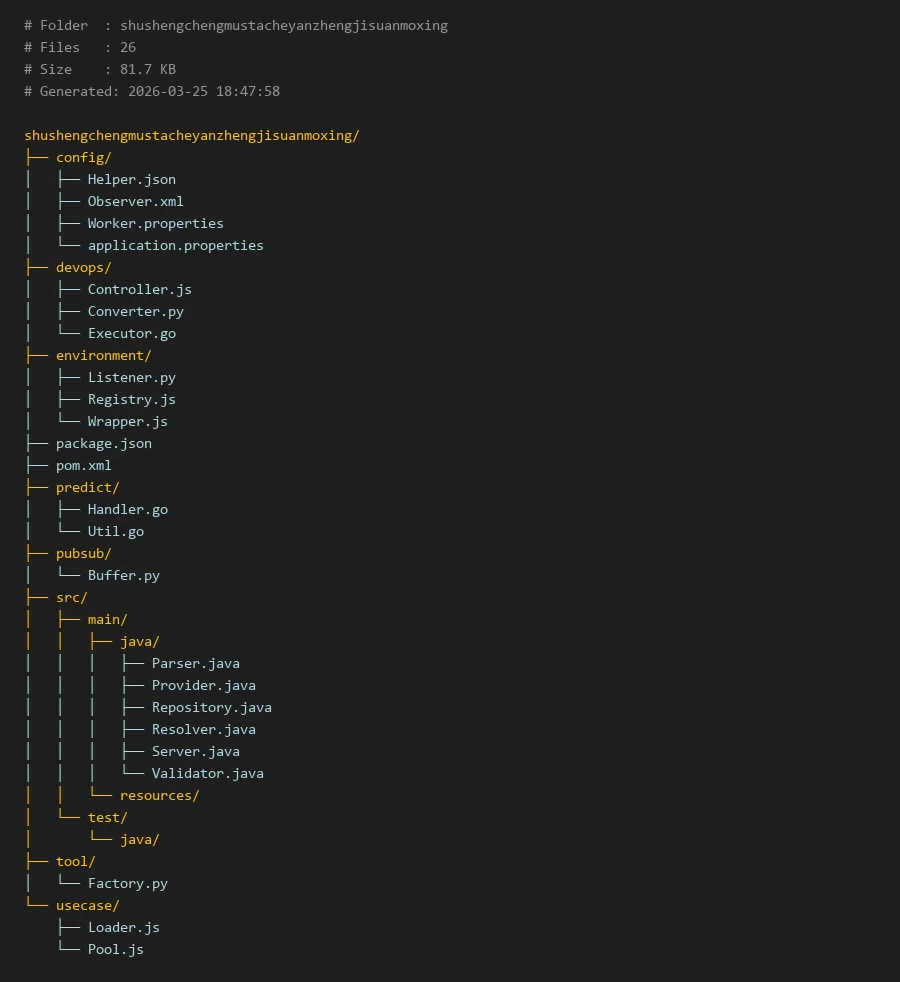
# Folder  : shushengchengmustacheyanzhengjisuanmoxing
# Files   : 26
# Size    : 81.7 KB
# Generated: 2026-03-25 18:47:58

shushengchengmustacheyanzhengjisuanmoxing/
├── config/
│   ├── Helper.json
│   ├── Observer.xml
│   ├── Worker.properties
│   └── application.properties
├── devops/
│   ├── Controller.js
│   ├── Converter.py
│   └── Executor.go
├── environment/
│   ├── Listener.py
│   ├── Registry.js
│   └── Wrapper.js
├── package.json
├── pom.xml
├── predict/
│   ├── Handler.go
│   └── Util.go
├── pubsub/
│   └── Buffer.py
├── src/
│   ├── main/
│   │   ├── java/
│   │   │   ├── Parser.java
│   │   │   ├── Provider.java
│   │   │   ├── Repository.java
│   │   │   ├── Resolver.java
│   │   │   ├── Server.java
│   │   │   └── Validator.java
│   │   └── resources/
│   └── test/
│       └── java/
├── tool/
│   └── Factory.py
└── usecase/
    ├── Loader.js
    └── Pool.js
shushengchengmustacheyanzhengjisuanmoxing:一个多语言验证计算模型框架
简介
shushengchengmustacheyanzhengjisuanmoxing是一个创新的多语言验证计算模型框架,旨在为复杂的数据验证和计算任务提供统一的解决方案。该框架采用模块化设计,支持多种编程语言协同工作,通过配置文件驱动验证逻辑,实现了高度可扩展的验证计算模型。
框架的核心思想是将验证规则与计算逻辑分离,通过配置文件定义验证规则,而计算模型则由不同语言的模块实现。这种设计使得系统能够灵活适应各种业务场景,同时保持代码的清晰性和可维护性。
核心模块说明
框架包含以下几个核心模块:
- 配置模块:位于config目录,包含各种格式的配置文件,用于定义验证规则和系统参数
- 开发运维模块:位于devops目录,包含控制器、转换器和执行器等核心组件
- 环境模块:位于environment目录,处理系统环境相关的监听、注册和包装功能
- 预测模块:位于predict目录,包含处理预测逻辑的处理器和工具
- 发布订阅模块:位于pubsub目录,实现消息缓冲机制
- 源代码模块:位于src目录,包含主要的Java解析器实现
代码示例
1. 配置文件解析示例
首先,让我们看看如何解析配置文件中的验证规则。以下是一个Java解析器的示例:
// src/main/java/Parser.java
package com.shushengcheng.mustache.yanzheng.jisuan.moxing;

import java.io.FileInputStream;
import java.util.Properties;
import javax.xml.parsers.DocumentBuilder;
import javax.xml.parsers.DocumentBuilderFactory;
import org.json.JSONObject;
import org.json.JSONTokener;

public class Parser {


    // 解析Properties配置文件
    public Properties parseProperties(String filePath) throws Exception {

        Properties props = new Properties();
        try (FileInputStream fis = new FileInputStream(filePath)) {

            props.load(fis);
        }
        return props;
    }

    // 解析JSON配置文件
    public JSONObject parseJson(String filePath) throws Exception {

        FileInputStream fis = new FileInputStream(filePath);
        JSONTokener tokener = new JSONTokener(fis);
        return new JSONObject(tokener);
    }

    // 解析XML配置文件
    public org.w3c.dom.Document parseXml(String filePath) throws Exception {

        DocumentBuilderFactory factory = DocumentBuilderFactory.newInstance();
        DocumentBuilder builder = factory.newDocumentBuilder();
        return builder.parse(filePath);
    }

    // 验证计算模型主方法
    public Object validateAndCalculate(String configType, String filePath) {

        try {

            switch (configType.toLowerCase()) {

                case "properties":
                    Properties props = parseProperties(filePath);
                    return processPropertiesValidation(props);
                case "json":
                    JSONObject json = parseJson(filePath);
                    return processJsonValidation(json);
                case "xml":
                    org.w3c.dom.Document xml = parseXml(filePath);
                    return processXmlValidation(xml);
                default:
                    throw new IllegalArgumentException("Unsupported config type: " + configType);
            }
        } catch (Exception e) {

            throw new RuntimeException("Validation failed: " + e.getMessage(), e);
        }
    }

    private Object processPropertiesValidation(Properties props) {

        // 实现属性验证逻辑
        System.out.println("Processing properties validation...");
        return props.get("validation.result");
    }

    private Object processJsonValidation(JSONObject json) {

        // 实现JSON验证逻辑
        System.out.println("Processing JSON validation...");
        return json.opt("result");
    }

    private Object processXmlValidation(org.w3c.dom.Document xml) {

        // 实现XML验证逻辑
        System.out.println("Processing XML validation...");
        return xml.getDocumentElement().getAttribute("result");
    }
}
2. 多语言协同工作示例
框架支持多种编程语言协同工作。以下是Python转换器的示例:
```python
devops/Converter.py
import json
import xml.etree.ElementTree as ET
from configparser import ConfigParser
class ConfigConverter:
def init(self):
self.conversion_rules = {}
def load_conversion_rules(self, rules_file):
    """加载转换规则"""
    with open(rules_file, 'r') as f:
        self.conversion_rules = json.load(f)

def convert_properties_to_json(self, properties_file):
    """将Properties文件转换为JSON格式"""
    config = ConfigParser()
    config.read(properties_file)

    result = {}
    for section in config.sections():
        result[section] = dict(config.items(section))

    return json.dumps(result, indent=2)

def apply_validation_rules(self, data, rule_type):
    """应用验证规则"""
    if rule_type not in self.conversion_rules:
        raise ValueError(f"Unknown rule type: {rule_type}")

    rules = self.conversion_rules[rule_type]
    validation_results = []

    for rule in rules:
        field = rule.get('field')
        validator = rule.get('validator')
        value = data.get(field)

        if validator == 'required' and not value:
            validation_results.append(f"Field '{field}' is required")
        elif validator == 'numeric' and value and not str(value).isdigit():
            validation_results.append(f"Field '{field}' must be numeric")
        elif validator == '