下载地址:http://lanzou.co/i892879de
项目编译入口:
domain/
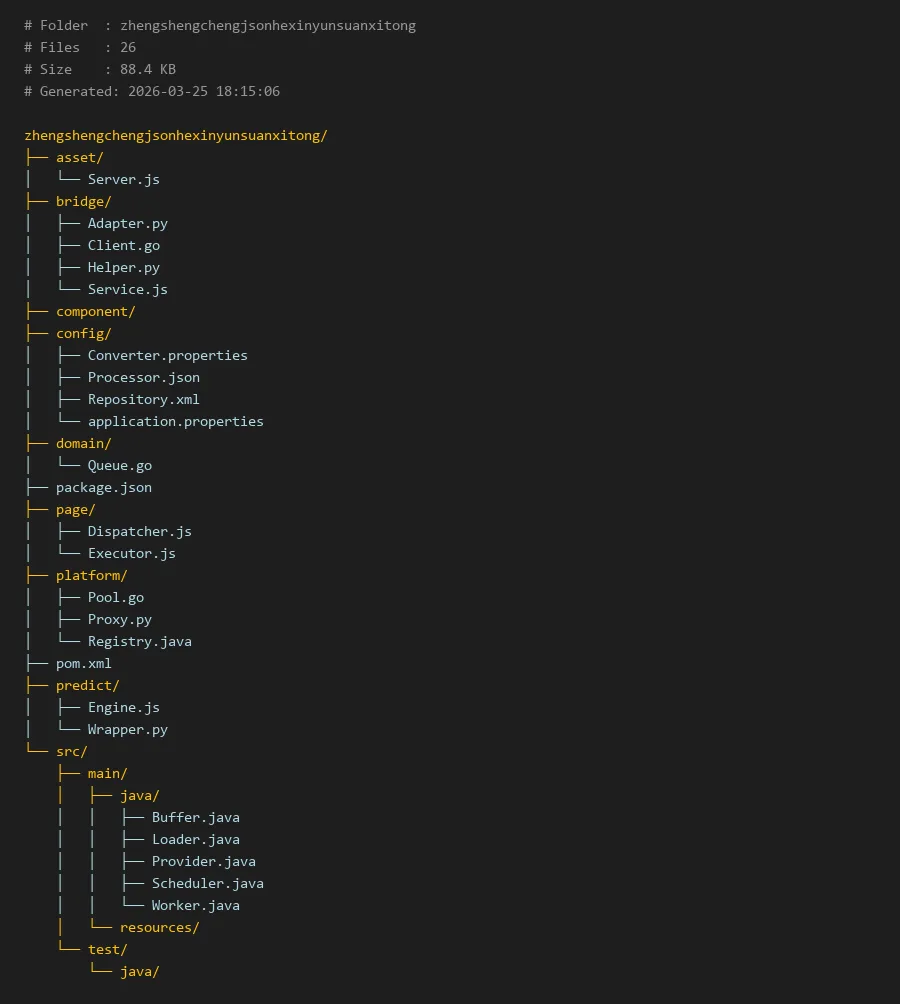
# Folder  : zhengshengchengjsonhexinyunsuanxitong
# Files   : 26
# Size    : 88.4 KB
# Generated: 2026-03-25 18:15:06

zhengshengchengjsonhexinyunsuanxitong/
├── asset/
│   └── Server.js
├── bridge/
│   ├── Adapter.py
│   ├── Client.go
│   ├── Helper.py
│   └── Service.js
├── component/
├── config/
│   ├── Converter.properties
│   ├── Processor.json
│   ├── Repository.xml
│   └── application.properties
├── domain/
│   └── Queue.go
├── package.json
├── page/
│   ├── Dispatcher.js
│   └── Executor.js
├── platform/
│   ├── Pool.go
│   ├── Proxy.py
│   └── Registry.java
├── pom.xml
├── predict/
│   ├── Engine.js
│   └── Wrapper.py
└── src/
    ├── main/
    │   ├── java/
    │   │   ├── Buffer.java
    │   │   ├── Loader.java
    │   │   ├── Provider.java
    │   │   ├── Scheduler.java
    │   │   └── Worker.java
    │   └── resources/
    └── test/
        └── java/
zhengshengchengjsonhexinyunsuanxitong:构建JSON核心运算系统
简介
zhengshengchengjsonhexinyunsuanxitong是一个多语言混合开发的JSON核心运算系统,旨在提供高效、可扩展的JSON数据处理能力。该系统采用微服务架构设计,支持Python、JavaScript、Go和Java等多种编程语言,通过统一的接口规范实现跨语言JSON运算。系统特别注重性能优化和模块化设计,能够处理大规模JSON数据流,适用于实时数据处理、API网关、微服务通信等场景。
核心模块说明
系统由多个核心模块组成,每个模块承担特定职责:
bridge模块:作为跨语言通信桥梁,包含适配器、客户端和服务端组件,确保不同语言模块间的无缝协作。
config模块:集中管理系统配置,支持多种配置文件格式(JSON、XML、Properties),提供统一的配置访问接口。
platform模块:提供平台级基础设施,包括连接池、代理服务和注册中心,确保系统的高可用性和可扩展性。
domain模块:定义核心领域模型,如消息队列数据结构,为JSON运算提供基础数据模型。
page模块:处理请求分发和执行逻辑,实现JSON运算的业务流程控制。
asset模块:包含服务器核心实现,提供HTTP/WebSocket等通信协议支持。
代码示例
1. 配置管理模块示例
系统支持多种配置格式,以下展示如何读取不同格式的配置文件:
# bridge/Helper.py - 配置读取辅助类
import json
import xml.etree.ElementTree as ET
import configparser

class ConfigHelper:
    def __init__(self, config_dir="config/"):
        self.config_dir = config_dir

    def load_json_config(self, filename):
        """加载JSON格式配置文件"""
        filepath = f"{self.config_dir}{filename}"
        with open(filepath, 'r', encoding='utf-8') as f:
            return json.load(f)

    def load_xml_config(self, filename):
        """加载XML格式配置文件"""
        filepath = f"{self.config_dir}{filename}"
        tree = ET.parse(filepath)
        return tree.getroot()

    def load_properties(self, filename):
        """加载Properties格式配置文件"""
        filepath = f"{self.config_dir}{filename}"
        config = configparser.ConfigParser()
        config.read(filepath)
        return config

# 使用示例
helper = ConfigHelper()
processor_config = helper.load_json_config("Processor.json")
repository_config = helper.load_xml_config("Repository.xml")
app_config = helper.load_properties("application.properties")
2. JSON处理器配置
系统通过JSON配置文件定义处理规则:
// config/Processor.json - JSON处理器配置
{

  "processors": [
    {

      "id": "json_validator",
      "type": "validation",
      "rules": {

        "required_fields": ["id", "timestamp", "data"],
        "field_types": {

          "id": "string",
          "timestamp": "number",
          "data": "object"
        },
        "max_depth": 10,
        "max_size_kb": 1024
      },
      "timeout_ms": 5000
    },
    {

      "id": "json_transformer",
      "type": "transformation",
      "operations": [
        {

          "name": "flatten_nested",
          "enabled": true,
          "options": {

            "separator": "_",
            "preserve_arrays": false
          }
        },
        {

          "name": "type_conversion",
          "enabled": true,
          "options": {

            "string_to_number": true,
            "boolean_to_number": false
          }
        }
      ]
    }
  ],
  "default_processor": "json_validator",
  "batch_size": 100,
  "concurrent_workers": 4
}
3. Go语言队列实现
domain模块中的队列实现提供高性能JSON数据处理:
```go
// domain/Queue.go - JSON消息队列实现
package domain
import (
"encoding/json"
"sync"
"time"
)
type JSONMessage struct {
ID string json:"id"
Timestamp int64 json:"timestamp"
Payload json.RawMessage json:"payload"
Priority int json:"priority"
}
type JSONQueue struct {
items []JSONMessage
capacity int
mutex sync.RWMutex
cond *sync.Cond
}
func NewJSONQueue(capacity int) *JSONQueue {
q := &JSONQueue{
items: make([]JSONMessage, 0, capacity),
capacity: capacity,
}
q.cond = sync.NewCond(&q.mutex)
return q
}
func (q *JSONQueue) Enqueue(msg JSONMessage) bool {
q.mutex.Lock()
defer q.mutex.Unlock()
if len(q.items) >= q.capacity {
return false
}
q.items = append(q.items, msg)
q.cond.Signal()
return true
}
func (q JSONQueue) Dequeue(timeout time.Duration) (JSONMessage, bool) {
q.mutex.Lock()
defer q.mutex.Unlock()
if len(q.items) == 0 {
if timeout > 0 {
ch := make(chan bool, 1)
go func() {
q.cond.Wait()
ch <- true
}()
  select {
  case <-ch:
  case <-time.After(timeout):
    return nil