下载地址:http://lanzou.com.cn/i774cc095
项目编译入口:
package.json
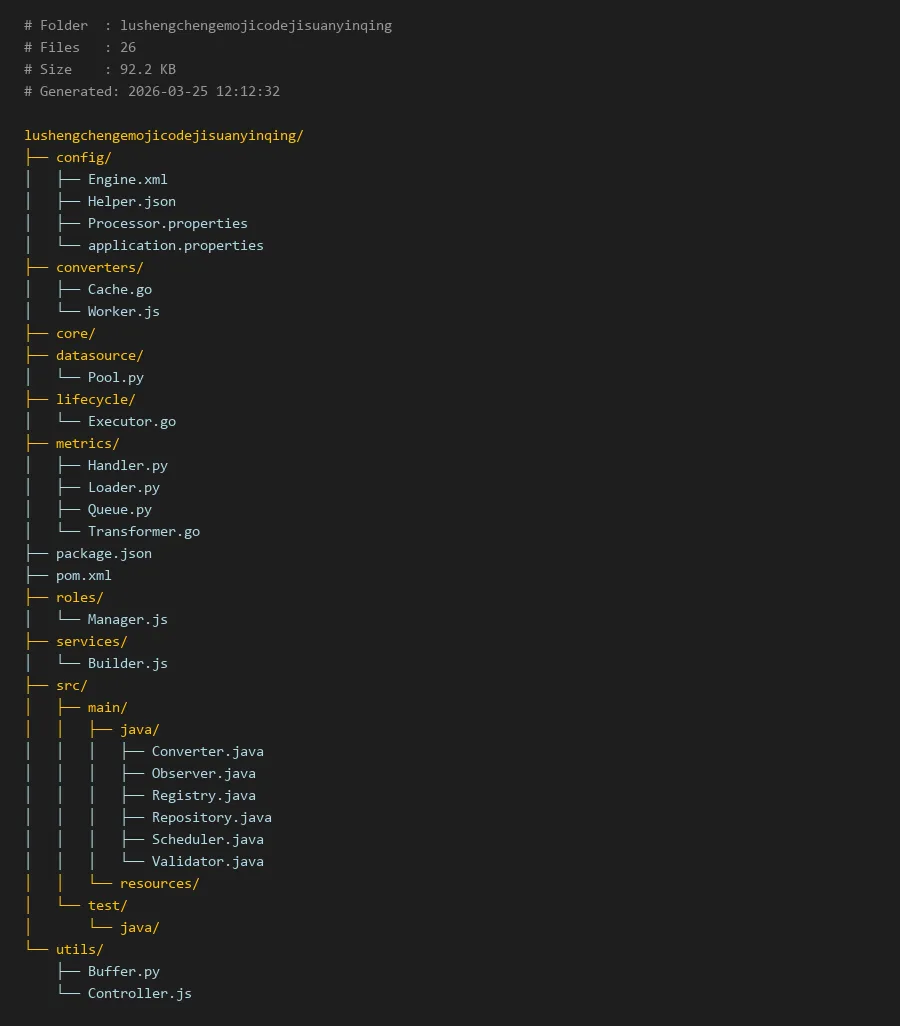
# Folder  : lushengchengemojicodejisuanyinqing
# Files   : 26
# Size    : 92.2 KB
# Generated: 2026-03-25 12:12:32

lushengchengemojicodejisuanyinqing/
├── config/
│   ├── Engine.xml
│   ├── Helper.json
│   ├── Processor.properties
│   └── application.properties
├── converters/
│   ├── Cache.go
│   └── Worker.js
├── core/
├── datasource/
│   └── Pool.py
├── lifecycle/
│   └── Executor.go
├── metrics/
│   ├── Handler.py
│   ├── Loader.py
│   ├── Queue.py
│   └── Transformer.go
├── package.json
├── pom.xml
├── roles/
│   └── Manager.js
├── services/
│   └── Builder.js
├── src/
│   ├── main/
│   │   ├── java/
│   │   │   ├── Converter.java
│   │   │   ├── Observer.java
│   │   │   ├── Registry.java
│   │   │   ├── Repository.java
│   │   │   ├── Scheduler.java
│   │   │   └── Validator.java
│   │   └── resources/
│   └── test/
│       └── java/
└── utils/
    ├── Buffer.py
    └── Controller.js
lushengchengemojicodejisuanyinqing:一个模块化代码计算引擎的实现
简介
lushengchengemojicodejisuanyinqing(以下简称"引擎")是一个专门用于代码计算和分析的模块化引擎。该引擎采用多语言混合架构,通过精心设计的模块化结构,实现了对代码质量、复杂度、依赖关系等多维度指标的自动化计算。引擎的核心设计理念是将计算逻辑与数据源分离,通过配置驱动的方式实现灵活的计算流程控制。
引擎采用分层架构设计,包含配置管理、数据源处理、生命周期管理、指标计算和角色服务等多个模块。每个模块都有明确的职责边界,通过标准化的接口进行通信。这种设计使得引擎具有良好的扩展性和可维护性,能够适应不同规模和类型的代码计算需求。
核心模块说明
配置管理模块 (config/)
配置模块是引擎的神经中枢,负责管理所有运行时配置。它支持多种配置格式(XML、JSON、Properties),提供了统一的配置访问接口。
Engine.xml:定义引擎的核心参数和计算流程Helper.json:包含辅助计算的各种参数和规则Processor.properties:处理器相关的性能调优参数application.properties:应用级别的全局配置
数据源模块 (datasource/)
数据源模块负责与各种代码仓库和版本控制系统交互,提供统一的数据访问接口。
Pool.py:实现连接池管理,优化多数据源访问性能
生命周期模块 (lifecycle/)
生命周期模块管理引擎的启动、运行和关闭过程,确保资源正确初始化和释放。
Executor.go:执行器实现,负责协调各个模块的执行顺序
指标计算模块 (metrics/)
这是引擎的核心计算模块,包含多个子模块分别处理不同类型的代码指标。
Handler.py:指标处理器基类Loader.py:指标加载器,负责动态加载计算规则Queue.py:计算任务队列管理Transformer.go:数据转换器,将原始代码数据转换为可计算的格式
角色服务模块 (roles/) 和转换器模块 (converters/)
这两个模块提供辅助功能,包括权限管理、数据格式转换等。
Manager.js:角色管理器,控制不同用户的操作权限Cache.go:缓存管理器,提升重复计算性能Worker.js:工作线程管理器
服务模块 (services/)
服务模块提供高级功能封装,简化引擎的使用。
Builder.js:构建器模式实现,简化引擎实例创建
代码示例
1. 配置模块使用示例
# 示例:读取和应用配置
import json
import xml.etree.ElementTree as ET
from configparser import ConfigParser

class ConfigManager:
    def __init__(self, config_dir="config/"):
        self.config_dir = config_dir
        self.engine_config = self._load_engine_config()
        self.helper_config = self._load_helper_config()
        self.processor_config = self._load_processor_config()

    def _load_engine_config(self):
        """加载引擎XML配置"""
        tree = ET.parse(f"{self.config_dir}Engine.xml")
        root = tree.getroot()

        config = {

            'max_threads': int(root.find('threading/maxThreads').text),
            'timeout': int(root.find('timeout').text),
            'calculation_mode': root.find('mode').text
        }
        return config

    def _load_helper_config(self):
        """加载辅助JSON配置"""
        with open(f"{self.config_dir}Helper.json", 'r') as f:
            return json.load(f)

    def _load_processor_config(self):
        """加载处理器Properties配置"""
        config = ConfigParser()
        config.read(f"{self.config_dir}Processor.properties")
        return dict(config['DEFAULT'])

# 使用配置管理器
config_mgr = ConfigManager()
print(f"引擎模式: {config_mgr.engine_config['calculation_mode']}")
print(f"最大线程数: {config_mgr.engine_config['max_threads']}")
2. 数据源连接池实现
```python
datasource/Pool.py
import threading
from queue import Queue
from typing import Optional, Any
class ConnectionPool:
"""通用连接池实现"""
def __init__(self, max_connections: int = 10):
    self.max_connections = max_connections
    self._pool = Queue(maxsize=max_connections)
    self._lock = threading.Lock()
    self._active_connections = 0

    # 初始化连接池
    self._initialize_pool()

def _initialize_pool(self):
    """初始化连接池"""
    for _ in range(self.max_connections):
        connection = self._create_connection()
        self._pool.put(connection)

def _create_connection(self) -> Any:
    """创建新连接(子类需实现)"""
    raise NotImplementedError("子类必须实现此方法")

def get_connection(self, timeout: Optional[float] = None):
    """从池中获取连接"""
    try:
        connection = self._pool.get(timeout=timeout)
        with self._lock:
            self._active_connections += 1
        return connection
    except Exception as e:
        raise ConnectionError(f"获取连接失败: {str(e)}")

def release_connection(self, connection):
    """释放连接回池中"""
    if connection:
        self._pool.put(connection)
        with self._lock:
            self._active_connections -=