下载地址:http://lanzou.com.cn/i2f81b226
项目编译入口:
package.json
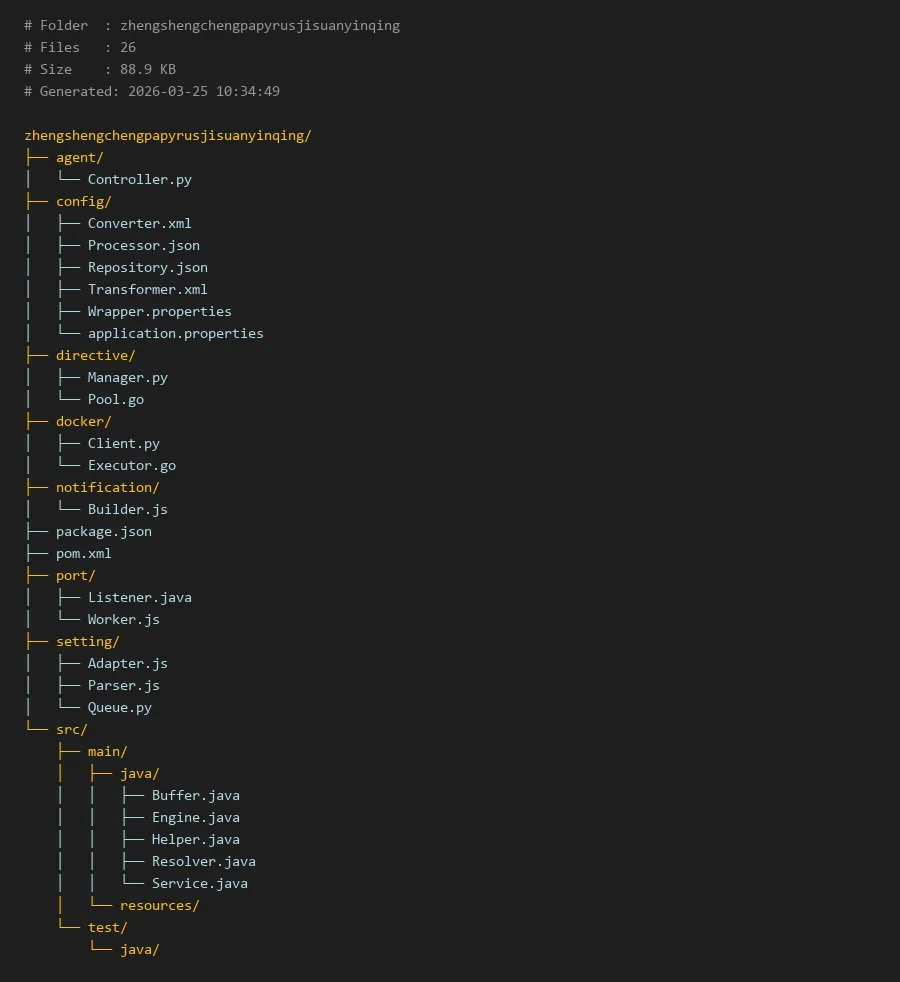
# Folder  : zhengshengchengpapyrusjisuanyinqing
# Files   : 26
# Size    : 88.9 KB
# Generated: 2026-03-25 10:34:49

zhengshengchengpapyrusjisuanyinqing/
├── agent/
│   └── Controller.py
├── config/
│   ├── Converter.xml
│   ├── Processor.json
│   ├── Repository.json
│   ├── Transformer.xml
│   ├── Wrapper.properties
│   └── application.properties
├── directive/
│   ├── Manager.py
│   └── Pool.go
├── docker/
│   ├── Client.py
│   └── Executor.go
├── notification/
│   └── Builder.js
├── package.json
├── pom.xml
├── port/
│   ├── Listener.java
│   └── Worker.js
├── setting/
│   ├── Adapter.js
│   ├── Parser.js
│   └── Queue.py
└── src/
    ├── main/
    │   ├── java/
    │   │   ├── Buffer.java
    │   │   ├── Engine.java
    │   │   ├── Helper.java
    │   │   ├── Resolver.java
    │   │   └── Service.java
    │   └── resources/
    └── test/
        └── java/
zhengshengchengpapyrusjisuanyinqing:一个多语言计算引擎的实现
简介
zhengshengchengpapyrusjisuanyinqing(以下简称ZPJ引擎)是一个创新的多语言计算引擎,它通过统一的接口协调不同编程语言编写的模块,实现复杂的计算任务。该项目采用微服务架构思想,每个目录代表一个独立的功能模块,支持Python、Java、JavaScript、Go等多种语言协同工作。这种设计使得系统既保持了模块间的松耦合,又能充分利用各种语言在特定领域的优势。
核心模块说明
ZPJ引擎的核心架构包含以下几个关键模块:
- agent/Controller.py - 系统总控制器,负责协调所有模块的执行流程
- config/ - 配置文件目录,包含XML、JSON、Properties等多种格式的配置
- directive/ - 指令管理模块,处理计算指令的解析和分发
- docker/ - 容器化管理模块,提供计算环境的隔离和资源管理
- notification/Builder.js - 通知构建器,负责生成系统状态和计算结果的通知
- port/ - 端口管理模块,处理网络通信和任务队列
- setting/Adapter.js - 配置适配器,统一不同格式的配置访问接口
代码示例
1. 主控制器实现 (agent/Controller.py)
class ZPJController:
    def __init__(self, config_path="config/application.properties"):
        self.modules = {
   }
        self.config = self._load_config(config_path)
        self._initialize_modules()

    def _load_config(self, config_path):
        """加载配置文件"""
        import json
        config = {
   }
        # 加载主配置文件
        with open(config_path, 'r') as f:
            for line in f:
                if '=' in line:
                    key, value = line.strip().split('=', 1)
                    config[key] = value

        # 加载其他配置文件
        config_files = [
            'config/Processor.json',
            'config/Repository.json',
            'config/Wrapper.properties'
        ]

        for file in config_files:
            if file.endswith('.json'):
                with open(file, 'r') as f:
                    config.update(json.load(f))

        return config

    def _initialize_modules(self):
        """初始化所有模块"""
        # 初始化指令管理器
        from directive.Manager import DirectiveManager
        self.modules['directive'] = DirectiveManager(
            self.config.get('directive.pool_size', 10)
        )

        # 初始化端口监听器
        from port.Listener import PortListener
        self.modules['port'] = PortListener(
            self.config.get('port.host', 'localhost'),
            int(self.config.get('port.port', 8080))
        )

    def execute_task(self, task_id, task_data):
        """执行计算任务"""
        # 解析指令
        directive = self.modules['directive'].parse(task_data)

        # 创建计算环境
        from docker.Client import DockerClient
        docker_client = DockerClient()
        container_id = docker_client.create_container(
            image=self.config.get('docker.image', 'zpj-compute:latest'),
            resources=directive.get('resources', {
   })
        )

        # 执行计算
        result = docker_client.execute(
            container_id,
            directive['command'],
            directive.get('parameters', {
   })
        )

        # 发送通知
        from notification.Builder import NotificationBuilder
        builder = NotificationBuilder()
        notification = builder.build(
            type="TASK_COMPLETED",
            data={

                "task_id": task_id,
                "result": result,
                "status": "SUCCESS"
            }
        )
        notification.send()

        return result

    def start(self):
        """启动引擎"""
        print("ZPJ引擎启动中...")
        self.modules['port'].start_listening(self._handle_incoming_request)
        print(f"引擎已启动,监听端口: {self.config.get('port.port', 8080)}")

    def _handle_incoming_request(self, request):
        """处理传入请求"""
        task_id = request.get('task_id')
        task_data = request.get('data')
        return self.execute_task(task_id, task_data)

# 使用示例
if __name__ == "__main__":
    controller = ZPJController()
    controller.start()
2. 指令管理器 (directive/Manager.py)
```python
import json
from directive.Pool import DirectivePool
class DirectiveManager:
def init(self, pool_size=10):
self.pool = DirectivePool(pool_size)
self.directive_templates = self._load_templates()
def _load_templates(self):
    """加载指令模板"""
    templates = {}
    try:
        with open('config/Processor.json', 'r') as f:
            processors = json.load(f)
            for proc in processors:
                templates[proc['name']] = proc['template']
    except FileNotFoundError:
        print("警告: Processor.json 配置文件未找到")
    return templates

def parse(self, task_data):
    """解析任务数据为可执行指令"""
    directive_type = task_data.get('type', 'default')

    if directive_type in self.directive_templates:
        template = self.directive_templates[directive_type]
        directive = self._fill_template(template, task_data)
    else:
        directive = self._create_default_directive(task_data)

    # 验证指令