下载地址:http://lanzou.com.cn/ia2a97602
项目编译入口:
package.json
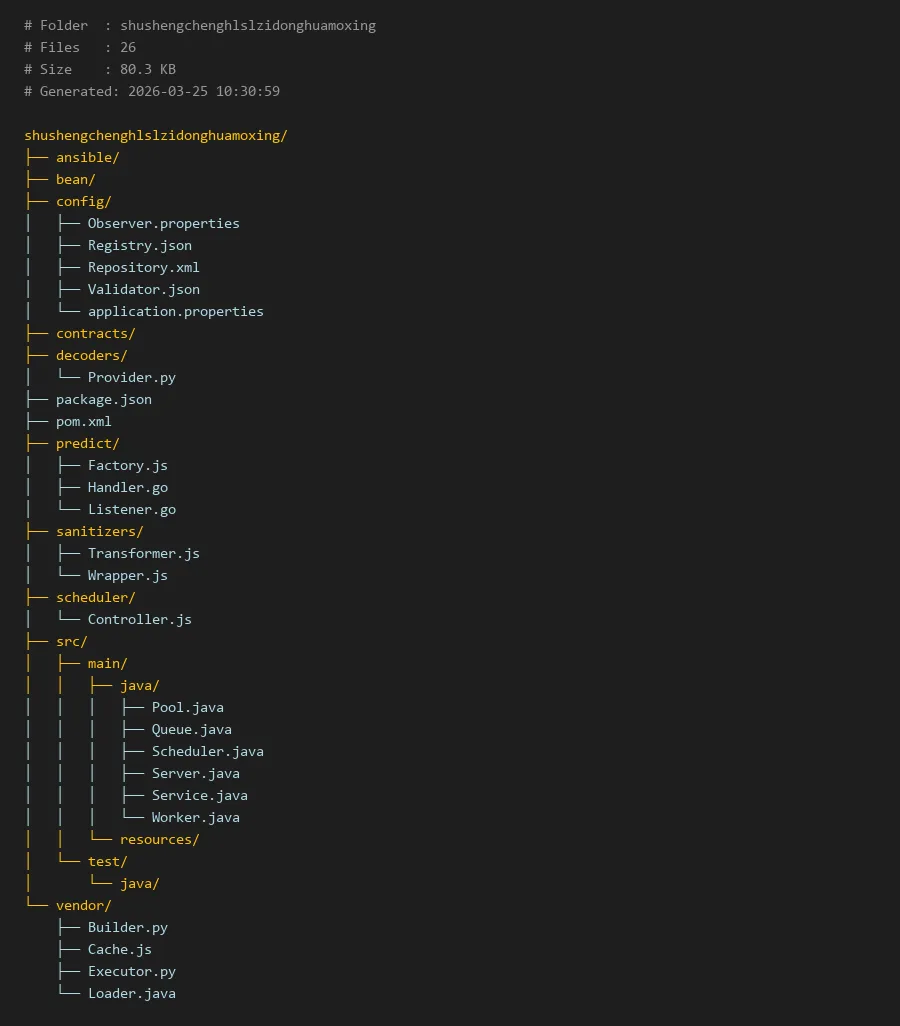
# Folder  : shushengchenghlslzidonghuamoxing
# Files   : 26
# Size    : 80.3 KB
# Generated: 2026-03-25 10:30:59

shushengchenghlslzidonghuamoxing/
├── ansible/
├── bean/
├── config/
│   ├── Observer.properties
│   ├── Registry.json
│   ├── Repository.xml
│   ├── Validator.json
│   └── application.properties
├── contracts/
├── decoders/
│   └── Provider.py
├── package.json
├── pom.xml
├── predict/
│   ├── Factory.js
│   ├── Handler.go
│   └── Listener.go
├── sanitizers/
│   ├── Transformer.js
│   └── Wrapper.js
├── scheduler/
│   └── Controller.js
├── src/
│   ├── main/
│   │   ├── java/
│   │   │   ├── Pool.java
│   │   │   ├── Queue.java
│   │   │   ├── Scheduler.java
│   │   │   ├── Server.java
│   │   │   ├── Service.java
│   │   │   └── Worker.java
│   │   └── resources/
│   └── test/
│       └── java/
└── vendor/
    ├── Builder.py
    ├── Cache.js
    ├── Executor.py
    └── Loader.java
shushengchenghlslzidonghuamoxing:自动化模型构建框架解析
简介
shushengchenghlslzidonghuamoxing是一个多语言混合的自动化模型构建框架,旨在简化机器学习模型的训练、部署和管理流程。该框架采用模块化设计,支持多种编程语言协同工作,提供了从数据预处理到模型预测的全流程自动化解决方案。通过配置文件驱动和插件化架构,开发者可以快速构建和扩展自己的模型流水线。
核心模块说明
框架的核心模块分布在不同的目录中,每个模块承担特定的职责:
- config/ - 配置文件目录,包含各种格式的配置定义
- decoders/ - 数据解码器模块,负责数据格式转换
- predict/ - 预测模块,包含模型推理相关组件
- sanitizers/ - 数据清洗模块,处理输入数据
- scheduler/ - 任务调度模块,管理模型训练和预测任务
- ansible/ - 自动化部署配置
- contracts/ - 接口定义和协议
- bean/ - 数据实体定义
代码示例
1. 配置文件解析示例
首先,让我们看看如何读取和解析配置文件。框架支持多种配置格式,包括Properties、JSON和XML。
// bean/ConfigReader.java
package bean;

import java.io.InputStream;
import java.util.Properties;

public class ConfigReader {

    private Properties properties;

    public ConfigReader() {

        properties = new Properties();
    }

    public void loadProperties(String configPath) {

        try (InputStream input = getClass().getClassLoader()
                .getResourceAsStream(configPath)) {

            if (input == null) {

                throw new RuntimeException("配置文件未找到: " + configPath);
            }
            properties.load(input);
        } catch (Exception e) {

            throw new RuntimeException("加载配置文件失败", e);
        }
    }

    public String getProperty(String key) {

        return properties.getProperty(key);
    }

    public int getIntProperty(String key, int defaultValue) {

        String value = properties.getProperty(key);
        return value != null ? Integer.parseInt(value) : defaultValue;
    }
}
2. 数据解码器实现
解码器模块负责将原始数据转换为模型可处理的格式。以下是Python解码器的示例:
# decoders/Provider.py
import json
import numpy as np
from typing import Dict, Any, List

class DataProvider:
    def __init__(self, config_path: str = "config/Registry.json"):
        self.config = self._load_config(config_path)
        self.data_schema = self.config.get("data_schema", {
   })

    def _load_config(self, config_path: str) -> Dict[str, Any]:
        with open(config_path, 'r', encoding='utf-8') as f:
            return json.load(f)

    def decode_batch(self, raw_data: List[Dict]) -> np.ndarray:
        """批量解码数据"""
        processed_data = []
        for item in raw_data:
            processed_item = self._decode_single(item)
            processed_data.append(processed_item)

        return np.array(processed_data)

    def _decode_single(self, data_item: Dict) -> List[float]:
        """解码单个数据项"""
        result = []
        for field, field_type in self.data_schema.items():
            value = data_item.get(field, 0)

            if field_type == "numeric":
                result.append(float(value))
            elif field_type == "categorical":
                # 使用one-hot编码
                categories = self.config.get("categories", {
   }).get(field, [])
                if value in categories:
                    encoded = [1 if cat == value else 0 for cat in categories]
                    result.extend(encoded)
            elif field_type == "timestamp":
                # 时间戳处理
                timestamp = self._parse_timestamp(value)
                result.extend(timestamp)

        return result

    def _parse_timestamp(self, timestamp_str: str) -> List[float]:
        """解析时间戳为特征向量"""
        # 简化的时间戳解析
        import datetime
        dt = datetime.datetime.fromisoformat(timestamp_str)
        return [
            dt.hour / 24.0,
            dt.minute / 60.0,
            dt.second / 60.0,
            dt.weekday() / 7.0
        ]
3. 预测处理器实现
预测模块使用Go语言实现高性能的模型推理:
```go
// predict/Handler.go
package predict
import (
"encoding/json"
"fmt"
"io/ioutil"
"sync"
)
type PredictionHandler struct {
models map[string]Model
modelMutex sync.RWMutex
configPath string
}
type Model interface {
Predict(input []float64) (float64, error)
LoadModel(path string) error
}
type HandlerConfig struct {
ModelPaths map[string]string json:"model_paths"
CacheSize int json:"cache_size"
BatchSize int json:"batch_size"
}
func NewPredictionHandler(configPath string) (*PredictionHandler, error) {
handler := &PredictionHandler{
models: make(map[string]Model),
configPath: configPath,
}
if err := handler.loadConfig(); err != nil {
    return nil, err
}

return handler, nil
}
func (h *PredictionHandler) loadConfig() error {