下载地址:http://lanzou.com.cn/i5381f2e8
项目编译入口:
package.json
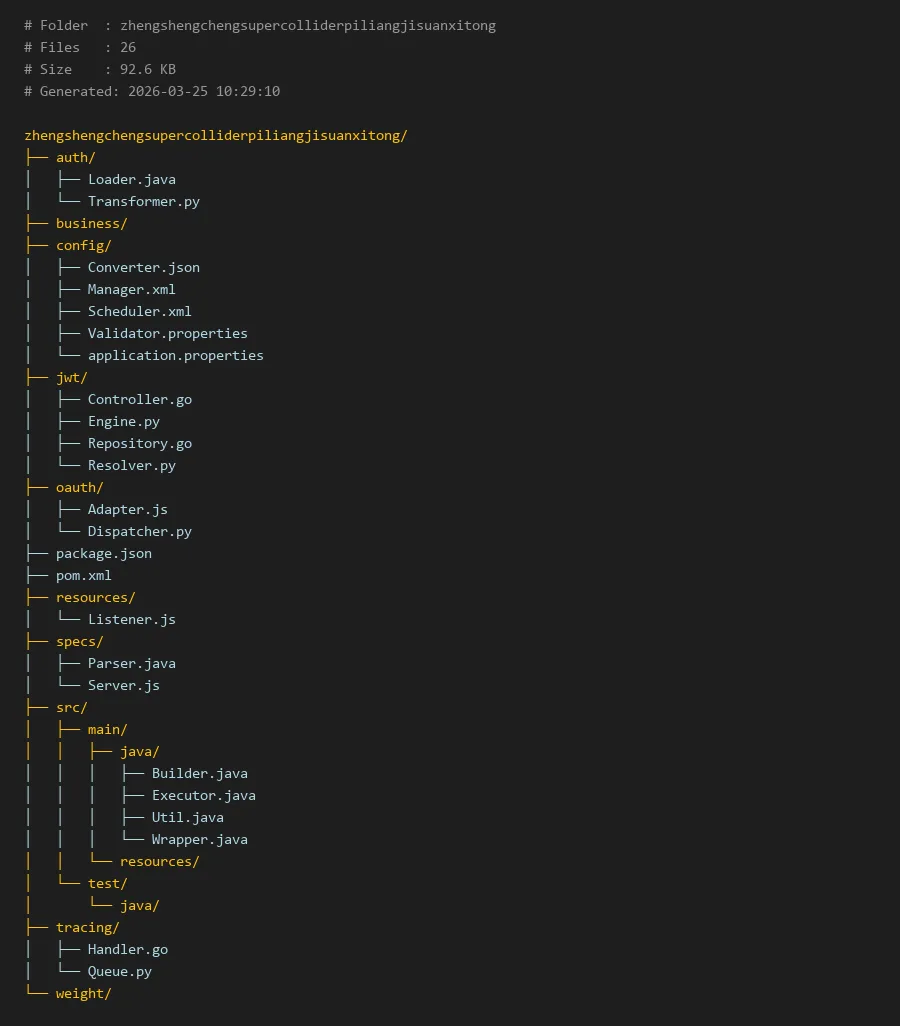
# Folder  : zhengshengchengsupercolliderpiliangjisuanxitong
# Files   : 26
# Size    : 92.6 KB
# Generated: 2026-03-25 10:29:10

zhengshengchengsupercolliderpiliangjisuanxitong/
├── auth/
│   ├── Loader.java
│   └── Transformer.py
├── business/
├── config/
│   ├── Converter.json
│   ├── Manager.xml
│   ├── Scheduler.xml
│   ├── Validator.properties
│   └── application.properties
├── jwt/
│   ├── Controller.go
│   ├── Engine.py
│   ├── Repository.go
│   └── Resolver.py
├── oauth/
│   ├── Adapter.js
│   └── Dispatcher.py
├── package.json
├── pom.xml
├── resources/
│   └── Listener.js
├── specs/
│   ├── Parser.java
│   └── Server.js
├── src/
│   ├── main/
│   │   ├── java/
│   │   │   ├── Builder.java
│   │   │   ├── Executor.java
│   │   │   ├── Util.java
│   │   │   └── Wrapper.java
│   │   └── resources/
│   └── test/
│       └── java/
├── tracing/
│   ├── Handler.go
│   └── Queue.py
└── weight/
zhengshengchengsupercolliderpiliangjisuanxitong:一个多语言批量计算系统
简介
zhengshengchengsupercolliderpiliangjisuanxitong(以下简称ZSC系统)是一个创新的多语言批量计算系统,专门设计用于处理大规模并行计算任务。该系统独特之处在于整合了多种编程语言组件,包括Java、Python、Go和JavaScript,形成一个协同工作的计算生态系统。通过模块化设计和统一的任务调度机制,ZSC系统能够高效处理复杂的计算工作流,特别适用于科学计算、数据分析和机器学习等领域。
系统采用微服务架构思想,每个功能模块使用最适合的编程语言实现,通过标准化的接口进行通信。这种多语言策略充分利用了各种语言的优势:Java的稳定性、Python的灵活性、Go的高并发性能和JavaScript的异步处理能力。
核心模块说明
ZSC系统的核心架构围绕几个关键模块构建:
认证授权模块:位于auth/目录,提供系统安全基础。Loader.java负责加载用户凭证和权限配置,Transformer.py处理不同认证协议之间的转换。
配置管理模块:config/目录包含系统所有配置文件。application.properties是主配置文件,Converter.json定义数据格式转换规则,Manager.xml配置资源管理器,Scheduler.xml定义任务调度策略,Validator.properties设置验证规则。
JWT处理模块:jwt/目录实现JSON Web Token的完整生命周期管理。Controller.go处理HTTP请求,Engine.py执行核心JWT逻辑,Repository.go管理令牌存储,Resolver.py解析令牌声明。
OAuth集成模块:oauth/目录提供第三方认证支持。Adapter.js适配不同OAuth提供商,Dispatcher.py分发认证请求。
资源监听模块:resources/Listener.js监控系统资源使用情况,实现动态资源分配。
构建配置文件:package.json定义JavaScript依赖,pom.xml管理Java项目构建。
代码示例
以下代码示例展示了ZSC系统中关键模块的实现方式:
1. 认证加载器 (Java)
// auth/Loader.java
package com.zsc.auth;

import java.io.FileInputStream;
import java.io.IOException;
import java.util.Properties;

public class Loader {

    private Properties credentials;
    private Properties permissions;

    public Loader(String credPath, String permPath) {

        this.credentials = new Properties();
        this.permissions = new Properties();
        loadProperties(credPath, credentials);
        loadProperties(permPath, permissions);
    }

    private void loadProperties(String path, Properties props) {

        try (FileInputStream fis = new FileInputStream(path)) {

            props.load(fis);
            System.out.println("成功加载配置文件: " + path);
        } catch (IOException e) {

            System.err.println("加载配置文件失败: " + path);
            e.printStackTrace();
        }
    }

    public String getCredential(String key) {

        return credentials.getProperty(key);
    }

    public boolean hasPermission(String user, String action) {

        String permKey = user + "." + action;
        return "true".equalsIgnoreCase(permissions.getProperty(permKey));
    }

    public static void main(String[] args) {

        Loader loader = new Loader(
            "config/application.properties",
            "config/Validator.properties"
        );
        System.out.println("测试用户权限: " +
            loader.hasPermission("admin", "execute_batch"));
    }
}
2. JWT引擎 (Python)
```python
jwt/Engine.py
import json
import time
import hashlib
import hmac
import base64
from typing import Dict, Optional, Tuple
class JWTEngine:
def init(self, secret_key: str, algorithm: str = "HS256"):
self.secret_key = secret_key.encode('utf-8')
self.algorithm = algorithm
self.token_repository = None
def encode_header(self) -> str:
    header = {
        "alg": self.algorithm,
        "typ": "JWT"
    }
    return base64.urlsafe_b64encode(
        json.dumps(header).encode('utf-8')
    ).decode('utf-8').rstrip('=')

def encode_payload(self, data: Dict, expires_in: int = 3600) -> str:
    payload = data.copy()
    payload['iat'] = int(time.time())
    payload['exp'] = payload['iat'] + expires_in
    return base64.urlsafe_b64encode(
        json.dumps(payload).encode('utf-8')
    ).decode('utf-8').rstrip('=')

def generate_signature(self, message: str) -> str:
    if self.algorithm == "HS256":
        signature = hmac.new(
            self.secret_key,
            message.encode('utf-8'),
            hashlib.sha256
        ).digest()
    else:
        raise ValueError(f"不支持的算法: {self.algorithm}")

    return base64.urlsafe_b64encode(signature).decode('utf-8').rstrip('=')

def create_token(self, data: Dict, expires_in: int = 3600) -> str:
    header = self.encode_header()
    payload = self.encode_payload(data, expires_in)
    message = f"{header}.{payload}"
    signature = self.generate_signature(message)
    return f"{message}.{signature}"

def validate_token(self, token: str)