下载地址:http://lanzou.com.cn/i70428d6a
项目编译入口:
package.json
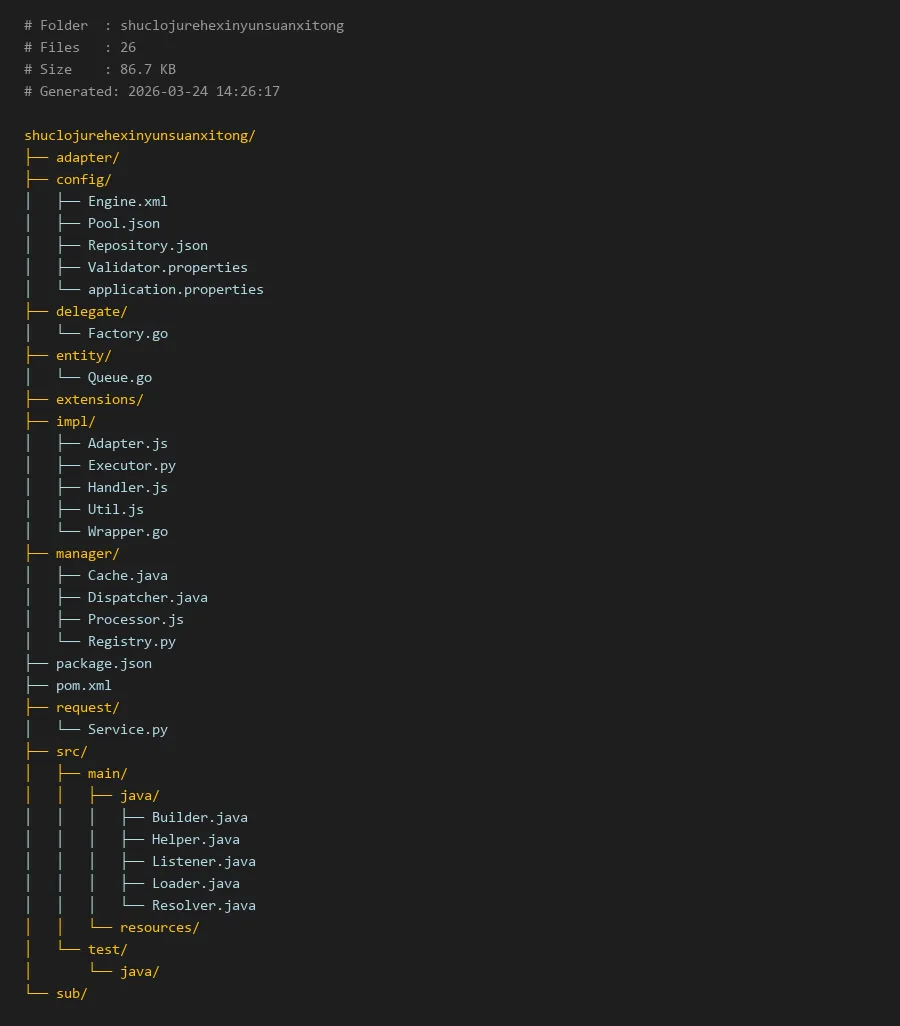
# Folder  : shuclojurehexinyunsuanxitong
# Files   : 26
# Size    : 86.7 KB
# Generated: 2026-03-24 14:26:17

shuclojurehexinyunsuanxitong/
├── adapter/
├── config/
│   ├── Engine.xml
│   ├── Pool.json
│   ├── Repository.json
│   ├── Validator.properties
│   └── application.properties
├── delegate/
│   └── Factory.go
├── entity/
│   └── Queue.go
├── extensions/
├── impl/
│   ├── Adapter.js
│   ├── Executor.py
│   ├── Handler.js
│   ├── Util.js
│   └── Wrapper.go
├── manager/
│   ├── Cache.java
│   ├── Dispatcher.java
│   ├── Processor.js
│   └── Registry.py
├── package.json
├── pom.xml
├── request/
│   └── Service.py
├── src/
│   ├── main/
│   │   ├── java/
│   │   │   ├── Builder.java
│   │   │   ├── Helper.java
│   │   │   ├── Listener.java
│   │   │   ├── Loader.java
│   │   │   └── Resolver.java
│   │   └── resources/
│   └── test/
│       └── java/
└── sub/
shuclojurehexinyunsuanxitong:一个多语言核心运算系统的设计与实现
简介
shuclojurehexinyunsuanxitong是一个采用多语言混合架构设计的核心运算系统。该项目最大的特色在于其模块化的设计和跨语言协作能力,通过精心设计的接口和适配器,让Java、Python、JavaScript、Go等多种编程语言能够在一个统一的系统中协同工作。系统主要面向需要高性能计算和复杂业务逻辑处理的场景,通过各语言的优势互补,实现了运算效率与开发效率的平衡。
系统采用微服务架构思想,每个模块相对独立,通过标准化的接口进行通信。这种设计不仅提高了系统的可维护性,也使得团队可以根据不同模块的技术需求选择最合适的编程语言进行开发。
核心模块说明
配置管理模块(config/)
该目录包含系统的所有配置文件,采用多种格式以适应不同场景:
Engine.xml:定义计算引擎的核心参数和规则Pool.json:配置线程池和连接池参数Repository.json:数据仓库和存储配置Validator.properties:数据验证规则配置application.properties:应用全局配置
实体与委托模块(entity/ 和 delegate/)
entity/Queue.go:使用Go语言实现的队列数据结构,充分利用Go的并发特性delegate/Factory.go:工厂模式实现,负责创建和管理各种运算组件实例
实现层模块(impl/)
这是系统的核心实现层,包含多种语言的实现:
Adapter.js:JavaScript适配器,处理前端和外部系统接入Executor.py:Python执行器,负责数值计算和机器学习相关运算Handler.js:JavaScript请求处理器Util.js:JavaScript工具函数库Wrapper.go:Go语言包装器,提供高性能的底层操作
管理模块(manager/)
系统管理核心,负责调度和协调:
Cache.java:Java实现的缓存管理器Dispatcher.java:Java实现的请求分发器Processor.js:JavaScript数据处理处理器Registry.py:Python实现的组件注册中心
代码示例
1. Go语言队列实现(entity/Queue.go)
package entity

import (
    "sync"
    "errors"
)

type Queue struct {

    items []interface{
   }
    lock  sync.RWMutex
    maxSize int
}

func NewQueue(maxSize int) *Queue {

    return &Queue{

        items:   make([]interface{
   }, 0),
        maxSize: maxSize,
    }
}

func (q *Queue) Enqueue(item interface{
   }) error {

    q.lock.Lock()
    defer q.lock.Unlock()

    if len(q.items) >= q.maxSize {

        return errors.New("queue is full")
    }

    q.items = append(q.items, item)
    return nil
}

func (q *Queue) Dequeue() (interface{
   }, error) {

    q.lock.Lock()
    defer q.lock.Unlock()

    if len(q.items) == 0 {

        return nil, errors.New("queue is empty")
    }

    item := q.items[0]
    q.items = q.items[1:]
    return item, nil
}

func (q *Queue) Size() int {

    q.lock.RLock()
    defer q.lock.RUnlock()
    return len(q.items)
}
2. Python执行器实现(impl/Executor.py)
```python
import numpy as np
import json
from typing import Any, Dict, List
import logging
class Executor:
def init(self, config_path: str = None):
self.logger = logging.getLogger(name)
self.operations = {
'add': self._add,
'multiply': self._multiply,
'matrix_multiply': self._matrix_multiply,
'statistics': self._calculate_statistics
}
def _add(self, operands: List[float]) -> float:
    """执行加法运算"""
    return sum(operands)

def _multiply(self, operands: List[float]) -> float:
    """执行乘法运算"""
    result = 1
    for operand in operands:
        result *= operand
    return result

def _matrix_multiply(self, matrices: List[np.ndarray]) -> np.ndarray:
    """执行矩阵乘法"""
    if not matrices:
        raise ValueError("No matrices provided")

    result = matrices[0]
    for matrix in matrices[1:]:
        result = np.dot(result, matrix)
    return result

def _calculate_statistics(self, data: List[float]) -> Dict[str, float]:
    """计算统计信息"""
    arr = np.array(data)
    return {
        'mean': float(np.mean(arr)),
        'median': float(np.median(arr)),
        'std': float(np.std(arr)),
        'min': float(np.min(arr)),
        'max': float(np.max(arr))
    }

def execute(self, operation: str, data: Any) -> Any:
    """执行指定操作"""
    if operation not in self.operations:
        raise ValueError(f"Unsupported operation: {operation}")

    self.logger.info(f"Executing operation: {operation}")
    return self.operations[operation](data)

def batch_execute(self, tasks: List[Dict]) -> List[Any]:
    """批量执行任务"""
    results = []
    for task in tasks:
        try:
            result = self.execute(task['operation'], task['data'])