四、C扩展与性能优化
4.1 C扩展开发基础
编写C扩展可以绕过GIL,获得接近原生的性能。
// example.c - C扩展示例
#include <Python.h>

// 计算斐波那契数列
static PyObject* fibonacci(PyObject* self, PyObject* args) {
    int n;
    if (!PyArg_ParseTuple(args, "i", &n)) {
        return NULL;
    }

    if (n <= 1) {
        return PyLong_FromLong(n);
    }

    long a = 0, b = 1, c;
    for (int i = 2; i <= n; i++) {
        c = a + b;
        a = b;
        b = c;
    }
    return PyLong_FromLong(b);
}

// 释放GIL进行长时间计算
static PyObject* heavy_compute(PyObject* self, PyObject* args) {
    int n;
    if (!PyArg_ParseTuple(args, "i", &n)) {
        return NULL;
    }

    // 释放GIL
    Py_BEGIN_ALLOW_THREADS

    long result = 0;
    for (int i = 0; i < n; i++) {
        result += i * i;
    }

    // 重新获取GIL
    Py_END_ALLOW_THREADS

    return PyLong_FromLong(result);
}

// 方法定义
static PyMethodDef Methods[] = {
    {"fibonacci", fibonacci, METH_VARARGS, "计算斐波那契数列"},
    {"heavy_compute", heavy_compute, METH_VARARGS, "释放GIL的计算"},
    {NULL, NULL, 0, NULL}
};

// 模块定义
static struct PyModuleDef module = {
    PyModuleDef_HEAD_INIT,
    "fastmath",
    "高性能数学计算模块",
    -1,
    Methods
};

// 初始化函数
PyMODINIT_FUNC PyInit_fastmath(void) {
    return PyModule_Create(&module);
}
对应的setup.py:
from setuptools import setup, Extension

module = Extension('fastmath', sources=['example.c'])

setup(
    name='fastmath',
    version='1.0',
    description='C扩展示例',
    ext_modules=[module]
)

# 编译:python setup.py build_ext --inplace
4.2 Cython:Python与C的桥梁
Cython是编写C扩展的最佳选择,语法接近Python。
# fastmath.pyx
import cython

@cython.boundscheck(False)  # 禁用边界检查
@cython.wraparound(False)   # 禁用负索引
def fibonacci_cython(int n):
    """Cython版本的斐波那契"""
    if n <= 1:
        return n

    cdef long a = 0
    cdef long b = 1
    cdef long c
    cdef int i

    for i in range(2, n + 1):
        c = a + b
        a = b
        b = c

    return b

# 类型化内存视图(高效数组操作)
def sum_array(double[:] arr):
    """使用内存视图求和"""
    cdef double total = 0
    cdef int i
    for i in range(arr.shape[0]):
        total += arr[i]
    return total

# 使用C函数
from libc.math cimport sqrt

def fast_sqrt(double x):
    return sqrt(x)

# 释放GIL
with cython.nogil:
    # 这里的代码不持有GIL
    pass
4.3 性能分析工具
import cProfile
import pstats
import line_profiler
import memory_profiler
import timeit

# 1. cProfile:函数级性能分析
def profile_cprofile():
    pr = cProfile.Profile()
    pr.enable()

    # 执行代码
    [x**2 for x in range(100000)]

    pr.disable()
    ps = pstats.Stats(pr).sort_stats('cumulative')
    ps.print_stats(10)

# 2. line_profiler:行级分析
@profile  # 需要:kernprof -l script.py
def slow_function():
    total = 0
    for i in range(10000):
        for j in range(10000):
            total += i * j
    return total

# 3. memory_profiler:内存分析
@profile  # 需要:python -m memory_profiler script.py
def memory_intensive():
    data = []
    for i in range(100000):
        data.append([i] * 100)
    return data

# 4. timeit:精确计时
def timeit_example():
    # 单次计时
    result = timeit.timeit(
        '[x**2 for x in range(1000)]',
        number=1000
    )
    print(f"平均耗时:{result / 1000 * 1000:.2f}ms")

    # 重复计时
    times = timeit.repeat(
        '[x**2 for x in range(1000)]',
        repeat=5,
        number=1000
    )
    print(f"最快:{min(times) / 1000 * 1000:.2f}ms")
五、系统级编程与网络编程
5.1 底层I/O与文件系统
import os
import fcntl
import mmap
import select
import socket

# 内存映射文件
def mmap_example():
    with open('large_file.txt', 'r+b') as f:
        # 映射整个文件
        mm = mmap.mmap(f.fileno(), 0)

        # 直接内存访问
        print(mm[:100])  # 读取前100字节
        mm[10:20] = b'ABCDEFGHIJ'  # 直接修改

        mm.close()

# 非阻塞I/O
def non_blocking_io():
    fd = os.open('file.txt', os.O_RDONLY | os.O_NONBLOCK)

    # 使用select监控I/O
    rlist, wlist, xlist = select.select([fd], [], [], 5.0)

    if fd in rlist:
        data = os.read(fd, 1024)

    os.close(fd)

# 异步I/O(Linux AIO)
import aiofiles

async def async_file_io():
    async with aiofiles.open('large_file.txt', 'r') as f:
        content = await f.read()
        print(f"读取{len(content)}字节")
5.2 高性能网络编程
import socket
import selectors
import asyncio

# 使用selectors实现事件驱动
class SelectorServer:
    def __init__(self, host='localhost', port=8888):
        self.selector = selectors.DefaultSelector()
        self.server = socket.socket(socket.AF_INET, socket.SOCK_STREAM)
        self.server.setsockopt(socket.SOL_SOCKET, socket.SO_REUSEADDR, 1)
        self.server.bind((host, port))
        self.server.listen()
        self.server.setblocking(False)
        self.selector.register(self.server, selectors.EVENT_READ, self.accept)

    def accept(self, sock):
        conn, addr = sock.accept()
        conn.setblocking(False)
        self.selector.register(conn, selectors.EVENT_READ, self.read)

    def read(self, conn):
        data = conn.recv(1024)
        if data:
            conn.send(b'ECHO: ' + data)
        else:
            self.selector.unregister(conn)
            conn.close()

    def run(self):
        while True:
            events = self.selector.select()
            for key, mask in events:
                callback = key.data
                callback(key.fileobj)

# 使用socketserver实现高并发
from socketserver import TCPServer, StreamRequestHandler, ThreadingMixIn

class ThreadingTCPServer(ThreadingMixIn, TCPServer):
    """多线程TCP服务器"""
    pass

class EchoHandler(StreamRequestHandler):
    def handle(self):
        data = self.rfile.readline().strip()
        self.wfile.write(b'ECHO: ' + data)

def run_tcp_server():
    server = ThreadingTCPServer(('localhost', 8889), EchoHandler)
    server.serve_forever()
六、设计模式与架构模式
6.1 架构模式
# 1. 事件驱动架构
class EventBus:
    """事件总线"""

    def __init__(self):
        self._handlers = {}

    def subscribe(self, event_type, handler):
        if event_type not in self._handlers:
            self._handlers[event_type] = []
        self._handlers[event_type].append(handler)

    def publish(self, event_type, data=None):
        if event_type in self._handlers:
            for handler in self._handlers[event_type]:
                handler(data)

# 2. 管道与过滤器架构
class Pipeline:
    """数据处理管道"""

    def __init__(self):
        self.filters = []

    def add_filter(self, filter_func):
        self.filters.append(filter_func)
        return self

    def execute(self, data):
        for filter_func in self.filters:
            data = filter_func(data)
        return data

# 使用
pipeline = Pipeline()
pipeline.add_filter(lambda x: x.strip()) \
        .add_filter(lambda x: x.lower()) \
        .add_filter(lambda x: x.replace(' ', '_'))

result = pipeline.execute("  Hello World  ")
print(result)  # "hello_world"

# 3. 插件架构
import importlib
import pkgutil

class PluginManager:
    """插件管理器"""

    def __init__(self, plugin_package):
        self.plugin_package = plugin_package
        self.plugins = {}
        self.load_plugins()

    def load_plugins(self):
        package = importlib.import_module(self.plugin_package)
        for finder, name, ispkg in pkgutil.iter_modules(package.__path__):
            module = importlib.import_module(f"{self.plugin_package}.{name}")
            if hasattr(module, 'register'):
                module.register(self)

    def register(self, name, plugin_class):
        self.plugins[name] = plugin_class

    def get_plugin(self, name):
        return self.plugins.get(name)
七、深度学习与AI工程化
7.1 自定义PyTorch扩展
# 自定义C++扩展示例
import torch
from torch.autograd import Function

class CustomFunction(Function):
    @staticmethod
    def forward(ctx, input):
        # 前向传播
        ctx.save_for_backward(input)
        return input * input

    @staticmethod
    def backward(ctx, grad_output):
        # 反向传播
        input, = ctx.saved_tensors
        return grad_output * 2 * input

# 使用
x = torch.tensor([1.0, 2.0, 3.0], requires_grad=True)
y = CustomFunction.apply(x)
y.sum().backward()
print(x.grad)  # tensor([2., 4., 6.])
八、Python高阶学习路径
8.1 知识体系图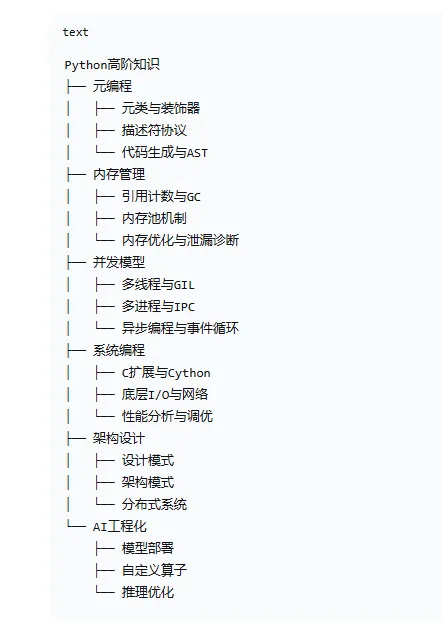
高阶开发者的标志不是掌握多少"高级特性",而是能够从系统层面思考问题,在遇到性能瓶颈时能够定位到问题本质,在需要扩展Python时能够写出优雅的C扩展。愿你在Python的世界里,不仅成为技术的高手,更成为能够创造工具、定义规则的先行者。
来源:
https://app-ad5sxofh8phd.appmiaoda.com